

Audio By Carbonatix
Ghana has reaffirmed its commitment to the One Health approach, with human, animal and environmental health stakeholders aligning priorities to advance integrated action.
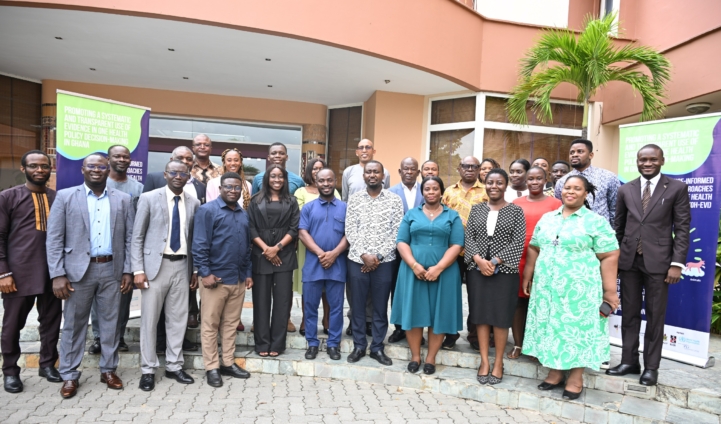
A national policy dialogue in Accra provided a platform to review progress and chart next steps. The meeting was promoted by the Evidence-Informed Policy Approaches for One Health (OH-EVI) project, led by the Global Health and Infectious Disease Research Group at the Kumasi Centre for Collaborative Research in Tropical Medicine (GHID-KCCR), KNUST, with support from the Friedrich-Loeffler-Institut (FLI), the World Health Organization (WHO) and the German Ministry of Health.
The event built on findings from a three-day stakeholder engagement in November 2024, which produced Evidence Briefs for Policy (EBPs) to strengthen Ghana’s evidence-based decision-making on One Health and antimicrobial resistance (AMR).
Ghana’s COVID-19 response demonstrated the value of cross-sector coordination during public health emergencies. Since then, the country has created a One Health Platform and developed a draft policy, though implementation has not yet begun.
Dr. Michael Owusu, lead of the Virology and Diagnostic Group at KNUST and co-lead of the One Health Virology Group at KCCR, said the gap between evidence generation and policy use must be closed.
“Who collects the evidence and feeds it into our surveillance systems?” he asked. “Reports are published, but key lessons often fail to inform policy uptake.”
Dr. John Amuasi, Principal Investigator of the OH-EVI project, said the unfinished policy could be an advantage.
“This may be a blessing in disguise,” he said. “Because the policy hasn’t been finalized, we now have the opportunity to incorporate recent evidence synthesized through the OH-EVI project, grounded in real stakeholder engagement, and aligned with important global currents like the Lancet One Health Commission Report and the WHO Pandemic Agreement. Ghana has a chance to lead in a way that is both informed and forward-looking.”
Ruth Arthur, Director of Disease Epidemics at the National Disaster Management Organisation, cited lessons from the UN Food and Agriculture Organization’s support in developing a multi-sectoral surveillance tool and work plan.
“We need to better communicate to leadership the value of One Health as an investment in national resilience,” she said.
Former Ghana Health Service Director of Public Health, Dr. Badu Sarkodie, stressed political will.
“Political buy-in is critical. Our leaders must understand it, own it, internalize it, and drive it,” he said. “Every government wants health security. One Health will provide that. Every government wants food security; One Health will provide that. Every government wants to reduce outbreaks; One Health will do that too.”
The OH-EVI project’s first phase built capacity and synthesized evidence. The current phase focuses on translating that evidence into policy options tailored to Ghana’s needs.
Participants identified three priorities: preparing a policy brief for national leadership, framing the social and economic value of One Health, and advocating for dedicated funding.
One participant summed up the challenge: “We have the knowledge. What we need now is coordinated action and leadership to ensure follow-through.”
Latest Stories
-
La Beach demolition: Senyo Hosi condemns lack of consultation
7 minutes -
Russian glide bomb attack on Zaporizhzhia kills at least 15 people
22 minutes -
Jinapor warns underperforming energy sector CEOs of consequences, says no protection for failure
24 minutes -
Fire destroys head of tipper truck on Lower Volta Bridge
28 minutes -
Palmer signs new Chelsea contract until 2034
30 minutes -
World Cup visa scandal: Mahama will act on corruption allegations – Abass Nurudeen
32 minutes -
Abass Nurudeen accuses Minority of ‘scandal scavenging’ over World Cup visa controversy
33 minutes -
US Embassy recognised NSA, GFA and GTA as separate entities for visa applications – Sports Minister’s aide
39 minutes -
Only 30% of Ghanaian teachers satisfied with their jobs – CAPCOE data reveals
50 minutes -
Communities affected by construction of Akosombo Dam urge government to speed up compensation process
1 hour -
World Cup visa scandal: Sports Ministry not shielding anyone – Sports Minister’s special aide
2 hours -
World Cup visa scandal: Over 30 people misrepresented as GTA board members to US Embassy – Vincent Assafuah alleges
2 hours -
Fire destroys wooden structure near Yesu Mo Villa at Bush Road
2 hours -
NDC threatens sanctions over oversized campaign posters, gives aspirants 5 days to comply
2 hours -
Star Oil paid GH¢2.7bn in taxes, levies in nine months of 2026
3 hours