

Audio By Carbonatix
Water resources lecturer at the Tamale Technical University, Ing. Prof. Zakaria Issaka has advised the Government to adopt the Sponge City initiative to manage the recurring floods and enhance sanitation in Ghana.
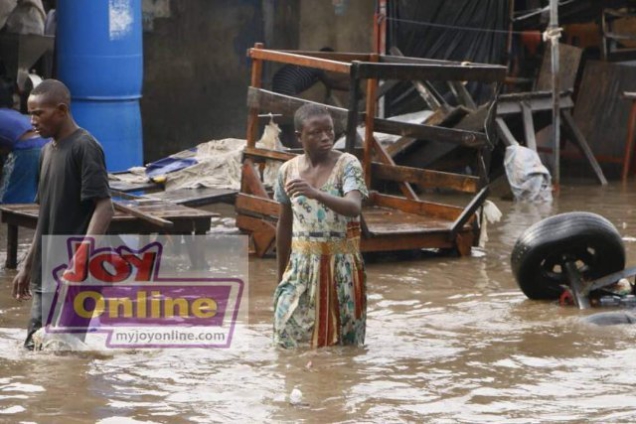
He highlighted the adverse impact of annual floods on the lives, infrastructure, and livelihoods of the people, particularly in Accra, where floods have become a regular occurrence despite efforts by past and current governments to address the issue.
An Environmental lecturer, Husein Mansuur at the same university, emphasised the impact of rapid urbanisation on the demand for land, leading to settlements in flood-prone areas by people with limited income.

He further emphasized that poor sanitation and waste management significantly contribute to the occurrence and severity of floods in urban centers. Improper waste disposal causes blockage of drainage systems due to the accumulation of solid waste and sediments from erosion deposition.
Therefore, improved waste management practices are essential for reducing flood risks, protecting public health, and fostering sustainable development, especially through SDG 6 (Clean Water and Sanitation) and SDG 11 (Sustainable Cities and Communities).
Despite efforts to address urban flooding, effective implementation remains a challenge, with high costs of mitigation measures and the inability of people to effect change contributing to the persistence of the problem.
Prof. Issaka further explained that while city authorities issue eviction notices to informal residents in flood-prone areas, such measures have not been effective and have even exacerbated the flooding problem.

The increase in impermeable surfaces due to urban development has led to higher surface water runoff, contributing to recurring flood events in various regions of Ghana, causing loss of lives and destruction of valuable resources and properties.
Several approaches are available to address the socio-economic, environmental, and institutional challenges faced by impoverished urban communities.
The government should look towards successful practices and lessons learned from Chinese cities to implement the Sponge City initiative. The Sponge City initiative is an urban planning concept designed to improve a city's capacity to absorb, store, and reuse rainwater similar to the natural hydrological processes.
It utilises permeable materials for ground pavement to enhance rainwater infiltration, purify groundwater for urban consumption, reduce water runoff, and promote environmental and ecological soil rehabilitation.
By adopting the Sponge City initiative in cities like Accra and other urban areas in Ghana, it is anticipated that these locations will become more flood-resilient, sustainably manage water resources and improve sanitation.
Latest Stories
-
I will go when EOCO is ready to do the right thing – Baffour Awuah on disputed invitation
16 minutes -
Uproar in France over award-winning author accused of using AI
37 minutes -
Mauritius backs Moroccan sovereignty as most credible solution to regional dispute over Moroccan Sahara
44 minutes -
Trump’s Board of Peace unveils $2.45bn plan to begin Gaza’s reconstruction
47 minutes -
I thought it was a kidnapping – Baffour Awuah explains dramatic escape from EOCO officers
55 minutes -
Cedi depreciates by 9.5% in nine months of 2026 – BoG
59 minutes -
Harvey Weinstein sentenced to 15 years in prison for sexual assault
1 hour -
Ghana’s public debt hit GH¢733.9 billion in July 2026
1 hour -
Dolly Parton’s manager accuses her nephew of ‘threats and intimidation’
1 hour -
“I don’t see any rational basis” – Inusah Fuseini rejects proposed five-year term
2 hours -
Constitution shouldn’t be amended simply because years have passed – IEA
2 hours -
Access Bank, Visa launch ‘Visa Accept’ in Ghana
2 hours -
‘Our young people must inherit story of what Africa created, not lost’ – Mahama
2 hours -
Afreximbank, GIIF and 24-Hour Economy Authority pact marks real progress toward 24-hour economy agenda
3 hours -
IMANI, Local Government Ministry discuss reforms on sanitation, local revenue and urban infrastructure
3 hours