

Audio By Carbonatix
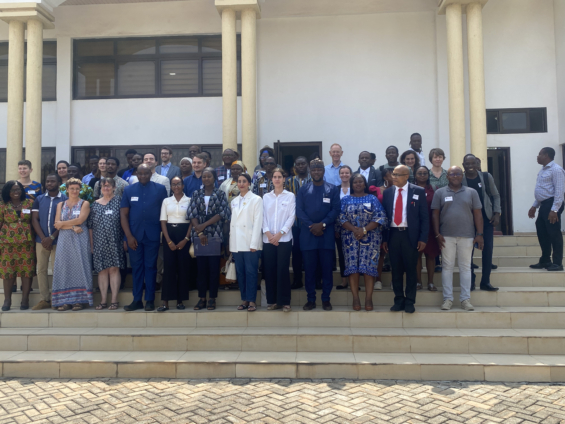
In a conference organised by the Merian Institute for Advanced Studies in Africa (MIASA), stakeholders advocated for efforts to address the multifaceted challenges facing West Africa.
They stressed the need for effective conflict management while creating lasting peace within communities, workplaces, and at the international level.
The call was made on Wednesday, December 11, at the University of Ghana, Legon at the Institute of Statistical Social and Economic Research (ISSER) Conference Hall on the theme 'Dealing with conflict, preparing for sustainable peace; Current research and its policy implications.'
The two-day conference was also in collaboration with the German Institute for Global and Area Studies (GIGA), the Kofi Annan International Peacekeeping Training Centre (KAIPTC), and the Legon Centre for International Affairs and Diplomacy (LECIAD).
In his keynote address, Ambassadorial Fellow at the Institute for Policy and Strategic Studies, Nigeria and former Director of Political Affairs at the ECOWAS Commission, Dr Aderemi Ajibewa, highlighted the need for effective conflict management and lasting peace in West Africa.
He emphasised that the region’s governance structure is the root cause of instability. Despite its rich natural resources, West Africa faces “governance poverty,” where weak governance, political instability, corruption, and exploitation of resources fuel ongoing conflict.
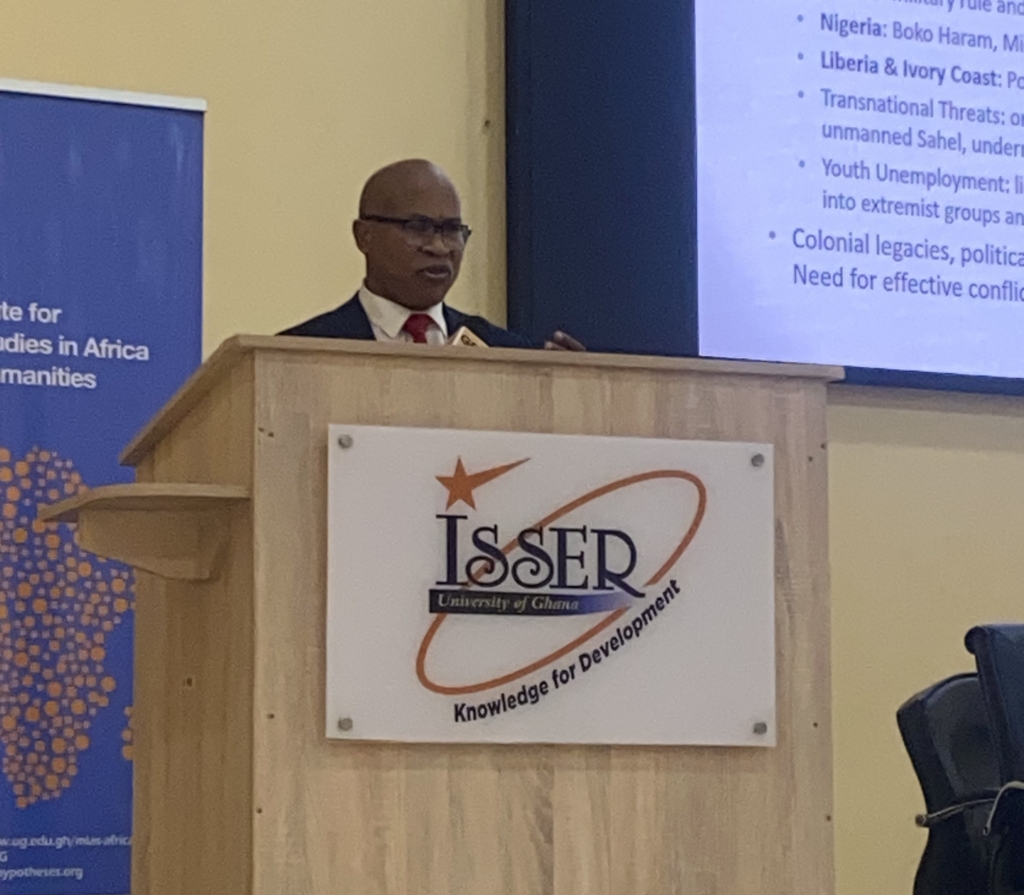
Dr Ajibewa pointed to examples like Nigeria’s Niger Delta, where oil wealth has led to environmental degradation and secessionist movements.
He also discussed the rise of military coups, youth vulnerability, gender inequality, and religious radicalism as contributing factors to instability.
He criticised the concentration of power in the hands of West African presidents and called for constitutional reforms to address these imbalances.
Additionally, he noted the impact of climate change, such as resource scarcity and migration, on regional tensions.
Despite these challenges, Dr Ajibewa urged a renewed commitment to democratic governance, socio-economic development, and regional cooperation. He concluded that a unified approach is necessary for sustainable peace and development in West Africa.
Also, Dr Jana Krause, a professor at the University of Oslo, delivered a keynote address analysing communal violence in Africa.
She stated that communal violence is a non-state armed conflict involving social groups organised around communal identities, such as ethnicity or religion, and distinguished it from other forms of violence like civil wars or election-related violence.
Using data from the Armed Conflict Location Event Data Project (ACLED), Dr Krause noted an apparent rise in communal violence across Africa over the past decade, though this may be partly due to improved reporting.
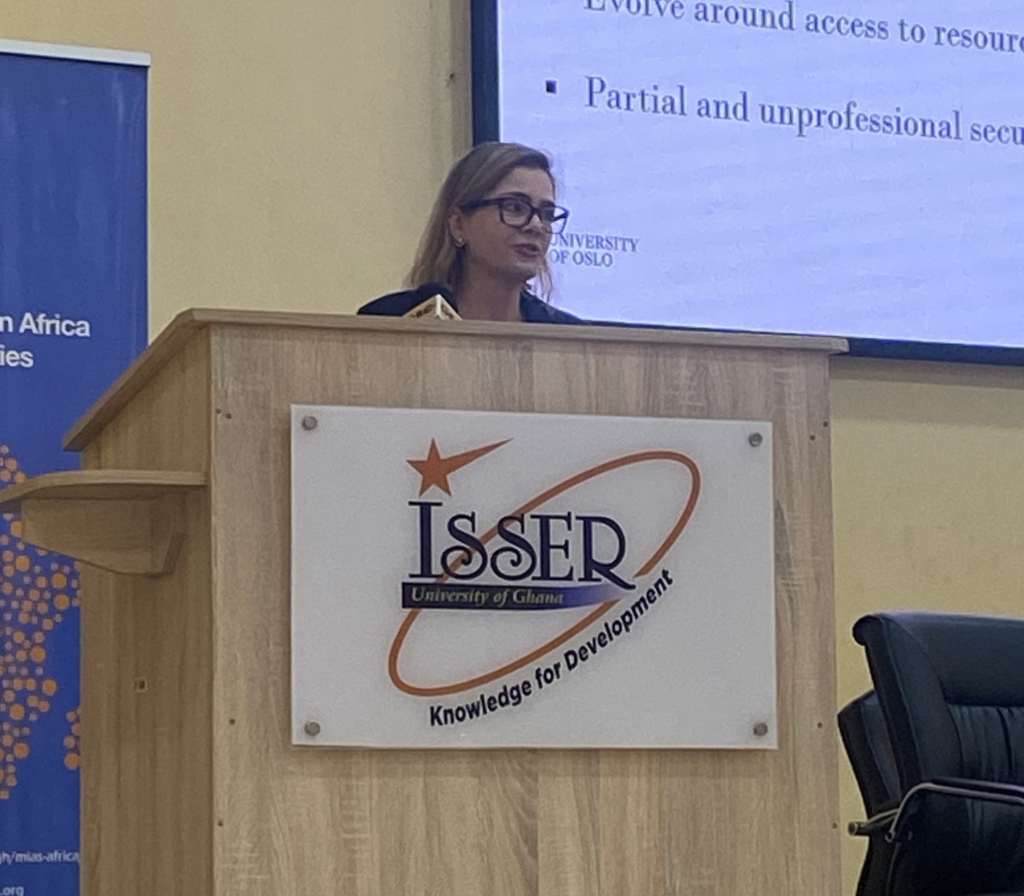
She examined patterns of communal violence through case studies from Kenya and Nigeria, highlighting distinctions between one-sided and two-sided violence and discussing the role of sexual violence, gender relations, and community norms in shaping such conflicts.
Dr Krause also presented findings from a study in Kenya that demonstrated the positive role of local peacebuilding initiatives in fostering community resilience against violence. The study revealed increased trust in peacebuilding actors and a strong belief in the benefits of these initiatives.
She called for context-specific strategies to address communal violence, emphasising the importance of understanding gender relations, supporting local peacebuilding efforts, and conducting further research to enhance prevention and resilience-building measures.
On her part, MIASA Director, Ghana, Prof. Grace Diabah, reinforced the need for action-oriented solutions, noting that dialogue must lead to tangible outcomes.
"All stakeholders must ensure that our actions promote sustainable peace," she said.
Reflecting on post-election violence in Ghana, she called for transparent electoral processes and citizen engagement to resolve disputes peacefully.
The Provost of the College of Humanities highlighted the importance of interdisciplinary collaboration in addressing Africa's regional and global challenges,
He reflected on Africa’s progress since the 1980s, noting improvements in governance but also acknowledging ongoing conflicts such as terrorism in the Sahel and local tribal disputes.
Emphasising the need for new conflict resolution approaches, he called for strategies rooted in African cultural practices and human security.
He stressed that peace-building requires collective effort, with every individual contributing through actions that uphold human dignity and justice.
Latest Stories
-
Clean up our politics before politics cleans us up
27 minutes -
2025 was a turning point, says Abradu-Otoo as NAFCO posts record GH¢91.7m profit
50 minutes -
Today’s front pages: Friday, September 25, 2026
1 hour -
‘FA President has four clubs; what do you think he would do?’ – Nana Baffour Awuah fires back
1 hour -
Kurt Okraku doesn’t like criticism, but Ghana football is beyond him – Nana Baffour Awuah
2 hours -
Ghana’s Liquidity Paradox: Why capital is not reaching productive businesses
2 hours -
Ghana football has collapsed under Kurt Okraku – Manhyia South MP
2 hours -
Mr John Blankson Adu Otu
2 hours -
Prof. D. K. Yeboah-Amankwah
2 hours -
AFCON 2027Q: Queiroz ‘proud’ of Black Stars performance despite defeat to Cote d’Ivoire
3 hours -
Your next home could be here: 3rd JoyNews Republic Bank Habitat Clinic opens at Junction Mall today
3 hours -
GCAA assures safety won’t be sacrificed to attract more airlines
3 hours -
AFCON 2027Q: Queiroz furious with ‘joke’ penalty awarded Cote d’Ivoire in Black Stars defeat
3 hours -
GCAA backs more domestic airlines to drive down airfares
3 hours -
SHC launches nationwide audit, gives occupants 21 days to regularise property interests
3 hours