

Audio By Carbonatix
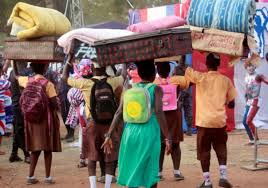
The Conference of Heads of Assisted Senior High Schools (CHASS) has urged parents and guardians to assist with the feeding challenges in senior high schools.
CHASS had earlier appealed to the Ghana Education Service (GES) to reconsider the reopening of high schools, citing unresolved financial issues, including the government's non-payment for perishable foods provided for students last year. However, the GES rejected this appeal.
Five days after schools reopened, the National Secretary of CHASS, Primus Baro, told JoyNews that the situation in high schools is dire, with many institutions having to ration food.
He therefore encouraged parents to support their children with food items for use at school to complement the government's provision.
"I encourage parents, and I have already advised my PTA to this effect, to let their children bring food like gari, shitor, and sugar to supplement whatever the school provides. I urge parents across the country, as the food situation has still not improved in the past two and three years, and it has worsened at this particular time," he said on JoyNews' Newsdesk on Wednesday, January 8.
He revealed that the situation is particularly severe in schools in northern Ghana.
"Food supplies are not reaching the schools. In places like Upper West, Upper East, and the Northern regions, apart from rice, the schools have no stable food supplies. Oil is completely unavailable. For example, in my school, I currently don't have a single drop of oil, so my matron has been using margarine to replace oil for cooking. I don't have maize or beans—only rice and some gari," he added.
He stressed that "We are still relying on the old practices of sending students with what they have, and that’s the only reason we allowed the students to return. Otherwise, the situation is still far from ideal."
The Free Senior High School (SHS) programme, initiated by the previous Nana Akufo-Addo-led government, has faced numerous challenges over the years, including insufficient classroom and dormitory facilities, inadequate food, and more.
Critics have also argued that the programme has led to an increase in the number of SHS graduates, but not necessarily in the quality of education.
However, the new president, John Mahama, before winning the election, promised to revitalise the programme rather than abolish it.
Latest Stories
-
‘Avoid political comments’ – Domelevo advises Chief Justice
12 minutes -
‘I don’t trust OSP’ to probe GH¢70k ‘bribe’ allegation – Kwasi Kwarteng
26 minutes -
Road inspections not to witch-hunt contractors – Kwame Agbodza
50 minutes -
Inter Milan mount stunning comeback to beat Napoli
58 minutes -
Modric plans to play for Croatia past 41st birthday
1 hour -
Bayern fail to score for first time in 59 games
1 hour -
Bawumia preparing new cocoa policy package for farmers – Annoh-Dompreh
1 hour -
Wa-Tumu-Bolga road upgrade will unlock agriculture, trade – Agbodza
1 hour -
Ghana Maritime Authority readies oil-spill response vessel for deployment
1 hour -
Ayariga turns to drones, AI to tackle Agbogbloshie waste mountain
1 hour -
Agbogbloshie waste heap must go – Mahama Ayariga declares
2 hours -
Government to upgrade all rural telephony sites to 4G – Communications Minister
2 hours -
Rural calls, data to become cheaper by Q1 2027 – Sam George
2 hours -
National Chief Imam remains Ghana’s strongest symbol of interfaith harmony – Mahama Ayariga
2 hours -
Nhyiaesohene pledges support to ECG to curb encroachment
2 hours