

Audio By Carbonatix
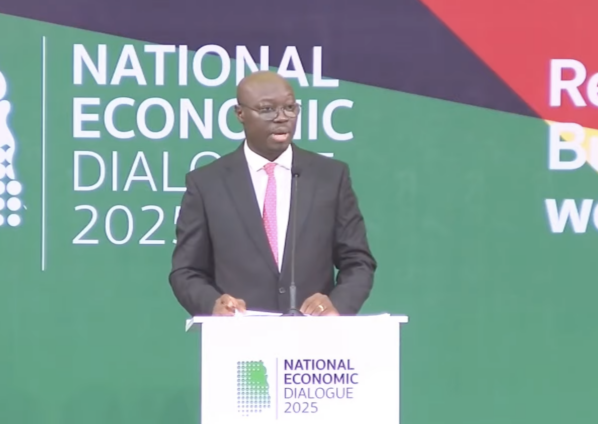
Finance Minister Dr Cassiel Ato Forson has emphasised the urgent need for institutional reforms to enhance productivity and accelerate Ghana’s economic transformation.
He warned that without comprehensive policy changes, Ghana may not achieve upper-middle-income status until after 2050.
Speaking at the National Economic Dialogue 2025, Dr Forson stressed that Ghana cannot afford to wait that long to attain economic progress.
“Without comprehensive reforms, unfortunately, Ghana will only achieve upper-middle-income status after the year 2050, and we cannot wait until then,” he said.
“There is an urgent need for comprehensive policies and institutional reforms that enhance productivity, improve the quality of infrastructure and services, and elevate human capital and workforce skills. These reforms have the potential to transform Ghana within a generation, tripling its per capita income by 2050,” he explained.
He highlighted the importance of reorienting fiscal policies to support economic growth and structural transformation. According to him, Ghana’s economic future depends on the level of reforms implemented.
“If nothing is done, Ghana will only become an upper-middle-income country by 2050. With moderate reforms, we can achieve this by 2042, but if we introduce ambitious reforms, Ghana can reach upper-middle-income status by 2038,” he explained. “We have no choice but to introduce measures to reset our economy.”
Dr Forson outlined a seven-chapter framework aimed at resetting the economy. He said the first focus will be on stabilising the economy and creating prosperity for all.
“We have no choice; we will have to introduce measures to reset our economy,” he said. “Chapter one is resetting the economy and creating prosperity for all. Chapter two is jobs for all, Chapter three is Ghana’s framework for industrial revitalisation, support, and transformation, which we call Ghana First.”
He added that another major focus will be infrastructure, human capital development, governance, and economic diplomacy.
“Chapter four will be powering growth through infrastructural development. Chapter five is investing in people for inclusive growth. Chapter six will be restoring good governance and combating corruption, and chapter seven will be deepening international relations and foreign policy so that Ghana can benefit from economic diplomacy,” he explained.
Latest Stories
-
Haruna Iddrisu calls for limits on annual university accommodation fee increases
7 minutes -
Today’s front pages: Tuesday, October 13, 2026
54 minutes -
Wealth Over Water: How Galamsey Is Threatening Ghana’s Water Security
2 hours -
LA 2028: Black Queens pumped up for second leg of Mauritius tie
2 hours -
LA 2028: Black Queens hold final training session ahead of second leg against Mauritius
2 hours -
Standards are not Seasonal: What the EC appointments teach both sides
2 hours -
King Mohammed VI urges private sector to create youth jobs and spread benefits of growth
2 hours -
KGL U17 Colts 2026: Greater Accra win title after penalties win over Western Region
2 hours -
UK Investment Roadshow opens in London to advance UK-Ghana growth partnership
3 hours -
Assemblies of God requires pastors to resign before entering partisan politics – Rev. Wengam
3 hours -
Ghana targets 20% annual reduction in maternal deaths – Health Minister
3 hours -
Cyber attacks in Africa grow faster than global rate, report finds
3 hours -
Ghana signs UAE deal to create 5,000 overseas jobs
3 hours -
One Million Coders Programme targets 100,000 digital jobs in two years – Sam George
3 hours -
John Jinapor, Italian Ambassador explore opportunities for energy sector investment
3 hours