

Audio By Carbonatix
The UK government has brought in a temporary ban on holidaymakers bringing in cheese and meat products from the EU in a bid to prevent the spread of foot-and-mouth disease.
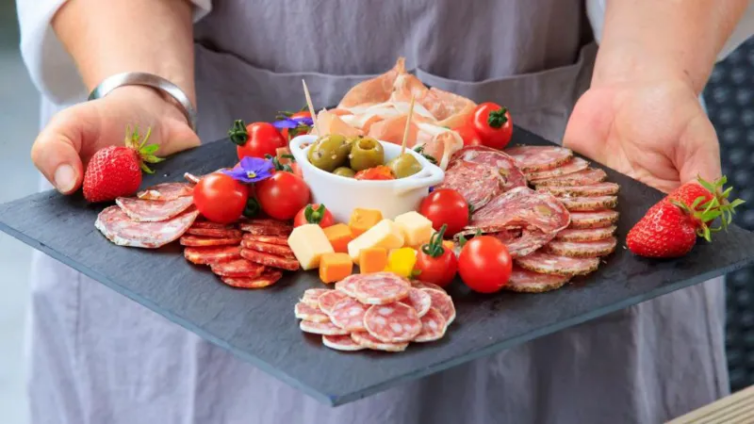
Travellers have not been allowed to bring back items such as cured meat and cheese, including in sandwiches, since Saturday due to the growing outbreak on the continent.
The restrictions apply regardless of whether the goods are packed or packaged, or bought from duty free.
It follows an earlier ban of similar products from Germany, Hungary, Slovakia and Austria after rising cases of the cattle disease in those countries.
The restrictions apply to people arriving in Great Britain, not Northern Ireland, Jersey, Guernsey, or the Isle of Man.
Products will be seized and destroyed if people try to bring them in, and in "serious cases" people could be fined up to £5,000.
The list of restricted products includes:
- pork
- beef
- lamb
- mutton
- goat
- venison
- other products made from these meats, for example sausages
- milk and dairy products like butter, cheese and yoghurt
People can bring up to 2kg per person of powdered infant milk, infant food, or special food needed for medical reasons.
Foot and mouth disease is a highly infectious virus which causes blisters inside an animal's mouth and under their hooves, and can cause lameness and problems feeding.
There are currently no cases of foot-and-mouth disease in the UK.
The last outbreak in the UK was in 2001. Although there were only 2,000 confirmed cases, more than six million sheep, cattle and pigs were slaughtered.
This is because each of those cases meant a farm having all of its livestock killed and burned.
The Guild of Fine Food, which represents independent food and drink retailers, said the ban on "holiday treats" had been "hurried", but added it brought UK government policy for holidaymakers more in line with restrictions already placed on small businesses.
"The food and drink industry absolutely supports the fact that we must protect our farmers and that biosecurity is paramount," said John Farrand, managing director of the Guild of Fine Food.
However, he said that "bureaucracy" brought in after Brexit had added "significant constraints" for small food and drink importers and exporters.
Latest Stories
-
Mysterious illness leaves children struggling to walk, hear as Mafi Kope community appeals for urgent medical help
12 minutes -
Ghana begins free rabies vaccination for 25,000 pets
18 minutes -
Ghana Navy strengthens operational readiness with specialist seaman gunners training
22 minutes -
Nkrumah’s legacy must be measured by action, not ceremonies – Armah-Kofi Buah
27 minutes -
Kwesi Pratt Jnr questions Ghana-US defence cooperation agreement over sovereignty concerns
34 minutes -
Nkrumah’s legacy must drive African unity, self-reliance and environmental protection – Armah-Kofi Buah
38 minutes -
Nkrumah’s inspiration should unite Africans despite political differences – Dr Opoku Prempeh
41 minutes -
Some dissolved NSA board members could be reappointed – Kofi Adams
1 hour -
Mahama leaves for New York to attend 81st UN General Assembly
1 hour -
Aston Villa beat Mohammed Kudus’ Tottenham 3-1 as Spurs struggles continue
1 hour -
Auditor-General’s COVID audit omissions worrying for anti-corruption fight – CDD-Ghana
1 hour -
Bawa-Rock supports over 300 Obuasi Town Hall fire victims with GH¢1.5m package
1 hour -
Western regional security council steps into Betterland-Gwira mining dispute
1 hour -
Photos: Nkrumahfest 2026 draws dignitaries as Ghana celebrates Kwame Nkrumah’s legacy
1 hour -
Flames, smoke seen near Riyadh airport after Saudi warning of aerial attack threat
1 hour