

Audio By Carbonatix
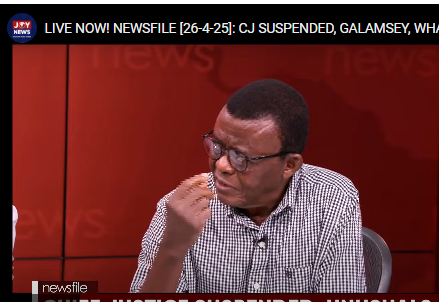
Former UN Senior Governance Advisor, Professor Baffour Agyeman-Duah, has called for serious introspection regarding the handling of petitions aimed at removing the Chief Justice.
His comments come in the wake of the Chief Justice's suspension by President John Dramani Mahama, a move that has sparked widespread public and political discourse.
Speaking on JoyNews’ Newsfile programme, Professor Agyeman-Duah expressed concern over how such actions affect the principle of separation of powers.
“In a democracy, the last thing you want is for the Executive to behave in a manner that undermines another arm of government,” he said, adding that historical examples show that presidents have often acted cautiously when displeased with Chief Justices.
He pointed out that, historically, there have been moments when presidents were displeased with Chief Justices. “However, even in such cases, those leaders acted with caution,” he said.
Professor Agyeman-Duah noted, “Presidents have been mindful of this and restrained themselves from taking steps that could compromise the judiciary’s independence.”
He further emphasised the importance of respecting the constitution.
“The constitution provides a clear process for handling such matters, and that process must be followed,” he said. He commended Inusah Fuseni’s presentation on the matter, praising how it rightly highlighted the importance of adhering to constitutional procedures.
However, he also explained that while the process must be followed, the president has some discretion. He recalled an incident during former President Akufo-Addo’s tenure when a petition was submitted.
“In that case, the president, in consultation with the Council of State, determined there was no prima facie case and declined to proceed,” he said. “That was a valid approach that upheld the separation of powers without initiating formal proceedings.”
In contrast, he noted that the current president has chosen to take a different path by moving the petition forward, because you cannot fault him because he is following the process."
“While this is still in line with constitutional procedure, the president could have exercised discretion, as others have done in the past, and concluded that the petition did not merit further action,” he stated.
He concluded by urging a broader reflection on how such petitions are treated, especially given the delicate balance of power in a democratic system.
“We need to reflect on how such petitions are handled to ensure the integrity of our democratic institutions,” he said.
Latest Stories
-
Bond market: Turnover declined by 28% to GH¢1.56bn
21 minutes -
Volta Region National Public Speaking contest advances drug prevention conversation
26 minutes -
New health training facility at Ampoma-Jema to address admission shortfalls, but Minister flags missing amenities
50 minutes -
Black Challenge unveiled with sights set on Amputee World Cup glory
1 hour -
Pay striking teachers before expressway spending, Dr Kingsley Agyemang tells government
2 hours -
Customs intercepts assault rifle, two pistols and 610 rounds of ammunition at Tema Port
2 hours -
PKO boxers secure wins at Odwira Festival
2 hours -
South Tongu Records Rise in Teenage Pregnancy
3 hours -
Cabinet threw out US health compact faster than anything I’ve seen – Mahama
3 hours -
MoFA urges Finance Ministry to reverse World Bank food programme withdrawal over GH¢643m commitments
3 hours -
NAGRAT demands signed timelines before calling off strike
3 hours -
National Investment Quiz: West Africa SHS, St. Louis SHS advance to semi-finals
3 hours -
Shatta Wale appeals to Mahama for balanced framework to tackle social media abuse without stifling free speech
3 hours -
Education Ministry urges data-driven talks to resolve teacher impasse
3 hours -
‘What we wanted was money to buy medications’ – Dr Nawaane on US health support
3 hours