

Audio By Carbonatix
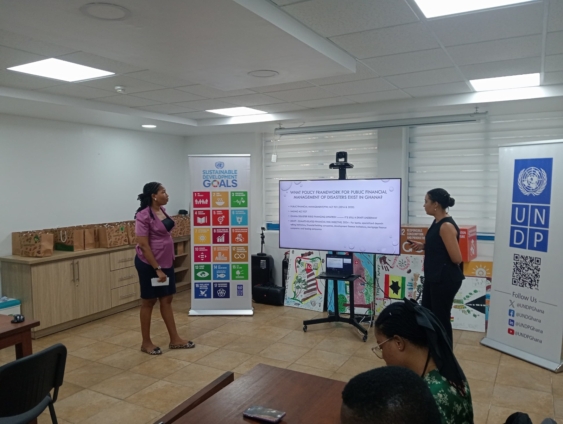
The United Nations Development Programme (UNDP), Ghana has brought together key government agencies, industry players, and risk experts in Accra to develop a national strategy that will improve Ghana’s ability to finance disaster response quickly and efficiently.
Organized through UNDP’s Insurance and Risk Finance Facility (IRFF), the stakeholders engagement workshop convened representatives from the Ministry of Finance, National Insurance Commission (NIC), National Disaster Management Organization (NADMO), Environmental Protection Agency (EPA), National Development Planning Commission (NDPC), Ghana Hydrological Authority, Ghana Meteorological Agency, Civil Society Organisations, and leading risk modelling experts.
The objective is to co-create a Disaster Management and Risk Finance Strategy Framework that will enable Ghana to access faster and more predictable financing when floods, droughts, and other natural hazards occur.
In her opening remarks, Dr. Amina Sammo, Coordinator of UNDP’s Insurance and Risk Finance Facility, described the workshop as an opportunity to shape a robust national strategy through collaboration among ministries, regulators, insurers, development partners, and technical experts.
“This initiative isn’t only about policy, it’s about real people: the waakye sellers, Koko vendors, charcoal traders in inner-cities, Zongo communities, and farmers whose livelihoods are threatened each time disasters strike,” she said.
Dr. Sammo emphasised that pre-arranged disaster finance, designed and agreed upon in advance, can save lives by ensuring quick and predictable funding in emergencies.
She highlighted innovative tools being considered for the strategy, including parametric insurance, contingency planning, risk financing, and risk-layering mechanisms.
These are aligned with Ghana’s development goals and global frameworks such as the Sendai Framework for Disaster Risk Reduction, the Paris Agreement, and the Sustainable Development Goals (SDGs).
She urged stakeholders to take ownership of the strategy and integrate disaster risk financing into national policies, budgets, and planning processes, stressing that its success depends on collective leadership and decisive action.
Prof. Asaah S. Mohammed, Lead Consultant on the project, encouraged participants to adopt flexible approaches informed by global best practices. He announced that a follow-up session will be held in the weeks to review the draft framework for validation.
The workshop is seen as a significant step in Ghana’s efforts to become a resilient, shock-ready nation capable of protecting its most vulnerable citizens in the face of disasters.
Latest Stories
-
Ghana needs a law to sustain constitutional reforms – CDD-Ghana
1 hour -
COVID fumigation audit: Auditor-General has a lot of questions to answer – Akwatia MP
1 hour -
Stranded Ghanaian medical graduates in Cuba appeal to Mahama for immediate return
1 hour -
GNFS contains fire outbreak at Teshie Lekma Road near Lekma Hospital
8 hours -
Samia Nkrumah rejects the narrative that Ghanaians were happy after Nkrumah’s overthrow
9 hours -
A Mother’s pain: Tribute by Ivan Baidoo’s mother
9 hours -
‘Forgive us for staying away’ — Samia Nkrumah leads family back to Nkroful, pledges to preserve Nkrumah’s legacy
9 hours -
Ernest Nuamah scores twice as Lyon beat Rennes
9 hours -
‘My dear Ivan’ – A father’s tribute to a son tragically killed
9 hours -
GNPC Explorco advances Voltaian Basin drilling preparations with 13.5km access road
9 hours -
Cabinet approves facility manager for Borteyman Sports Complex – Kofi Adams
10 hours -
Sanitation is improving; critics may be ‘living in another world’ – Salaga South MP replies Bekwai MP
10 hours -
Government must do more to tackle sanitation crisis – Bekwai MP
10 hours -
World Cleanup Day: GFF begins sanitation education in local communities
11 hours -
EU Ambassador, IGP discuss stronger cooperation on policing and security
11 hours