

Audio By Carbonatix
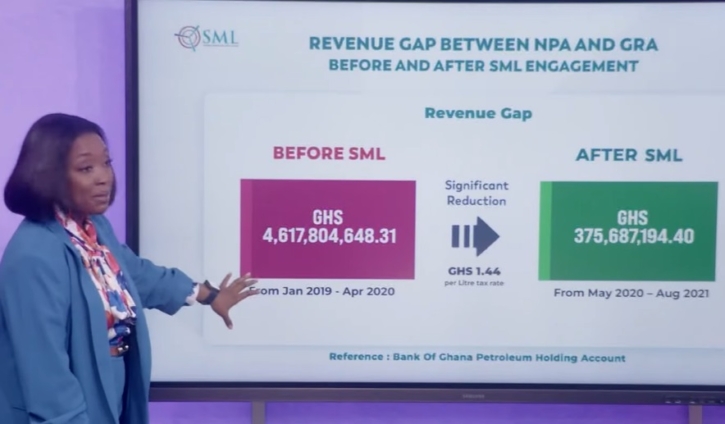
Director of Support Services at Strategic Mobilisation Ghana Limited (SML), Dr. Yaa Serwaa Sarpong has slammed critics of the company’s operations, saying that SML’s innovations have rattled individuals and entities who previously likely benefited from loopholes in Ghana’s petroleum sector.
Speaking on The Upfront on Joy News, Dr. Sarpong described some of the backlash against SML as orchestrated, suggesting that those uncomfortable with the company’s role in sealing revenue leakages view it as a threat.
She said when you eliminate manual processes and plug leakages, you frustrate those who have long exploited the system and that some of SML’s most vocal critics simply see the company as a threat.

SML, a Ghanaian-owned company engaged by the Ghana Revenue Authority (GRA), specialises in revenue assurance, real-time monitoring, and audit services in the petroleum downstream sector.
According to Dr. Sarpong, the company’s technological interventions have drastically reduced opportunities for underreporting and tax evasion.
She noted that prior to SML’s involvement, GRA relied on data reported by oil marketing companies themselves — a system that lacked independence and transparency.
“Now, we use check meters, satellite transmissions, and real-time dashboards. Every litre lifted is accounted for, and all the data is verifiable independently of the traders. Naturally, this doesn’t sit well with those who preferred the opacity,” Dr. Sarpong explained.
If what SML does is not revenue assurance, then what is?
In the face of mounting scrutiny, Dr. Yaa Sarpong robustly defended the company’s role in Ghana’s petroleum revenue monitoring, insisting that SML’s systems epitomise revenue assurance.
She challenged critics who question the company’s value, citing the technological infrastructure and financial model SML has brought to the sector.
“If what we’re doing isn’t revenue assurance, then what is?” she asked. “We’ve eliminated manual loopholes, digitised all records, and provided GRA with real-time visibility over petroleum transactions across the country.”
She said SML fully funds its system development, installations, and operations, receiving compensation only from a portion of the revenue its interventions help to recover — a model she said is both efficient and transparent.
“Our contract allows the government to keep 95% of the additional revenue collected. The remaining 5% supports our operations. Compare this to traditional arrangements, and it becomes clear that this is one of the most value-driven contracts in the sector,” she explained.
Dr. Yaa Sarpong maintained that before SML’s engagement, GRA relied on paper-based documentation stored in sacks — making audit trails unreliable and prosecutions difficult.
“Today, with automated systems, digitised records, and cloud storage, all that has changed. It’s a complete transformation,” she said.
Read also:
Latest Stories
-
Turning invitations into arrests is making citizens reluctant to assist police – Twumasi Ankrah
12 minutes -
The Traffitech-GH SMS spot-fine system: The good, the sad, and the funny – Bright Simons writes
24 minutes -
Hawa Koomson pledges experienced and mature leadership of NPP women’s wing
2 hours -
Young woman found dead at Kasoa Peace Town
2 hours -
Playback: The Law examined lawful arrest in Ghana
2 hours -
Mahama urges African governments to treat healthcare as an investment, not budget cost
3 hours -
Bawumia congratulates John Boadu and new NPP executives, pledges support ahead of 2028
3 hours -
Aksa Energy delegation pays courtesy call on GRA Commissioner-General
3 hours -
‘No talent should be left out’ – Bawumia pledges inclusive NPP campaign for 2028
3 hours -
Prof. Mike Oquaye recounts how he blocked the Special Prosecutor’s attempt to arrest Bawku Central MP
3 hours -
Make health sovereignty a priority for Africa – Mahama
4 hours -
Dorimon Naa, Wa West DCE lead massive clean-up exercise; threaten sanctions against recalcitrant residents
4 hours -
Photos from Adom FM Y2K Jam
4 hours -
Praye Tiatia steals the show at Adom FM Y2K Jam [Watch]
4 hours -
Boakye Agyarko congratulates John Boadu, pledges support for NPP leadership
4 hours