

Audio By Carbonatix
President John Mahama has announced that the government’s ban on the export of non-ferrous scrap is expected to boost Ghana’s processed metal exports by between "$250 million and $300 million annually", describing the move as a decisive step toward strengthening the country’s industrial base.
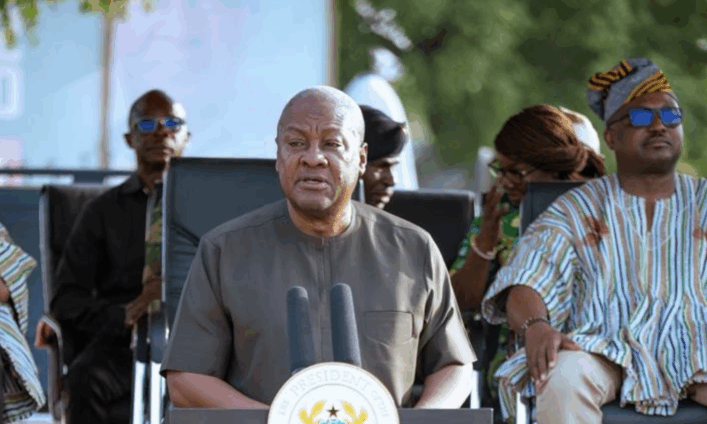
Speaking at the commissioning of the B5 Plus Limited Steel Manufacturing Plant at Prampram on Friday, February 20, the President said the policy is designed to secure raw materials for local manufacturers and accelerate value addition in the metals industry.
He explained that Ghana generates substantial volumes of scrap metal each year through construction, demolition, vehicle imports and other industrial activities. However, for years, a significant portion of that scrap has been exported in its raw form.
“Industrial capacity requires raw material security. By restricting non-ferrous scrap exports, the government ensures local processors have priority access to raw material for their production,” he said.
According to him, the policy will not only increase processed metal exports but also create between 5,000 and 10,000 new jobs across the value chain.
President Mahama added that the move would further enhance domestic revenue mobilisation through value-added tax, corporate taxes and pay-as-you-earn contributions.
He commended B5 Plus Group for its tax compliance, noting that the company is among the Ghana Revenue Authority’s most reliable taxpayers.
"They've paid more than $300 million in taxes and are looking to exceed $500 million very soon."
While acknowledging concerns raised by the company over frequent audits, he suggested that regulatory oversight must be balanced and predictable.
The President said the broader objective is to move Ghana up the value chain by exporting finished and semi-finished products rather than raw scrap materials.
Linking the policy to the government’s “Big Push” infrastructure agenda, he said massive investments in roads, highways, railway modernisation, bridges, interchanges, energy transmission lines, affordable housing and industrial parks will require a strong and reliable supply of iron and steel.
"Africa is projected to require over $100 billion annually in infrastructure development. West Africa alone faces significant infrastructure deficits.
"If Ghana develops a strong steel base, we not only build our own roads and bridges, we will also supply steel to the whole sub-region. This is how infrastructure becomes industrial strategy. The 24-hour economy program is particularly relevant to energy-intensive industries such as steel manufacturing," President Mahama added.
Latest Stories
-
No preacher has the right to impose beliefs on bus passengers – Kwesi Pratt Jr backs preaching ban
3 minutes -
Africa Maritime Security Forum opens in Accra with call for stronger continental cooperation
3 minutes -
Techiman North MP fulfills promise with new CHPS Compound in Kokoago
14 minutes -
Enterprise Trustees, Sinapi Aba launch ‘Asetenapa Plan’ to promote retirement savings among informal workers
16 minutes -
Gov’t working to ensure GAUA strike is called off by October 16 – Haruna Iddrisu
20 minutes -
KAIPTC Commandant calls for continent-wide strategy to tackle Africa’s maritime security threats
32 minutes -
GRIDCo investigates Mallam substation fire as power restoration continues in Accra
33 minutes -
20% digital tax is not E-Levy – GRA boss
43 minutes -
Defence Minister calls for intelligence-sharing and regional cooperation to tackle maritime insecurity
47 minutes -
Afenyo-Markin failed to comply with procedural rules in defamation suit – Sammy Gyamfi’s lawyers
58 minutes -
GRA recovered GH¢1.3bn out of about GH¢1.4 bn unpaid VAT from ECG – Anthony Sarpong
1 hour -
KMA to extend daily toll collection to nights and weekends
1 hour -
Ghana secures second consecutive term on UN Human Rights Council
1 hour -
KATH Catheterisation lab targets December completion amid specialist staffing concerns
1 hour -
Government working to address economic challenges driving youth into galamsey – Mahama
1 hour