

Audio By Carbonatix
President John Dramani Mahama has announced that Ghana is on course to exit financial support from Gavi, the Vaccine Alliance, by 2030 as the country strengthens efforts towards self-reliance in healthcare financing and vaccine delivery.
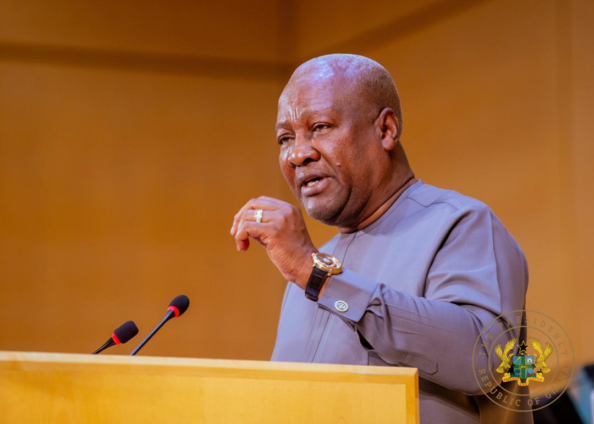
Delivering the keynote address at the 79th World Health Assembly in Geneva, Switzerland, President Mahama said Ghana’s progress in healthcare financing and vaccine access reflects its commitment to health sovereignty and long-term reform of global health systems.
“Ghana, I am also happy to report, is on track to exit Gavi funding for vaccines by the year 2030, and we hope to transition into a donor in the not-too-distant future,” he announced.
Gavi, the Vaccine Alliance, is a public-private partnership that works to expand access to vaccines and immunisation for children in lower-income countries. The alliance helps vaccinate more than half of the world’s children against some of the deadliest diseases globally.
It brings together donor and partner governments, the World Health Organisation, UNICEF, the World Bank, vaccine manufacturers, technical agencies, civil society organisations, the Bill & Melinda Gates Foundation, and other private sector partners.
Since its establishment in 2000, Gavi has helped immunise more than 1.2 billion children and is credited with preventing over 20.6 million future deaths, while contributing significantly to reductions in child mortality in 78 lower-income countries.
The President said Ghana’s domestic healthcare achievements form the foundation of what he described as the “Accra Reset Initiative”, a broader push aimed at reforming the global health architecture and strengthening health systems in developing countries.
“These domestic achievements are the foundation of my leadership of the Accra Reset Initiative,” he stated.
President Mahama said the World Health Assembly was expected to consider proposals for a joint process to reform the global health system and welcomed the development, noting that Ghana had co-chaired the Working Group for the Lusaka Agenda.
However, he expressed concern about attempts to preserve existing institutional structures rather than pursue meaningful reforms.
“As a committed apostle of reform of the world health architecture, I’m concerned about whispers I have heard that the current draft resolution seeks to protect existing organisational mandates and prohibits the recommendation of measures or consolidations,” he said.
Using a proverb from Mali’s Dogon people, he cautioned against reforms that fail to deliver real change.
“In Mali, the Dogon people warn that: ‘Do not let the sight of those eating roasted maize force you to cook your maize seeds,’” he said.
“If we launch a process of reform that is prohibited from recommending actual reform, we are merely performing a ritual.”
Mr Mahama stressed that the global health system must prioritise human survival over institutional interests.
“We cannot prioritise institutional comfort over human survival,” he said.
“The WHO’s legitimacy is not served by protecting silos. It is served by a fearless analysis of what works.”
He recalled hosting the Director-General of the World Health Organisation, Dr Tedros Adhanom Ghebreyesus, former Nigerian President Olusegun Obasanjo, and other global leaders in Accra in 2025 to advance discussions on health sovereignty.
“When I hosted Director-General Tedros, President Obasanjo and many others in Accra in 2025, we firmed up a vision for health sovereignty,” he said.
He explained that health sovereignty refers to countries’ practical ability to finance healthcare systems, regulate quality standards, and produce essential medical supplies locally.
“A continent that manufactures less than one per cent of its vaccines while carrying 25 per cent of the global disease burden is not sovereign,” he stated. “It is vulnerable. It is, at best, a ward of the international system.”
He clarified that health sovereignty should not be interpreted as isolationism.
“By sovereignty, we do not mean isolationism,” he said. “We are advocating the practical capacity of a nation to finance its own core functions, regulate its own quality, produce its own medicines and govern its own data.”
President Mahama also criticised inefficiencies in donor-driven health systems, noting that health ministers in the Global South often spend excessive time on reporting requirements instead of strengthening primary healthcare delivery.
To address these challenges, he said the Accra Reset Initiative—supported by a Presidential Council of leaders from the Global South—is being implemented through three key pillars.
The first is a high-level panel on reform, while the second is the Reform Interlock Observatory, designed to improve coordination among major global health institutions.
“It is a coherent mechanism to ensure that the strategies of the WHO, Gavi and the Global Fund don’t clash on the desk of a district health officer in rural Africa. They must be in sync,” he said.
The third pillar is the Health Investment National Gateway Enablers (HING), which he described as an operational engine to convert political commitments into bankable investments in local manufacturing and bio-innovation.
“This will serve as the operational engine that converts political will into bankable, executable investments in local manufacturing and bio-innovation,” he said.
Latest Stories
-
Atta Akyea denies seeking presidential pardon for Wontumi in galamsey case
19 seconds -
Photos: Mahama commissions 85-bed Police Hospital ward, donates two ambulances
9 minutes -
GTEC directs Ghana’s public universities to reopen by October 16 and begin lectures on October 19
10 minutes -
Star Oil donates GH¢1million towards construction of new CID facility
14 minutes -
Court hands Adjetey Sowah, two others lifetime bans after Amputee Football legal dispute
23 minutes -
NDC appoints Julius Kwame Anthony as a Deputy Communications Director
24 minutes -
Ghana repatriates 120 Nigerians rescued from suspected cybercrime centres
28 minutes -
NPP rejects Emelia Agbenyo’s appointment as Deputy EC Chair, demands withdrawal
33 minutes -
EOCO grants Suame MP John Darko enquiry bail in GH¢27m SIC investigation
36 minutes -
NPP cannot question EC appointment after appointing own people to Commission – Kwakye Ofosu
42 minutes -
BoG deepens public trust with regional stakeholder forum in Techiman
51 minutes -
‘We have turned the tide’ – Ato Forson says Ghana is ready to take off
56 minutes -
Police arrest man captured in viral video assaulting wife in Agona Nkwanta
58 minutes -
KATH Mother and Baby Unit construction stalled for 14 months over unpaid contractor arrears
1 hour -
Government wanted to ‘tilt the balance’ with new EC appointments – Kwakye Ofosu
1 hour