

Audio By Carbonatix
The International Monetary Fund (IMF) on Friday urged Ghana to take full advantage of the significant fiscal space created by its strong policy reforms and economic stabilisation programme to drive strategic investments and provide jobs for the people.
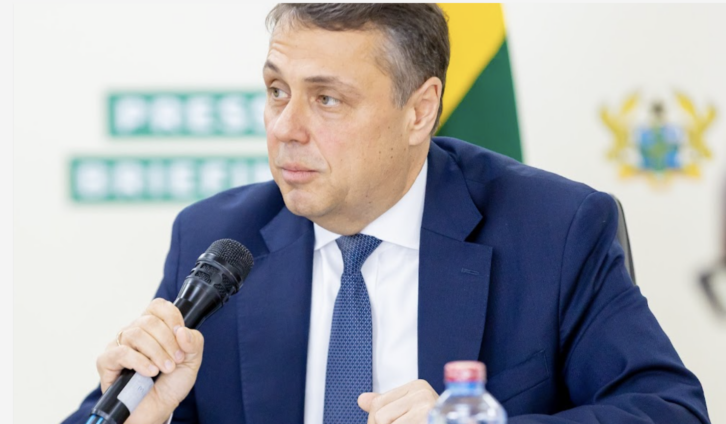
Mr Ruben Atoyan, IMF Chief Mission for Ghana, made the call during a joint briefing with the Ministry of Finance in Accra, on the back of a Staff-Level Agreement on the sixth review under the Extended Credit Facility (ECF) arrangement.
The briefing, which completed the country’s 2026 Article IV Consultation, saw the announcement of an end to Ghana’s three-year US$3 billion loan-supported programme.
This ushers the country into a new 36-month Policy Coordination Instrument request.
Mr Atoyan, who is also a Division Chief for IMF’s African Department, described Ghana’s fiscal and economic turnaround as “remarkable,” noting its current position of deploying the policy dividends to accelerate growth and create job.
“The fiscal space is ultimately the space the Government generated strong policies and now can be used going forward to support economic growth, employment and strategic investment in important sectors. This was much of our discussion,” he said.
Looking ahead, the IMF Division Chief identified two principal risks that Ghana must navigate carefully as it transitioned from stabilisation to growth – maintaining strong fiscal safeguards and exposure to gold price volatility.
On fiscal measures, he recommended better expenditure control, particularly among state-owned enterprise (SOEs) through public-private partnerships and avoiding spending outside the central government’s budget perimeter.
On gold price volatility, he cautioned that commodity prices were inherently unpredictable, especially in the current uncertain geopolitical environment, urging authorities to use the current favourable terms of trade to build adequate buffers.
Dr Cassiel Ato Baah Forson, the Minister of Finance, noted that the country’s focus after the ECF programme would be pivoted on three key things – stability, resilience, and development.
“Stability will build resilience and then use the resilience to develop. Clearly, the stability is done, we’ve announced the same and it’s been confirmed by the Fund. It’s now time for us to develop and create jobs,” he said.
“In the coming days, we’ll be announcing our flagship design – the ‘new economy,’ where we’ll be looking at areas of development and job creation,” he said.
“Be assured that from stability, we’ll build resilience and from resilience we’ll build an economy that will benefit the masses.”
Latest Stories
-
High Court sets November 4 for ruling on Wontumi’s bail application
12 minutes -
Tetteh Kwetey files nomination for NDC Greater Accra Regional Chairmanship
21 minutes -
Korle Bu appeals for more doctors, nurses as A&E Centre struggles under pressure
34 minutes -
AFCON 2027Q: ‘I’m optimistic Black Stars can turn things around’ – Agyemang-Badu
35 minutes -
Digital innovation could widen Africa’s inequalities if people are left out – Sam Jonah
37 minutes -
Galamsey is an economic, health and moral problem – Sam Jonah
40 minutes -
Africa must create AI technology instead of paying to use it – Sam Jonah
42 minutes -
2026 U-17 WWC: Black Maidens to face Norway, Brazil and Canada in Group C
47 minutes -
Agbodza, Sam George move to curb fibre optic cable cuts during road works
54 minutes -
2026 U-17 WWC: Black Maidens unveil 21-player squad for competition in Morocco
55 minutes -
South Africa evacuation and the minority’s half-truth
1 hour -
‘You never know tomorrow’ – Anthony Baffoe on contesting for GFA Presidency
1 hour -
Obuasi SHTS head accused of sexually abusing students is NDC Juaben secretary seeking chairmanship
1 hour -
Cedi depreciates by 7.11% against dollar in August 2026 – BoG report
2 hours -
Put women and youth at the centre of mineral resource governance — ActionAid
2 hours