

Audio By Carbonatix
Like many Ghanaians, I understand and appreciate the emotions driving the current debate about the future of our mining industry. When people look at our gold wealth and still see struggling communities, poor roads, unemployment, and underdevelopment, it is natural to ask whether Ghana is truly benefiting enough from its resources.
The concerns raised by the Institute of Economic Affairs (IEA), therefore, deserve attention. We should absolutely have a national conversation about how mining can deliver more value to our people. But as we discuss this, we must also be careful not to oversimplify a very complex issue.
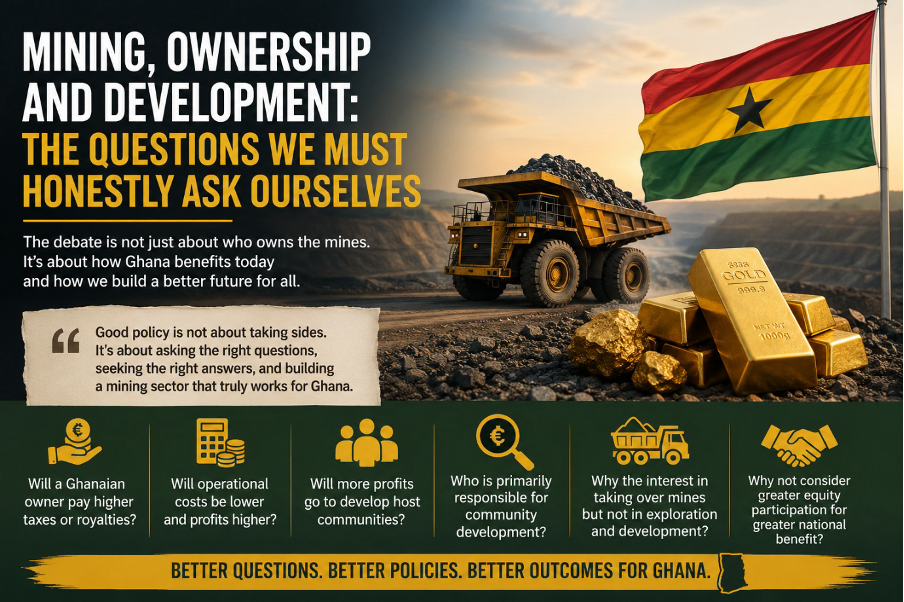
The question is not simply whether a mine should be foreign-owned or Ghanaian-owned. The more important question is: what exactly changes for the ordinary Ghanaian if ownership changes?
If tomorrow a Ghanaian company takes over a mine like Tarkwa, does that automatically mean the company will pay more taxes than the current operator? Will it voluntarily pay higher royalties to the government? Will it reduce its operational costs and somehow make mining cheaper? Will it spend more of its profits on community development while still satisfying banks, investors, lenders, and shareholders? These are not political questions. They are business realities.
Whether a mining company is Ghanaian-owned, South African-owned, Canadian-owned, or Australian-owned, the economics of mining do not change. Mining companies are businesses. They must raise capital, manage costs, pay workers, satisfy investors, and remain profitable to survive.
In fact, if the national objective is for Ghana to derive greater long-term financial benefit from its mineral resources, then another important question arises: why shouldn’t the government consider increasing equity participation in mining operations instead of focusing primarily on taking over mines or rejecting lease renewals?
Equity participation allows the State to directly share in the upside of profitable mining operations through dividends and capital appreciation, while still preserving investment stability and attracting technical expertise and financing. If the government believes certain mines are exceptionally profitable and strategic, then negotiated equity participation may provide a more practical and sustainable pathway to increasing national benefit than creating uncertainty around security of tenure.
This is how many successful resource-rich countries balance sovereignty with investment competitiveness.
That is why simply changing ownership does not automatically solve the development problem. And this brings us to another important question we often avoid asking honestly: who is primarily responsible for developing our communities?
Should mining companies support local development? Absolutely. And many already do. The Gold Fields Ghana Foundation, for example, has reportedly invested almost US$110 million into roads, schools, health facilities, agriculture, water systems, and youth programmes in its host communities over the years.
At the same time, the mining companies operating in Tarkwa reportedly paid about GHS5.1 billion in taxes in 2024 alone. So, we must also ask: after government collects these revenues, how much actually goes back into the mining communities?
If roads are poor, hospitals are inadequate, and communities remain underdeveloped, can we place the entire responsibility on mining companies while the central government retains most of the royalties and tax revenues in Accra? This is where the conversation becomes uncomfortable, but necessary.
The development of communities is fundamentally the responsibility of the State. Private companies can complement development. They cannot replace government.
Another difficult question we must ask ourselves is this: why are many people interested in taking over mines that have already been explored, developed, financed, and made profitable, but there is far less enthusiasm for investing in exploration itself?
Mining starts long before production. Companies spend years, sometimes decades, searching for minerals, conducting geological studies, undertaking environmental assessments, building infrastructure, and raising billions of dollars in financing before a mine even becomes operational. Many exploration projects fail entirely and never become mines.
So, if we truly want greater Ghanaian participation in mining, shouldn’t we also encourage Ghanaian investment in exploration and mine development from the beginning, rather than waiting until someone else has already taken the risk?
This is not an argument against Ghanaian ownership. Far from it. Every Ghanaian should want to see strong local mining companies competing globally. And thankfully, we are beginning to see that happen gradually.
But sustainable Ghanaian participation cannot be built on the perception that Ghana changes the rules once investors have already committed capital under existing laws. That approach may create short-term political excitement, but it could also damage investor confidence and make it harder, not easier, for both foreign and Ghanaian companies to raise long-term financing in the future.
We must also remember our own history. Ghana experimented with heavy state control of mining in the past, and the results were declining production, inefficiency, underinvestment, and eventually the collapse of much of the sector. That history does not mean we should reject reform. But it should remind us that ownership alone is not a magic solution.
Countries that have successfully benefited from mining including Botswana, Canada, Australia, and Chile did not do so simply by excluding foreign participation. They succeeded because they built strong institutions, stable policies, transparent governance systems, and competitive investment environments.
At the end of the day, this debate should not become a contest between patriotism and investment. We can pursue greater Ghanaian participation while still maintaining policy stability and attracting capital.
The real questions we should be asking are:
- How do we ensure more mineral revenues reach mining communities?
- How do we improve accountability in how royalties are used?
- How do we help Ghanaian companies invest from exploration to production?
- How do we create long-term mining policies that survive politics and governments?
- How do we use mining to genuinely transform local economies?
Those are the questions that will determine whether our mineral wealth truly benefits future generations. Because in the end, the issue is not just who owns the mine. The issue is whether the system itself works for Ghana.
Latest Stories
-
Be careful with cross-border lending, foreign currency exposures – BoG to financial institutions
2 hours -
GPL 2026/27: Medeama go three clear as Hearts of Oak recover and Bechem stage stunning comeback
2 hours -
Ntiamoah Foundation launches “BEYOND 20” anniversary campaign
2 hours -
Credit Risk Management Directive: BoG to begin implementation for banks, others from July 1, 2027
3 hours -
Ghana Brands Awards 2026: Leading brands, business trailblazers to shine on November 20
3 hours -
T-bills auction: Demand improves as government exceeds target by about 76%; interest rates soften
3 hours -
Ziope undertakes initiative to build a technologically inclined community, commissions self-help ICT lab
3 hours -
ECG announces power outage in parts of Tema, Central Region due to network fault, maintenance
4 hours -
When the Gospel Becomes a Weapon: The church, blackmail and the abuse of faith
4 hours -
JoyNews’ Jacqueline Ansomah Yeboah selected for UK Media Excellence for Emerging Technologies Fellowship
4 hours -
Mental Health Alliance urges government to operationalise Mental Health Fund
5 hours -
Ghana–Holy See agreement heads to Parliament after Cabinet approval
5 hours -
Luv FM Corporate Games 2026: Kumasi Central Prisons, Amanfiman Bank win big amid fun
5 hours -
WAFU B U17: Ghana top Group A after win over Togo
5 hours -
Ho Central Mosque reopens amid unresolved leadership dispute that led to closure
7 hours