

Audio By Carbonatix
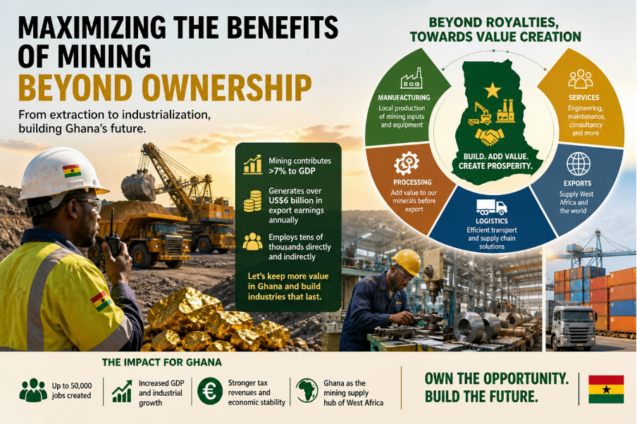
For over a century, mining has been one of Ghana’s economic heavyweights. It contributes over 7% to GDP, generates more than US$6 billion in export earnings each year, and keeps thousands of people employed, directly and indirectly.
On paper, that sounds like a success story. But if we’re being honest, it also feels like we’ve been sitting on a gold mine and still somehow checking our pockets to see where the money went. Despite these impressive numbers, the full developmental potential of mining in Ghana remains unrealised.
Ownership Is Good… But It’s Not the Whole Story
Lately, there’s been a lot of discussion about increasing Ghana’s ownership in mining companies. And yes, ownership matters; it gives control, influence, and a share of profits.
But here’s the thing: ownership alone won’t industrialise Ghana. Dividends go up and down with gold prices. Equity returns depend on company performance. Some years are good, some years, not so much.
So, if we rely only on ownership, we’re basically saying, “We’ll wait and see how the market behaves.” And as we all know, the market has a personality of its own; it doesn’t always send prior notice. The real opportunity lies beyond ownership—in what we build around mining.
Follow the Money—It’s Already There
Every year, mining companies in Ghana spend about US$2.5 billion on goods and services, from machinery and chemicals to safety gear and maintenance.
Now here’s the painful part: a large chunk of that money goes abroad. In simple terms, we dig for gold here, then send money out to buy what we need to keep digging for gold. If Ghana could produce even 40% of these inputs locally, we could retain around US$1 billion every year.
That’s not small change; that’s serious economic power. And interestingly, that amount could exceed what we might gain from tweaking royalties or increasing minority ownership stakes.
So maybe the real question is not “Who owns the mine?” But rather, “Who supplies the mine?”
Let’s Move Beyond Supplying Lunch and Transport
Ghana already has over 400 local suppliers supporting the mining sector. That’s encouraging. But many of them are concentrated in logistics and distribution important, yes, but not where the biggest value lies. The next step is clear: we must move into manufacturing, engineering, and technical services.
Because that’s where the real money is, real skills are built, and the real jobs are created. It’s the difference between delivering equipment and actually producing it.
Policy Alignment: Everyone Must Row in the Same Direction
Here’s where things get serious. Mining alone cannot drive industrialisation. Trade policy, investment strategy, and industrial planning all need to be aligned. In simple terms, the Ministry of Trade, Agribusiness and Industry, the Ghana Investment Promotion Centre, the Minerals Commission, and industry players must stop operating like separate WhatsApp groups and start operating as one coordinated team.
That means incentives for local manufacturing, guaranteed markets through mining companies, industrial zones built near mining areas like Tarkwa and Obuasi and deliberate efforts to attract investors into mining-related industries.
Without coordination, we risk policies that look good on paper but don’t deliver much in practice.
Let’s Talk About Real Opportunities, Not Just Ideas
The opportunities in mining-linked industries are not abstract; they are practical and achievable. Some of these are equipment manufacturing, such as fabricating drill rods, bolts, and spare parts locally. Chemical Production, such as producing inputs like cyanide and ammonium nitrate instead of importing everything, and lubricants and Oils. Others include protective Gear: Supplying boots, uniforms, and safety equipment (and yes, maybe finally making PPE that fits properly), as well as Engineering Services: Building strong local fabrication and maintenance clusters. These are not just industries; they are job creators, skill builders, and export opportunities.
Ghana as a Regional Mining Supply Hub
Here’s where it gets even more interesting. West Africa imports about US$10 billion in mining inputs each year. If Ghana captures just 10% of that market, that’s US$1 billion in exports. Think about that for a second, we could move from just exporting minerals to exporting the tools and services that power mining across the region. That’s a completely different level of economic positioning.
What Could This Mean for Ghana?
If done right, the impact could be transformational: up to 50,000 jobs created; increased GDP contribution from mining-linked industries; more stable and diversified tax revenues and stronger regional trade and influence.
In other words, mining stops being just an extractive sector and becomes a development engine.
It’s Not Just About Who Owns the Gold
The future of mining in Ghana is not just about ownership percentages or royalty rates. It’s about what the economy builds because of mining. Because at the end of the day, gold in the ground is valuable, gold in export is useful, but industries built around gold? That’s transformational. So yes, ownership matters. But if we stop there, we’re leaving too much on the table. And frankly, for a country blessed with so many resources, leaving value on the table is one thing we can no longer afford to do.
Latest Stories
-
Glasner suffers loss on Selhurst return as Palace beat Forest
8 minutes -
WAFU B U17: ‘We won but I expected more from my boys’ – Kassim Ocansey
13 minutes -
Man City cruise to statement win over 10-man Liverpool
22 minutes -
Be careful with cross-border lending, foreign currency exposures – BoG to financial institutions
3 hours -
GPL 2026/27: Medeama go three clear as Hearts of Oak recover and Bechem stage stunning comeback
3 hours -
Ntiamoah Foundation launches “BEYOND 20” anniversary campaign
3 hours -
Credit Risk Management Directive: BoG to begin implementation for banks, others from July 1, 2027
3 hours -
Ghana Brands Awards 2026: Leading brands, business trailblazers to shine on November 20
4 hours -
T-bills auction: Demand improves as government exceeds target by about 76%; interest rates soften
4 hours -
Ziope undertakes initiative to build a technologically inclined community, commissions self-help ICT lab
4 hours -
ECG announces power outage in parts of Tema, Central Region due to network fault, maintenance
5 hours -
When the Gospel Becomes a Weapon: The church, blackmail and the abuse of faith
5 hours -
JoyNews’ Jacqueline Ansomah Yeboah selected for UK Media Excellence for Emerging Technologies Fellowship
5 hours -
Mental Health Alliance urges government to operationalise Mental Health Fund
6 hours -
Ghana–Holy See agreement heads to Parliament after Cabinet approval
6 hours