


Audio By Carbonatix
It was a little after 3 pm when we arrived at St. Peter’s Anglican School in Ofankor.
School had already closed, though the bell had not rung to signal the usual cheerful end to the day.
A few students lingered, some of their uniforms stained with mud, while others trudged home along the roadside.
Earlier that morning, it had rained. Not heavily. Just enough to disrupt everything.
Inside the school compound, a wide, stagnant pool of water had formed right in the middle of the yard. What should be a safe, open space for play and movement has been swallowed up by water. The ground beneath was slippery, caked in mud. Some pathways were nearly impassable.
The aftermath of the rainfall was clear: learning had once again been interrupted. For students and teachers here, this is nothing new.
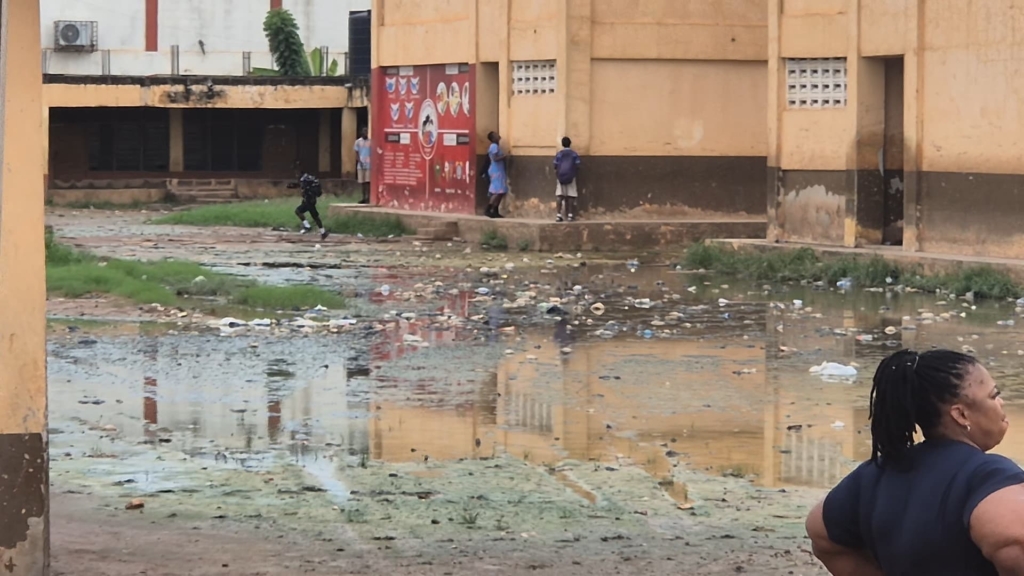
St. Peter’s Anglican School, a basic public school nestled in one of Accra’s many growing communities, has battled flooding for years. Whenever it rains, water collects across the compound due to poor drainage. Classrooms sometimes flood. The playground becomes unusable. And on some days, school has to be dismissed early if it opens at all.
Off camera, a few students quietly expressed their frustration. “We can’t even play anymore,” one said. “The playground is always full of water.”
However, trying to report on the issue openly proved more difficult than expected. During our visit, we were approached by the Assemblywoman for the area, who insisted we stop filming. She claimed we had no right to document the scene, even though it’s a public school facing a public concern.
This reaction underscores a deeper issue: a culture of silence around problems that directly affect children in public schools. Why should students have to navigate flooded grounds and risk injury or illness just to get an education? Why has nothing been done for so long?
Multiple sources from the community say the problem has existed for years without any structural intervention. Drainage in the area is poor, and the school sits on a low-lying plot, turning it into a catchment for runoff whenever it rains.
As urban development continues in Ofankor and similar communities, questions around infrastructure planning and school safety become even more urgent. For the children of St. Peter’s, the rainy season has become a recurring nightmare.
The cost of inaction is high, and it's the children who are paying for it. Each day the water returns, so does the message: their school is not a priority.
Have you seen this at other schools in your community? Share your story with us.
Latest Stories
-
NDC threatens sanctions over oversized campaign posters, gives aspirants 5 days to comply
38 minutes -
Star Oil paid GH¢2.7bn in taxes, levies in nine months of 2026
52 minutes -
Samson’s Take: The rule of law is cheaper before the bulldozer
53 minutes -
GRA blames system failure for delay in issuing receipt over passenger’s customs duty
1 hour -
Livestream: Newsfile discusses World Cup visa scandal, beach demolitions, education strikes, BRICS bid
1 hour -
NC-PTAs welcomes end of teachers’ strike, urges parents to prepare children for Monday
1 hour -
Government procures over 2,000 transformers as Ghana’s electricity access hits 89.13% – Energy Minister
2 hours -
UTAG-UG threatens strike on October 19 over unpaid allowance
2 hours -
Let The Constitution direct Chieftaincy to deliver “All Development Is Local”
3 hours -
John Jinapor outlines renewable energy, nuclear power priorities for 2027
4 hours -
Ghana explores centre of excellence for hearing, communication and cochlear implant care
5 hours -
Schizophrenia-related disorders lead mental health cases recorded in Ghana
5 hours -
Dutch authorities enlist Ghana in hunt for fugitive drug lord Bolle Jos
5 hours -
Ghana housing finance conference adopts communiqué to improve affordable housing access
10 hours -
Special Initiatives Minister urges Wa Technical Institute to enrol more girls as EU-backed solar training lab opens
10 hours