

Audio By Carbonatix
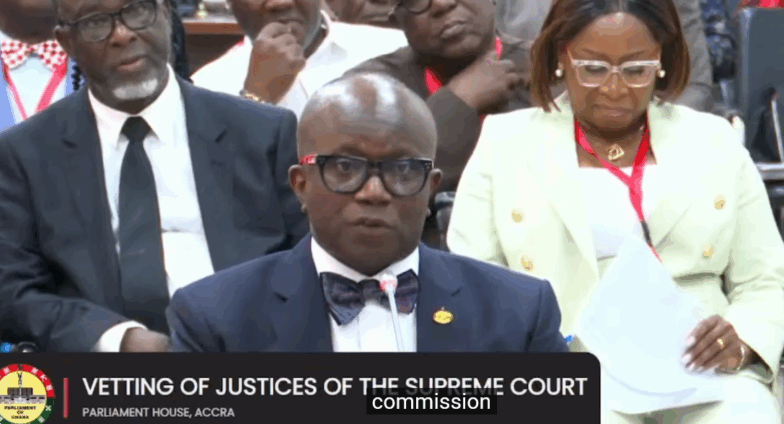
Supreme Court nominee, Justice Eric Kyei Baffour Ackaah-Boafo, says the country’s justice system must not tolerate arrests that are not supported by proper investigations and credible evidence.
Appearing before the Appointments Committee of Parliament on Friday, June 20, Justice Ackaah-Boafo was responding to questions on his previously stated legal opinion criticising the police for arrests made solely on the basis of association or unverified claims by co-accused persons.
“My view is that there is a need to have proper investigations and not a co-arrestee's say-so be the basis for prosecution,” he stated.
Referring to a case in which he gave a concurring opinion, he explained: "Apart from those who were arrested with him, saying that he was part of us, there wasn’t any investigation that was conducted to link the individual. These statements were actually not repeated in court apart from a caution statement.”
Justice Ackaah-Boafo stressed that arbitrary arrests, especially those not backed by credible evidence, undermine public trust in law enforcement and the justice system.
Asked how the judiciary can prevent arrests used to settle personal scores or suppress dissent, he said, “The only way the judiciary can confront this is when presented with a compendium of evidence, assess it and say that there was no basis for this arrest and no basis for the prosecution. If ultimately there’s no evidence, there’s no evidence.”
On institutional reforms needed to prevent abuse of police powers, the nominee urged the Attorney General’s Department and prosecutorial services to develop clearer ethical and operational guidelines for investigators.
“These guidelines ought to come from the Ministry of Attorney General and the prosecutorial services. In other jurisdictions, no matter the charge, if a matter has been unduly delayed, it could be stayed. Should someone stand trial for five years without calling any evidence? These are conversations that we can have,” he added.
Justice Ackaah-Boafo also acknowledged that until a case is formally filed in court, the judiciary’s power to intervene in investigative excesses is limited, but emphasized the need for broader legal reforms to uphold justice and human rights.
Latest Stories
-
Greening must be part of Ghana’s development, not an afterthought – Prof Naana Jane
60 minutes -
ECG procurement is where politicians ‘milk’ the company – Ben Boakye
1 hour -
IPPs’ contractual arrangements partly to blame for energy sector problems – TUC’s Dr Otoo
1 hour -
Like Benzema & as good as Haaland – Alonso on Joao Pedro
1 hour -
Check out 41 countries Ghanaians can visit without a visa on ordinary passports
2 hours -
I disrupted pre-season travel plans to prepare players – Arteta
2 hours -
Richarlison’s move to Vasco da Gama falls through
2 hours -
Dictator meme shows lack of human awareness – Mbappe
2 hours -
2030 World Cup: Moroccan official told to stop making 2030 final promise
2 hours -
Mourinho compares Mbappe and Vini Jr to fruit trees after boos
2 hours -
Lewis Hall signs new contract with Newcastle until 2031
2 hours -
Signed instead of Rashford, Gordon is proving worth at Barca
2 hours -
2026 BECE automatic placement rate hits 87.3%, highest since 2021 — CSSPS data
2 hours -
Ghanaian youngster Zayan Omar joins Spanish side Málaga
2 hours -
New Man City signings desperate to win – Dias
3 hours