

Audio By Carbonatix
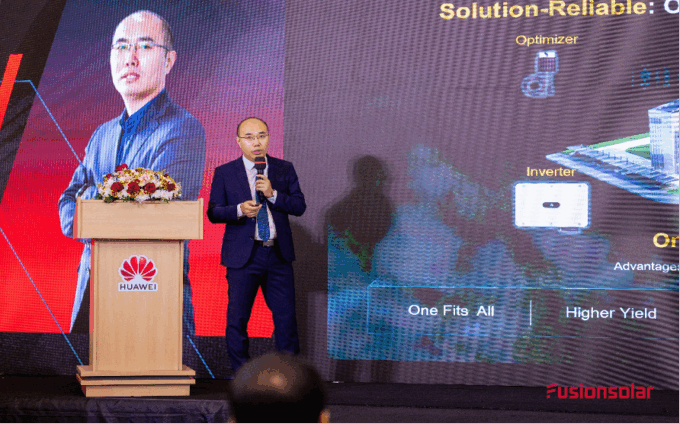
Huawei Ghana has launched a new wave of clean energy innovations, unveiling the world’s first hybrid cooling Energy Storage System (ESS) at its 2025 Partner Summit and Commercial & Industrial Product Launch in Accra.
Themed “Lighting Up A Greener Ghana”, the event showcased solar solutions designed to tackle Ghana’s energy challenges and fast-track its transition to a low-carbon future.
Bob Wang, Director of Huawei Ghana Digital Power, said the timing is critical.
He pointed out that while Ghana’s electricity access rate is relatively high at 85–87%, other West African neighbours like Liberia and Sierra Leone trail at around 60%. Compounding the problem are soaring electricity costs, with Ghana recording a 40% tariff hike in 2025 alone.
Mr Wang noted that clean energy is no longer out of reach.
“The cost of solar panels and batteries has significantly dropped,” he said.
“Solar panel prices have fallen by 50% in the past two years, and raw materials for batteries by up to 85%.”
He highlighted a growing trend where companies are installing rooftop solar to become energy producers, not just consumers.
Backing this push, Julius Nkansah-Nyarko, Senior Manager for Renewable Energy Regulation at the Energy Commission, praised Huawei’s leadership in the sector.
He revealed that renewable energy currently contributes just under 5% of Ghana’s installed capacity, with distributed generation—especially rooftop solar—making up 86.5 megawatts.
He also announced a major national rollout of net metering starting this year.
The plan aims to equip 12,000 public facilities, 4,010 households, and 6,000 SMEs with solar systems to reduce dependence on the national grid.
The highlight of the launch was the introduction of Huawei’s ESS 250—hailed as the first in the industry to use a hybrid of air and liquid cooling.
According to Sampson Zickson, Senior Business Development Manager at Huawei Ghana Digital Power, this design offers better battery temperature control, longer lifespan, and greater safety.
“The system automatically switches between air and liquid cooling, cutting auxiliary power use by 30%,” he said.
Other key features include a round-trip efficiency of 91.3%—the highest in the industry—a ten-year battery lifespan with 75% health retention, and an advanced safety system with six-sided insulation and multi-level shutdown protection.
The ESS also cuts installation time to just two hours and eliminates the need for third-party cooling setups.
Zickson also spotlighted Huawei’s social impact, noting that over 75,000 women and girls have received training in ICT and clean energy technologies through the company’s programs.
The summit reaffirmed Huawei’s two-decade presence in Ghana, employing over 300 locals and making long-term investments in digital and energy infrastructure.
“Our mission is to provide reliable, innovative energy solutions that support Ghana’s transition to clean power,” Wang said.
With its latest launch, Huawei signals a strong commitment to helping Ghana achieve energy resilience, sustainability, and a greener economy.
Latest Stories
-
Standards are not Seasonal: What the EC appointments teach both sides
54 seconds -
King Mohammed VI urges private sector to create youth jobs and spread benefits of growth
2 minutes -
UK Investment Roadshow opens in London to advance UK-Ghana growth partnership
13 minutes -
Assemblies of God requires pastors to resign before entering partisan politics – Rev. Wengam
23 minutes -
Ghana targets 20% annual reduction in maternal deaths – Health Minister
28 minutes -
Cyber attacks in Africa grow faster than global rate, report finds
30 minutes -
Ghana signs UAE deal to create 5,000 overseas jobs
37 minutes -
One Million Coders Programme targets 100,000 digital jobs in two years – Sam George
40 minutes -
John Jinapor, Italian Ambassador explore opportunities for energy sector investment
42 minutes -
NHIA seeks legal reforms to support Free Primary Healthcare
46 minutes -
Beatrice Annan defends Afi Agbenyo’s EC appointment, cites record of gender advocacy
49 minutes -
Ghana seeks investment deals in Bangkok amid global economic crises
53 minutes -
IMF raises Ghana’s 2026 growth forecast to 5.7%, sees inflation falling to 4.8%
54 minutes -
Ablakwa urges Africans not to view immigrants as threat to national progress
59 minutes -
Mahama Cares must fund treatment, not looting – Asogli chiefs
60 minutes