

Audio By Carbonatix
Kenya aims to carry out a pioneering $1 billion debt-for-food security swap by March next year, a finance ministry document showed on Tuesday, as the country looks to novel solutions to ease its hefty debt burden.
The plan is expected to work in a similar way as so-called debt-for-nature swaps carried out by several countries in recent years that offered lower interest rates in exchange for nature protection.
A debt-for-food swap would likely allow a country to replace costly existing debt with lower-cost financing on condition it channels the savings towards programmes to boost food security, finance experts say.
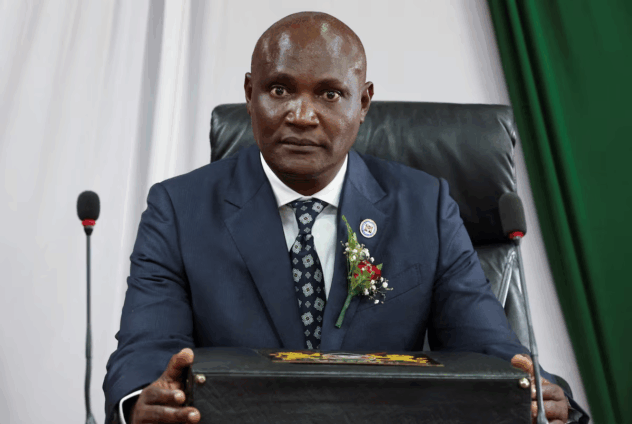
Officials at the Finance Ministry could not be reached for comment, but Finance Minister John Mbadi told a local television station earlier this year the government was in advanced discussions on a swap involving the World Food Programme's participation.
President William Ruto's government spends roughly one-third of its revenue on interest payments - one of the highest ratios in the world - and is eager to bring debt spending down.
Debt swap agreements with a focus on social or environmental benefits are becoming an increasingly popular financing tool in poorer parts of the world. Countries including Ecuador, Belize and Gabon have undertaken debt-for-nature deals in recent years.
Ivory Coast completed the first major evolution of the model last December with a debt-for-education swap with the help of a World Bank "credit guarantee". Guarantees are included to persuade creditors to lower borrowing costs.
Kenya, which is East Africa's biggest economy, had a total public debt equivalent to 67.8% of its GDP at the end of June this year, the Finance Ministry said in the document, which is called an annual borrowing plan.
The government also plans to borrow $500 million using sustainability-linked bonds by March 2026, a World Bank loan of $757 million by March next year and another loan of $457 million in June, the document showed.
It is also looking to cut its debt costs by turning to securitised debt and converting a $5 billion rail loan into the Chinese currency, it has said recently.
Latest Stories
-
Meko Bono 2026: Vice President pledges agricultural revival as Atebubu hosts grand homecoming
35 minutes -
Russian skydiver Sergey Boytcov sets world record with 11,551-metre stratosphere jump
39 minutes -
Ablakwa-led committee submits five reports to Mahama ahead of 2027 AU chairmanship
45 minutes -
Africa not seeking Western cash in reparations campaign – Ablakwa
1 hour -
Production decline, reserve depletion threaten Ghana’s upstream sector – Jinapor
1 hour -
Surveyors caution against treating compensation disputes as professional misconduct
1 hour -
Mahama calls for AU dialogue on migration after South Africa xenophobic tensions
1 hour -
I haven’t experienced any envy in the gospel music industry — Ohemaa Mercy
3 hours -
Prayer does not solve everything — Ohemaa Mercy
3 hours -
New PURC office symbolises stronger consumer protection – Dr Jinapor
3 hours -
Rev. Wengam re-elected Assemblies of God, Ghana General Superintendent
3 hours -
Less than 20km of clearing left to connect Accra-Kumasi Expressway to Kumasi – Agbodza
4 hours -
US judge strikes down policy suspending immigrant visa processing for 75 nations
4 hours -
MCEs collecting fees from galamseyers are facilitating illegality – Ken Ashigbey
4 hours -
Developer LMI Holdings commits to completing first 700 Saglemi housing units
4 hours