

Audio By Carbonatix
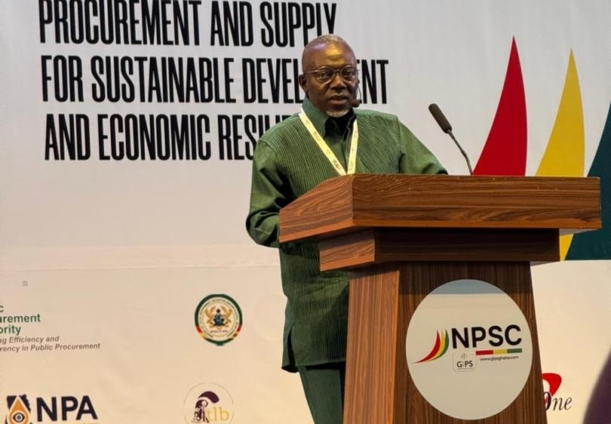
Chartered Director and governance strategist, Professor Douglas Boateng, has urged Ghana to professionalise procurement through legislation, licensing, and strict standards to curb waste, boost industrialisation, and transform public budgets into lasting national assets.
Speaking at the National Procurement Summit at the University of Professional Studies, Accra (UPSA), Prof Boateng cautioned that the country cannot continue treating procurement casually.
“No one boards a plane with an unlicensed pilot or submits to surgery by an unlicensed surgeon,” he stated. “Yet every day we entrust national budgets to people who are not licensed procurement professionals. That business as usual is costing us schools, clinics, factories, jobs, and public trust.”
To address these challenges, Prof Boateng proposed the passage of an Act of Parliament to regulate the procurement profession, the creation of a Procurement and Supply body to license practitioners, and stronger safeguards to protect professionals from undue political or corporate pressure.
He further called for procurement to be positioned as a strategic tool for industrialisation, tying major contracts to local content and enforcing life-cycle costing to reduce waste.
“Professional procurement is the first machine on the factory floor,” he said. “Without reforms, industrialisation will remain a speech rather than a reality.”
Citing examples from South Korea, Norway, and Singapore, Prof Boateng explained how these countries strategically used procurement to build industries and grow national wealth.
“They did not wait for miracles. They used purchase orders as tools and contracts as classrooms. We can do the same,” he stressed.
He urged leaders to make procurement reform a national priority. “Leaders cannot fix everything at once. Fix procurement first. Appoint qualified people, give them authority and protection, set a clear charter linking purchasing to service reliability and industrial goals, publish simple dashboards, replace those who will not learn, and reward those who deliver,” Prof Boateng advised.
“Procurement is not a clerical corner. It is where analysis becomes nation-building. The purchase order is a policy tool. Use it wisely, and you will write development into daily life,” he concluded.
Latest Stories
-
Government promises support for Kumasi Central Market fire victims
2 minutes -
Vibes The Movie: Big Ghun’s Ghanaian film earns five nominations at 2026 REFFA
32 minutes -
MamaCare CEO warns unresolved conflicts among health workers could undermine maternal and neonatal care
56 minutes -
Health professionals urged to translate medical knowledge into practice to save mothers
1 hour -
Conflicts among care providers linked to maternal, neonatal deaths – Expert
3 hours -
GIS marks 10th TIME conference, champions improved teaching practices
3 hours -
BRICS Or Balance? What Ghana’s bid really means
3 hours -
GPRTU wants full TRAFFITECH-GH implementation to start in 2027
3 hours -
Mahama announces plans to import electric wheelchairs for PWDs
4 hours -
KGL U17 Colts 2026: Western beat Prempeh Elite Academy to set up final final with Greater Accra Region
4 hours -
Late Solanke strike salvages 10-man Spurs draw at Man United
4 hours -
Gender Ministry to monitor welfare of Nana Akua Addo’s children amid domestic violence case
4 hours -
Benedict Okyere Yeboah: Ghana’s football problem goes beyond sacking a coach
4 hours -
GPL 2026/27: Darkwah Wiafe’s winner sees All Blacks beat Kotoko
4 hours -
ITF World Tour : Patel Wins Boys’ Singles Final at J100 Accra
5 hours