

Audio By Carbonatix
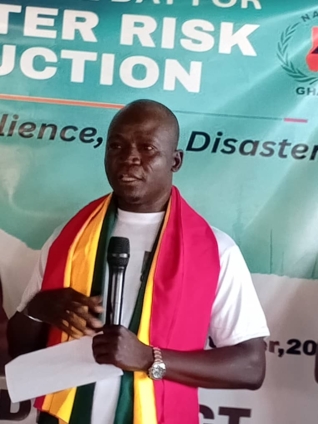
The Acting Bongo District Director of the National Disaster Management Organisation (NADMO), Patrick Anamoo Akuntubgo, has called for a shift from reactive disaster response to proactive investment in resilience and preparedness.
He said disasters often strike suddenly and with devastating consequences, but with proper planning, community involvement and the right investments in early warning systems, education and infrastructure, their impacts could be greatly reduced.
“Disasters do not wait. They strike with speed and at an upsetting cost. But the good news is that disasters may be sudden, but they are always predictable,” he stated, adding that prevention remains the most effective and sustainable approach to saving lives and resources.
Mr Akuntubgo made the call at a ceremony in Bongo to mark this year’s International Day for Disaster Risk Reduction, observed globally every October 13 to raise awareness on strategies for minimising the impact of disasters on lives and livelihoods.

The day was characterised by a route march and awareness creation about disasters, with participants holding placards with inscriptions “Fund resilience, not disaster 2025,” “Fire prevention is key to safety tomorrow,” among others.
He said the theme for this year’s International Day for Disaster Risk Reduction, “Fund Resilience, Not Disasters,” speaks directly to the urgent need for governments, development partners and communities to prioritise disaster prevention measures rather than waiting for calamities to occur before acting.
The Acting Director lamented that too often, resources were only mobilised after disasters had occurred, noting that this approach was not sustainable, stressing the urgent need to invest in preventive measures.
“What if we invested that money before the disaster? What if those funds went into building stronger houses, training our youth in emergency response, restoring degraded lands, or building dams and irrigation systems to withstand climate shocks?” he asked.
Mr Akuntubgo noted that the Bongo District continued to experience challenges such as erratic rainfall, floods, droughts, bushfires and poor waste management, which increased the vulnerability of communities.
However, he emphasised that the people of Bongo were resilient, and their resilience must be matched with resources, planning and political will, assuring that the NADMO in the district was committed to shifting focus from disaster response to risk reduction through education, community engagement and partnerships.
He mentioned that his outfit was strengthening community education and awareness through the creation of zonal offices, training of disaster volunteer groups, collaboration with local authorities and youth groups, and establishment of school-based disaster clubs.
He added that NADMO was also working closely with development partners to channel resources directly to vulnerable communities to improve their preparedness and response capabilities.
Mr Akuntubgo called on all stakeholders, including government institutions, civil society organisations, the media and the private sector, to support the agenda of building resilience, stressing that “disaster risk reduction is not a cost, it is an investment.”
He further appealed to policymakers to make disaster risk reduction a budgetary priority, urged donors and development partners to focus more on long-term resilience rather than emergency relief, and called on community members to embrace safer environmental and social practices.
To the youth, he encouraged active participation in climate action and environmental protection, describing them as the future custodians of community safety and sustainability.
He said, “Let the world know that in the Bongo District, we will not wait for disaster to strike. We will prepare, we will plan, and above all, we will invest in resilience,” to build a future where the people are not victims of disasters, but designers of their own safety and survival.
Latest Stories
-
Finance Minister advises African governments to strengthen regional tax cooperation
9 minutes -
NPP accuses NDC of master-minding demolition of Ho regional office fence
9 minutes -
Ghana plans stronger regional power trade with Nigeria
10 minutes -
GRA Commissioner-General calls for stronger tax cooperation to boost regional revenue mobilisation
11 minutes -
NACOC needs more personnel to tackle drug trafficking – Toobu
14 minutes -
Railway workers resist KMA eviction order, demand consultation
16 minutes -
Legacy Leadership Africa Institute to host boardroom women’s leadership programme
28 minutes -
Ghana needs a law to sustain constitutional reforms – CDD-Ghana
4 hours -
COVID fumigation audit: Auditor-General has a lot of questions to answer – Akwatia MP
4 hours -
Stranded Ghanaian medical graduates in Cuba appeal to Mahama for immediate return
4 hours -
GNFS contains fire outbreak at Teshie Lekma Road near Lekma Hospital
10 hours -
Samia Nkrumah rejects the narrative that Ghanaians were happy after Nkrumah’s overthrow
11 hours -
A Mother’s pain: Tribute by Ivan Baidoo’s mother
11 hours -
‘Forgive us for staying away’ — Samia Nkrumah leads family back to Nkroful, pledges to preserve Nkrumah’s legacy
12 hours -
Ernest Nuamah scores twice as Lyon beat Rennes
12 hours