

Audio By Carbonatix
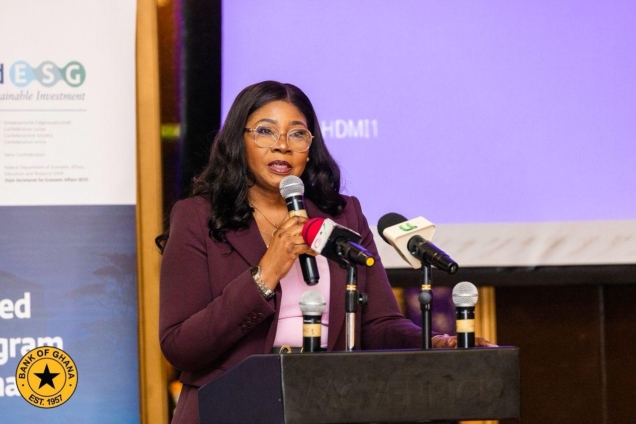
The Second Deputy Governor of the Bank of Ghana (BoG), Matilda Asante-Asiedu, has urged financial institutions to balance profit-making with sustainable investment practices, particularly in the country’s extractive sector.
Speaking at a forum on sustainable banking practices, she underscored the importance of looking beyond short-term financial gains and considering the long-term socio-economic and environmental impacts of financing decisions.
“I was just doing the math. Between mining and oil and gas, in the first half of this year, their contribution to GDP amounts to 20 percent,” she noted. “That’s significant. It’s the backbone of the economy.”
While acknowledging the crucial role these sectors play in driving Ghana’s economic growth, Mrs. Asante-Asiedu also highlighted the inherent risks they pose. She urged financial institutions to shift their mindset away from solely maximizing shareholder value.
“But it also comes with its own issues and risks. As people in the financial services sector, our objective is profit-making. Especially in a commercial environment like I used to be in, where it’s often about making shareholders happy,” she said.
She challenged players in the financial space to adopt a forward-thinking approach, stressing the need to integrate environmental, social, and governance (ESG) considerations into their lending practices.
Her remarks come at a time when Ghana is intensifying its push for green finance and sustainable banking. The Bank of Ghana recently reported a 73.6 percent compliance rate with sustainable banking standards as of the first quarter of 2025, signaling growing commitment to environmentally responsible financing.
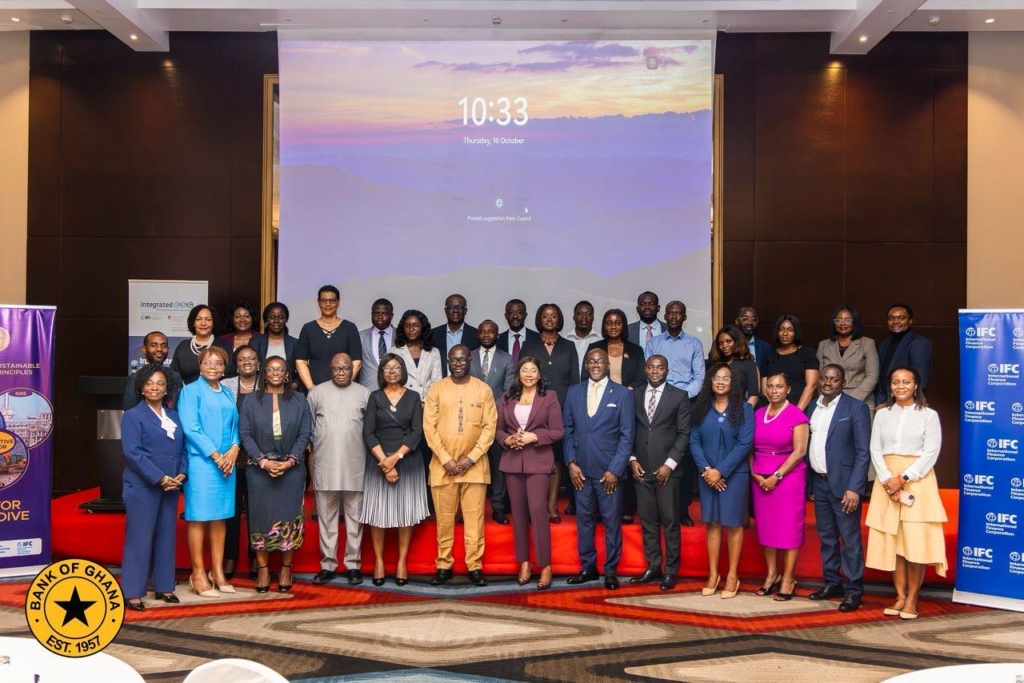
The forum brought together key stakeholders from the banking, extractive, and development sectors to deliberate on strengthening sustainability frameworks within the financial industry.
John Awuah, CEO of the Ghana Association of Banks, called for reforms to de-risk sustainable projects in the extractive and energy sectors, which are often deemed high-risk and capital-intensive. He proposed the introduction of political risk insurance products and other incentives to reduce exposure.
“Access to sustainable finance is often constrained by high perceived risks and limited long-term funding. This is where de-risking mechanisms become indispensable. We must actively explore and scale up tools such as partial credit guarantee schemes,” he noted.
Meanwhile, Yiwande Giwa, Senior Country Manager for the International Finance Corporation (IFC), expressed optimism that continued engagement would be crucial in building an environmentally sustainable financial ecosystem.
The forum was jointly organized by the Bank of Ghana and the International Finance Corporation (IFC).
Latest Stories
-
AG proposes Bar Welfare Fund to provide social protection for lawyers
57 seconds -
Tales from abroad: Returning home is not always the remedy
2 minutes -
GES opens applications for non-teaching staff promotion; here’s who qualifies
16 minutes -
What Is Wrong With Us: We fly halfway around the world to admire discipline, then fly home to tolerate chaos
18 minutes -
Discipline must not become abuse in raising children – ARK Foundation
25 minutes -
Photos: Culture, technology and cuisine take centre stage at Russia’s youth festival
27 minutes -
‘Who approved Laboma structures?’ – Victoria Bright calls for review of permitting system
33 minutes -
“The Darkest Chapter”: Latif Abubakar’s 21st production brings President Mahama’s UN reckoning to the National Theatre stage
36 minutes -
Teacher, three others investigated over alleged kidnapping of suspected MoMo fraudster in Kumasi
37 minutes -
Afenyo-Markin mourns Bernice Offei, describes her songs as ‘sermons set to music’
37 minutes -
Don’t just learn AI tools, use them to improve productivity – ALX Enterprise
44 minutes -
Free rabies vaccination campaign targets 25,000 dogs and cats nationwide
50 minutes -
Ghana needs a system to track child protection funding to where risks are highest – ARK Foundation
53 minutes -
AI may not replace humans, but workers who fail to adapt could lose jobs – ALX Enterprise
55 minutes -
Gideon Boako: Bretton Woods is fraying; Ghana has built a bridge
56 minutes