

Audio By Carbonatix
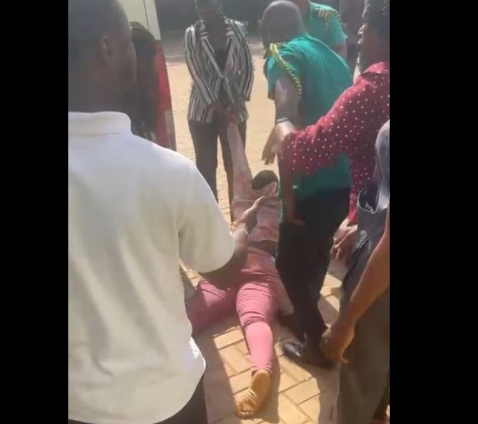
A dramatic and tense situation unfolded at the VICSEM Hotel in Ogbojo, Accra, on Tuesday afternoon, November 11, 2025, as Ghana Immigration Service (GIS) officials attempted to forcibly remove a group of deportees recently repatriated from the United States.
Eyewitnesses at the scene reported that the effort to relocate the deportees, who are part of an ongoing arrangement between the U.S. government under President Donald Trump and Ghana, generated confusion and significant distress among the returnees.
Immigration officials were spotted in viral videos dragging a woman on the floor into a waiting vehicle.
The intention of their action is not clear but the attempted removal suggests officials were trying to move the individuals from the hotel facility where they were initially accommodated upon arrival.
The incident highlights the sensitive nature of Ghana’s agreement to receive its citizens deported from the U.S.
The current group arrived as part of a deal governed by a Memorandum of Understanding (MOU) with the United States.
Crucially, the government maintains that this arrangement is legally binding but does not require parliamentary ratification, distinguishing it from treaties or defence agreements.
Ghana's decision to accept the deportees has been publicly framed as being driven purely by humanitarian concerns, responding to reports of harsh treatment and poor conditions faced by deportees from abroad.
The confrontation at the hotel comes amid heightened political scrutiny over the repatriation policy.
The government had previously faced sharp criticism from the Minority in Parliament following the earlier acceptance of a group of 14 deportees.
The Minority accused government officials of attempting to sidestep parliamentary approval for the controversial arrangement.
This apprehension is compounded by the recent announcement from the Minister of Foreign Affairs, Samuel Okudzeto Ablakwa, that Ghana was expecting an additional 40 West African deportees from the United States.
In a related development, a human rights lawyer and legal representative to some of the deportees, Oliver Barker-Vormawor, is alleging that Ghana is now facilitating the return of these individuals to their home countries, where their lives are at risk.
Barker-Vormawor's post highlights that the U.S. government cannot legally deport these individuals directly to their home countries because they have been "granted protection" based on a "genuine fear of persecution."
By accepting them, Ghana essentially becomes an intermediary.
Latest Stories
-
Nvidia boss rejects AI extinction fears as ‘doomsday narratives’
3 hours -
Workers came across human remains – and unearthed a mass grave of 572 people
3 hours -
Each Jehovah’s Witness member now decides whether to accept or donate main blood components
4 hours -
Trump says US will form ‘AI Force’ and appoint an artificial intelligence tsar
4 hours -
Google’s Gemini AI hacked three companies in security test
4 hours -
Converse pulls ‘deeply upsetting’ advert after backlash
4 hours -
Warren Buffett steps down after six decades at Berkshire – ‘Father Time always wins’
4 hours -
Billionaire Man United owner says he has lost confidence in the UK
4 hours -
I have experienced racism a thousand times – Lamine Yamal
5 hours -
Ipswich Town investigates racist abuse of Fatawu
5 hours -
Man City battle past Sunderland in eight-goal thriller
5 hours -
Neville calls Man Utd ‘pathetic’ – but Carrick maintains belief
5 hours -
Cunha rescues point for Man United at Fulham
5 hours -
Government has improved sanitation in one-and-a-half years — Salaga South MP
5 hours -
Impressive defence behind Iraola’s solid Liverpool start
5 hours