

Audio By Carbonatix
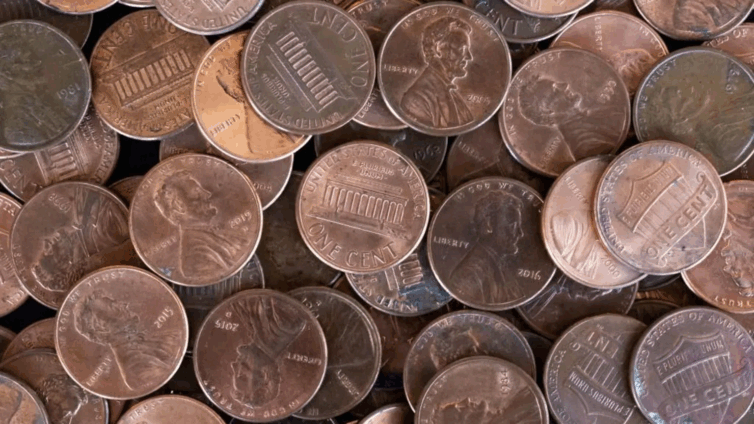
The US is set to make its final penny.
The Philadelphia Mint will strike its last batch of one-cent coins on Wednesday, after more than 230 years of production.
The coins will remain in circulation, but the phase-out has already prompted businesses to start adjusting prices, as they say pennies are becoming harder to find.
The government says the move will save money, or as President Donald Trump put it in February when he first announced the plans: "Rip the waste out of our great nation's budget, even if it's a penny at a time".
Pennies, which honour Civil War president Abraham Lincoln and are made of copper-plated zinc, today cost nearly four cents each to make — more than twice the cost of a decade ago, according to the Treasury Department. It estimates the decision to end production will save about $56m a year.
Officials have argued that the rise of electronic transactions is making the penny, which first went into production in 1793, increasingly moot.
The Treasury Department estimates that about 300 billion of the coins will remain in circulation, "far exceeding the amount needed for commerce".
Many pennies end up falling out of use. About 60% of all coins in circulation in the US - or about $60-$90 for the typical household - sits stashed at home in piggy banks, deemed not worth trading in, according to a 2022 government analysis.
But penny-pinchers beware: as businesses start rounding up prices, the move is expected to raise costs for shoppers. One study by researchers at the Richmond Federal Reserve estimated that it could cost consumers $6 million annually.
Other countries have also phased out their lowest value coins. Canada, for example, made its last batch of one cent coins in 2012.
Australia and New Zealand retired one and two cent coins in the 1990s, and New Zealand stopped production of five cent coins in 2006.
The UK floated a plan to scrap 1p coins in 2018, though the proposal was later withdrawn.
But the rise of electronic transactions did prompt the UK to halt production of coins in 2024, after officials decided there were sufficient 1p and 2p coins in circulation.
In the US attention has now turned to the nickel, which has a face value of five cents but costs nearly 14 cents to produce.
Retiring that coin would have a far bigger impact on shoppers, costing consumers some $55m per year, according to the Richmond Fed study.
Latest Stories
-
Black Stars must win next game against Côte d’Ivoire – Carlos Queiroz
31 minutes -
Global Game Scouting Tournament set for September 25 kick-off in Accra
54 minutes -
Queiroz outlines long-term plan to rebuild Black Stars for 2030 World Cup
1 hour -
‘Most important trophy now is the next game’ – Carlos Queiroz
2 hours -
Ahafo Ano South West DCE laid to rest as Muslims hold final prayers
3 hours -
Ghanaian professor Kofi Akamani shot dead in US; wife arrested
3 hours -
Sammy Gyamfi says 2018 NACOC removal from port inspections weakened drug checks
3 hours -
Greater Accra region accounts for 77% of total secured credit in half-year 2026 – BoG
3 hours -
Founder’s Day: We face forward, but are we moving?
3 hours -
Sheenah Naturals unveils Akuaba Collection at Beauty Inside Out Conference
4 hours -
T-bills: 91-day, 364-day yields to trade slightly higher in second half of 2026
4 hours -
Black Stars: It’s our decision to leave Kudus to recover – Queiroz
4 hours -
Sammy Gyamfi backs Mahama’s directive to restore NACOC’s at ports
4 hours -
Queiroz provides insight into Kudus’ decision to withdraw from Black Stars squad
4 hours -
I’m not changing after 47 Years – Queiroz fires back at critics
4 hours