

Audio By Carbonatix
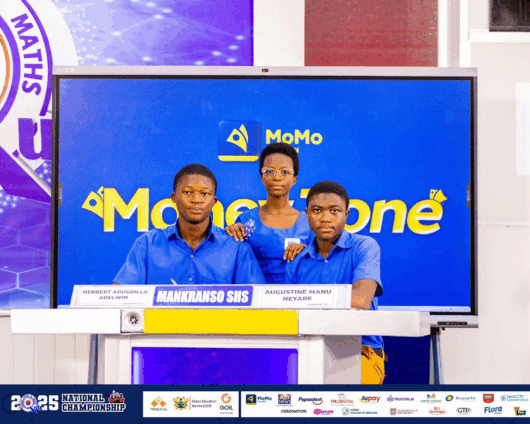
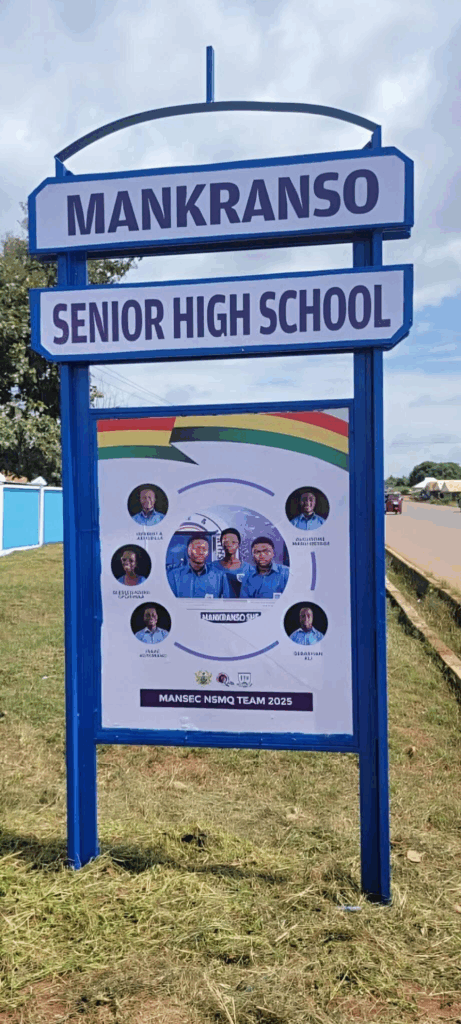
Education Minister Haruna Iddrisu has announced that Mankranso Senior High School will be upgraded following its exceptional performance in the 2025 National Science and Maths Quiz (NSMQ).
Speaking at a media briefing on Wednesday, November 19, the Minister said the school’s achievement deserves national recognition. “We will expand the number of Category A schools, and on my way here, I have added Mankranso Senior High School based on their performance at the 2025 National Math and Science Quiz,” he stated.
He praised the students for excelling despite limited resources. “My heart is warmed to reach out to them to know that the country appreciates that, given the deprivation, they have demonstrated excellence in academic pursuit,” he added.
Mankranso SHS, a Category C school in the Ahafo Ano Southwest District of the Ashanti Region, defied all odds to reach the semifinals of the 2025 NSMQ for the first time. Their achievement has drawn national attention, especially given the school’s long-standing infrastructural challenges. Some teachers have described the school as an “advanced JHS” due to its poor facilities.
From worn-out classrooms to the bright national stage, Mankranso SHS proved that brilliance can emerge from difficult conditions—and that with the right support, even more can be achieved.
Mr Iddrisu said the upgrade forms part of a broader government plan to restructure the school categorisation system. He revealed that the government intends to upgrade 10 Category B schools to Category A and 10 Category C schools to Category B, while providing additional support to schools showing exceptional promise.
He highlighted similar cases, such as a school in Kade in the Eastern Region, where a student recently won the Best Science Student award despite the absence of a science laboratory. “I’ll reward them with a laboratory into next year,” he promised.
The Minister also reflected on wider challenges in the secondary education sector, pointing to the impact of the former double-track system. He argued that the arrangement affected quality because students had fewer contact hours with teachers. “You remember double track?” he asked. “It necessarily and avoidably contributed to the low quality of education because the number of hours spent by students and teachers was affected. Many of the girls and boys spent more time at home and less time in school.”
To help close these gaps, he announced a new flagship initiative—the Ghana Secondary Learning Improvement Programme—supported by the World Bank with a US$180 million investment. “The World Bank team is in town,” he said, explaining that they are assessing facilities nationwide and will help complete some of the abandoned E-block schools.
Latest Stories
-
Government promises support for Kumasi Central Market fire victims
3 minutes -
Vibes The Movie: Big Ghun’s Ghanaian film earns five nominations at 2026 REFFA
34 minutes -
MamaCare CEO warns unresolved conflicts among health workers could undermine maternal and neonatal care
58 minutes -
Health professionals urged to translate medical knowledge into practice to save mothers
1 hour -
Conflicts among care providers linked to maternal, neonatal deaths – Expert
3 hours -
GIS marks 10th TIME conference, champions improved teaching practices
3 hours -
BRICS Or Balance? What Ghana’s bid really means
3 hours -
GPRTU wants full TRAFFITECH-GH implementation to start in 2027
4 hours -
Mahama announces plans to import electric wheelchairs for PWDs
4 hours -
KGL U17 Colts 2026: Western beat Prempeh Elite Academy to set up final final with Greater Accra Region
4 hours -
Late Solanke strike salvages 10-man Spurs draw at Man United
4 hours -
Gender Ministry to monitor welfare of Nana Akua Addo’s children amid domestic violence case
4 hours -
Benedict Okyere Yeboah: Ghana’s football problem goes beyond sacking a coach
4 hours -
GPL 2026/27: Darkwah Wiafe’s winner sees All Blacks beat Kotoko
4 hours -
ITF World Tour : Patel Wins Boys’ Singles Final at J100 Accra
5 hours