

Audio By Carbonatix
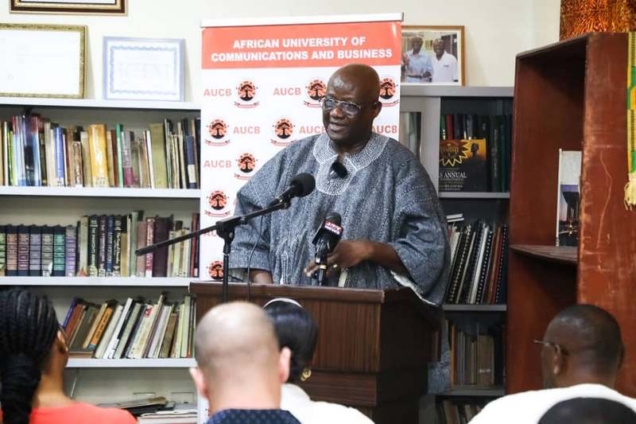
Mr Awentami Paul Afoko has urged young Ghanaians to embrace the courage of non-conformists, warning that the country’s progress depends on citizens who are willing to stand out, resist societal pressure, and question decisions before accepting them.
Speaking at the fifth Dialogue Public Lecture held at the Ama Ata Aidoo Centre for Creative Writing at the African University of Communications and Business (AUCB) on November 21, 2025, Mr Afoko said true national transformation will not come from people who simply “join the chorus,” but from those bold enough to challenge norms and refuse to be intimidated by fear or power.
“Living as a non-conformist in a conformist world means refusing to be swallowed by the crowd,” he told the audience. “The ability to question actions before they happen is the trait the youth must adopt if Ghana truly wants progress.”
Mr Afoko acknowledged that non-conformists often face difficulties, but argued that these very struggles are what drive national growth. He cautioned that widespread corruption and the persistence of tribalism remain major threats to development.
“Corruption is everywhere, but when corruption becomes normal and tribalism becomes fashionable, then we have a problem,” he said. “Sadly, tribalism is still around. That is why the youth must stand out and speak the truth even when it is hardest to do so.”
He warned that silence from the country’s brightest minds creates space for mediocrity to dominate public life.
“If the distinguished minds of this country keep quiet, mediocrity will take over,” he said. “And when that happens, the entire nation loses.”
Calling on the youth to recognise the responsibility that comes with standing out, he emphasised that non-conformity is not arrogance, but duty.
“Standing out is being responsible,” he noted. “You might not be noticed today, but you will be noticed eventually. The future belongs to those who refuse to be swallowed by the crowd.”
Mr Afoko added that conformity destroys innovation, justice, growth and progress, warning that if mediocrity becomes acceptable, the nation risks disaster—because intellectuals would then rely on mediocre voices to make laws and policies shaping Ghana’s destiny.
His message echoed the central theme of the lecture: that Ghana’s future depends on courageous citizens ready to challenge harmful norms, defend integrity and insist on accountability.
Latest Stories
-
Mohammed Kudus drops out of Ghana squad for AFCON 2027 qualifiers against Côte d’Ivoire and Gambia
17 minutes -
Africa World Airlines unveils first Embraer E190 as part of 10-aircraft fleet expansion
1 hour -
Civilian hospitalised after alleged machete attack by prison officers, inmates
2 hours -
Toobu rejects calls to recall Parliament over 3.9-tonne cocaine shipment
2 hours -
Residents in 5 Northern Regions warned of approaching rainstorm
2 hours -
Constituency Games still a work in progress – Sports Minister
3 hours -
Team Ghana set for historic Karting Africa Showrun in Angola
3 hours -
52-year-old South African arrested with suspected heroin after arriving from Accra
3 hours -
Shatta Wale challenges UPSA students to build entrepreneurial mindsets
4 hours -
Finance Minister advises African governments to strengthen regional tax cooperation
5 hours -
NPP accuses NDC of master-minding demolition of Ho regional office fence
5 hours -
Ghana plans stronger regional power trade with Nigeria
5 hours -
GRA Commissioner-General calls for stronger tax cooperation to boost regional revenue mobilisation
5 hours -
NACOC needs more personnel to tackle drug trafficking – Toobu
5 hours -
Railway workers resist KMA eviction order, demand consultation
5 hours