

Audio By Carbonatix
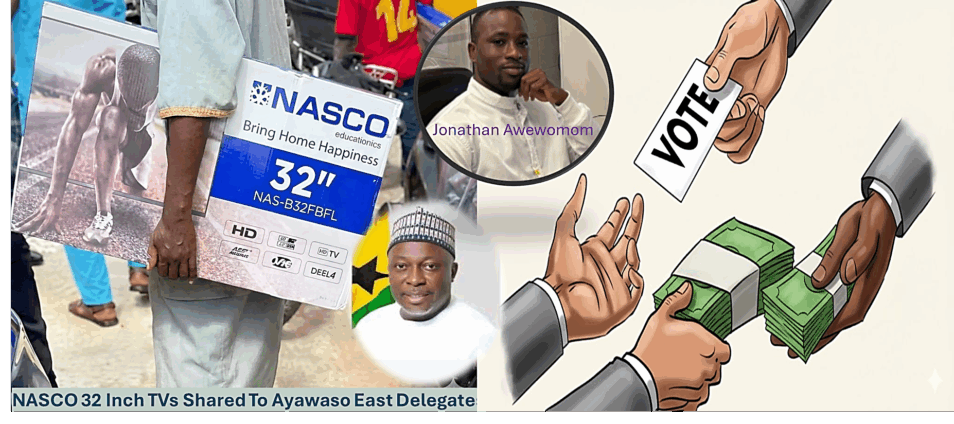
Ghana prides itself on being a beacon of democracy in Africa. Peaceful elections, orderly transitions, and a politically conscious population have long been our national selling points. Yet beneath the surface of this democratic pride lies a troubling practice that threatens the core of our democracy: the corruption of delegates through money and gifts.
In recent internal party elections across the political divide, public discourse has once again been dominated by reports and allegations of delegates receiving cash, household items, and other inducements in the run-up to voting. From parliamentary primaries to presidential internal contests, the pattern is familiar. Candidates defend these acts as “customary generosity,” “logistical support,” or “appreciation,” insisting that gifts do not amount to vote buying. But the uncomfortable question remains: if gifts do not influence choices, why are they so strategically distributed often on the eve of voting?
The highest Bidder Wins the elections
What is most alarming is not that money is used in politics, politics everywhere involves resources, but that inducements have become normalized as a legitimate pathway to leadership. The outcome is no longer uncertain; it has become the norm. Leadership selection is increasingly distorted, with many rising less by conviction or capacity and more by capital Over time, what should have been exceptional has become routine. Delegates are courted not primarily with ideas, competence, or vision, but with financial muscle.
This practice quietly but decisively reshapes outcomes. Candidates with deep pockets but shallow ideas often advance, while competent, principled individuals without financial strength are edged out. Elections become less a contest of ideas and more an auction. Leadership, in effect, goes to the highest bidder.
The long-term implication is devastating; leaders who buy their way to power often govern with the mindset of recovery, not service. The question after victory is no longer “How do I serve?” but “How do I recoup?” This logic explains much of the corruption, policy inertia, and self-preservation we lament in public office today.
Delegate Corruption to National Consequences
When delegates sell their conscience, the consequences do not end at party headquarters - they spill into national governance. A system that rewards money over merit opens the door to unqualified individuals, compromised actors, and even those with questionable sources of wealth. In such an environment, the nation risks being led not by its best minds, but by its most financially aggressive aspirants.
This is how democracies quietly decay. Not through coups or chaos, but through the steady erosion of moral choice at the grassroots of political selection.
It also raises a deeper concern: if money has become the decisive factor at the delegate level, what safeguards remain at the national level? Who regulates a system where those tasked with reform may themselves be beneficiaries of the very malpractice under scrutiny?
How Did We Get Here?
The uncomfortable truth is that this culture thrives in a society where questioning political or institutional behavior is often discouraged. Delegates who raise concerns are labeled ungrateful or disloyal. Citizens who ask hard questions are accused of attacking their party. Over time, conscience gives way to convenience.
Delegates may argue that they did not ask for gifts and that may be true. But acceptance is participation. The critical question is not whether inducements were requested, but whether they were appropriate, especially on election days. Can a conscience remain neutral when materially rewarded by one contestant?
What Do Mature Democracies Do Differently?
In many established democracies, internal party elections are tightly regulated. Campaign finance disclosures, spending caps, independent oversight committees, and severe sanctions for inducement are standard. Some parties prohibit any form of gift-giving outright, recognizing that perception alone can compromise legitimacy. While no system is perfect, these measures recognize a basic truth: unchecked money distorts democratic choice.
Ghana does not lack the intellectual or institutional capacity to reform its processes. What is needed is collective will across parties to acknowledge the problem and act decisively.
A Question for Our Political Conscience
Delegate corruption is not a partisan issue; it is a democratic one. It implicates all political traditions and demands collective honesty. The real challenge is this: who will be bold enough to end a practice from which many benefit?
Until that courage emerges, we must be honest about the cost. When delegates are bought, democracy is sold and toasted. And when democracy is sold, the nation pays - with poor leadership, stalled development, and public disillusionment. Ghana deserves better. And better begins with restoring conscience to choice.
The writer, Jonathan Awewomom, is a Research Scientist based in Miami, FLorida-USA and a Governance Advocate.Email: jonathankeinzie8a154@gmail.com
Latest Stories
-
Power restoration fault suspected in Kumasi Central Market fire
4 hours -
The 7-foot giant of Ngleshie Amanfro: Seven-foot Ghanaian Ephraim Saawa dreams of joining the national basketball team
4 hours -
Government promises support for Kumasi Central Market fire victims
4 hours -
Vibes The Movie: Big Ghun’s Ghanaian film earns five nominations at 2026 REFFA
5 hours -
MamaCare CEO warns unresolved conflicts among health workers could undermine maternal and neonatal care
5 hours -
Health professionals urged to translate medical knowledge into practice to save mothers
5 hours -
Conflicts among care providers linked to maternal, neonatal deaths – Expert
7 hours -
GIS marks 10th TIME conference, champions improved teaching practices
7 hours -
BRICS Or Balance? What Ghana’s bid really means
8 hours -
GPRTU wants full TRAFFITECH-GH implementation to start in 2027
8 hours -
Mahama announces plans to import electric wheelchairs for PWDs
8 hours -
KGL U17 Colts 2026: Western beat Prempeh Elite Academy to set up final final with Greater Accra Region
8 hours -
Late Solanke strike salvages 10-man Spurs draw at Man United
8 hours -
Gender Ministry to monitor welfare of Nana Akua Addo’s children amid domestic violence case
9 hours -
Benedict Okyere Yeboah: Ghana’s football problem goes beyond sacking a coach
9 hours