

Audio By Carbonatix
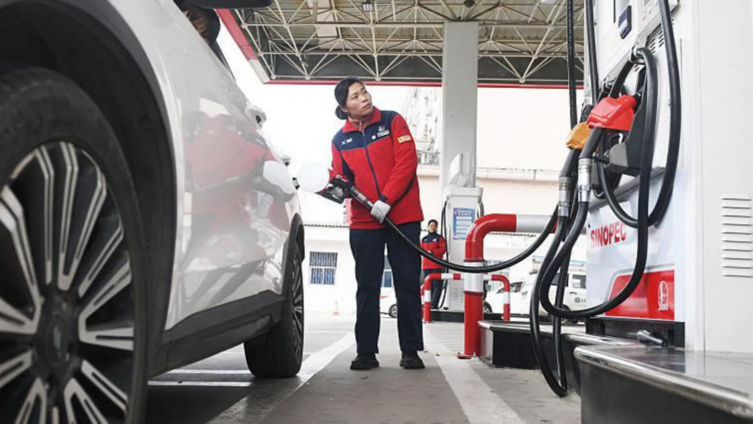
U.S. vacationers are barreling into peak summer driving season just as the gasoline market faces a supply crunch, with resilient domestic demand and surging fuel exports threatening to strain thin inventories and send pump prices climbing.
Surging summer demand from American motorists has not stopped U.S. refiners from increasingly prioritising lucrative diesel and jet fuel production to backfill global shortages caused by shipping disruptions at the Strait of Hormuz.
The critical passageway handles nearly a fifth of global oil flows and has effectively closed since the start of the Iran war.
Analysts warn that a supply deficit is looming as U.S. gasoline demand has remained robust despite pump prices surging roughly 40% since the war started, with prices hovering above $4. Also, some analysts worry that U.S. refineries may not be able to maintain near-capacity operations, noting that there have been more unplanned outages than expected lately.
The once-comfortable U.S. gasoline supply cushion built during the low-demand winter months had evaporated by the end of May, when summer driving season kicked off during the three-day Memorial Day holiday weekend. U.S. peak summer vacation season traditionally runs until early September.
NO MARGIN FOR ERROR
In the first week of June, gasoline inventories sank to their lowest seasonal level in a decade, just 215.1 million barrels, according to government data. Inventories have declined by more than 34 million barrels since the war started.
Even more depleted, distillate fuel oil inventories fell to a 23-year low in May, leaving the supply highly vulnerable to any further sudden shocks.
With domestic gasoline demand holding up in the face of high pump prices and exports strong, analysts warn that total demand for U.S.-produced fuel could reach 9.5 million barrels per day (bpd) this summer. That would outstrip the 9.2 million bpd that fuel makers can currently produce.
"Balances will definitely be severely tight because (refining margins) incentives still support jet fuel, and we all know that Middle Eastern refiners are not coming back quickly," said Sumit Ritolia, lead analyst for refining supply and modelling at Kpler.
GASOLINE, THE NEGLECTED CHILD
U.S. refiners, less reliant on Middle Eastern crude than Asian and European counterparts, are relatively shielded from the shipping disruption and able to maximize distillate output to capture strong margins.
In late April, the four-week average of U.S. jet fuel production surpassed 2 million barrels per day, opens new tab for the first time on record, the EIA said this week.
The U.S. exported 54.65 million barrels of diesel and jet fuel in May, the highest in Kpler data going back to 2017. The country exported 22.52 million barrels of gasoline in May, up from 20.10 million barrels in April.
"This has left gasoline as the neglected stepchild of the refinery slate," said Tamas Varga, analyst at PVM Oil Associates.
Historically, the U.S. could rely on European imports to ease regional gasoline deficits. That fallback option is logistically difficult and less economical now. Europe's fuel supplies are also tight, while freight rates are soaring due to the blockage of the Strait of Hormuz.
"Even if export rates stay where they are now and don’t rise with the desperate need of countries elsewhere, one can make a case for gasoline inventories to drop by 2 or 3 million barrels per week during summer crunch time," said Tom Kloza, chief energy adviser to Gulf Oil. The refined products supply remains tight even if refineries continue to run unfettered.
Analysts question whether refiners will be able to keep running their plants hard to capture these high margins. U.S. refiners ran their facilities at 95.3% of capacity in the first week of June, the highest in nearly a year.
There are already reports of some planned maintenance in the fall getting postponed, or moving to a smaller scope, said Raul Calzada, refining analyst at Energy Aspects. "If you defer maintenance, there's a chance later that you know you'll pay," said Calzada.
Some cracks are starting to show: April recorded the highest average unplanned U.S. refinery outages in the last five years, with roughly 483,000 barrels per day of crude oil processing capacity offline, according to IIR Energy data.
Latest Stories
-
Freddie Blay alleges Mahama ordered demolition of son’s Polo Beach Club at La Beach
6 minutes -
‘We’ve complied with all the rules’ – NPP assures transparency in national elections
16 minutes -
‘Who is financing all this?’ – Victoria Bright questions networks behind Ghana-linked drug trade
22 minutes -
If we don’t know Baffour Awuah’s charge, there’s a fishing expedition going on – Kofi Bentil
29 minutes -
Parliament questions continued detention of Baffour Awuah by EOCO, demands due process
1 hour -
Baffour Awuah did not report to EOCO voluntarily; an arrest warrant forced him – Theophilius Dzimega
1 hour -
Baffour Awuah case risks looking like a display of state power – Sulemana Braimah
1 hour -
Campaign posters, billboards take over Kumasi as NPP goes to polls
2 hours -
‘I’ve been told I’m also involved’ – John Darko says he’ll cooperate with EOCO if invited over Baffour Awuah case
2 hours -
Follow the evidence, not assumptions, in Baffour Awuah case – Victoria Bright
2 hours -
48-hour detention rule is not an automatic entitlement for EOCO – Victoria Bright
2 hours -
Baffour Awuah’s arrest is a political witch-hunt – Kofi Bentil
2 hours -
MT Asharami Ghana arrives in Tema as government pushes stronger LPG infrastructure
2 hours -
Weweso JHS wins 5th edition of Otumfuo Reading Competition 2026
3 hours -
‘Criminal law can’t turn every poor commercial judgment involving state entity into an offence’ – Victoria Bright
3 hours