

Audio By Carbonatix
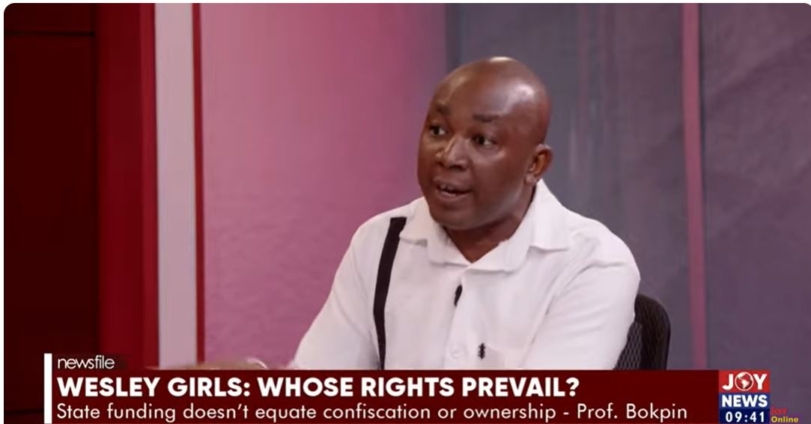
Economist and Finance Professor at the University of Ghana, Professor Godfred Bokpin, has urged the government and the public to approach current debates on religious rights in mission schools with caution, warning that any reforms must not erode the identity or long-standing investments made by these institutions.
His comments come amid intensifying national conversations following the Supreme Court’s directive to Wesley Girls’ High School to respond within 14 days to claims that Muslim students face restrictions on prayer, fasting, and the wearing of hijab.
Speaking on JoyNews' Newsfile on Saturday, November 29, Prof. Bokpin stressed that mission schools—Christian or Muslim—have historically partnered with the state in delivering quality education, and their rights over the schools must be respected.
“If we look at it in totality, the state grants space for mission schools to preach, and this partnership has been sustained for decades. No religious body will give up its right over its mission schools—they won’t,” he said.
He noted that it is inherently difficult for any religion to fully exercise its practices inside mission schools of another faith, and this reality should be acknowledged rather than denied.
“I believe we should be moving towards unity that recognises diversity,” he said. “We must promote tolerance that gives each group a safe space to operate. As the state supports all institutions, that approach becomes more sustainable.”
Prof. Bokpin drew from his personal experience attending a Muslim mission school, explaining the nuanced differences even within Islamic groups. Orthodox Muslims, he said, often feel uncomfortable in Ahmadiyya schools due to differences in belief and teaching—yet the Ahmadis were among the earliest to embrace Western-style education and invested heavily in establishing schools.
He commended the progress Muslim communities have made in promoting education, especially for girls, describing it as a “momentum shift” from past practices.
However, he emphasised that this new appreciation for formal education must not become a basis to dilute, override, or undermine the values upon which mission schools were built.
“This late realisation should not grant anyone the right to weaken mission schools for the investment they have made over the years,” he cautioned. “They have contributed significantly to national development.”
Latest Stories
-
Irresponsible mining: The land is not your own – Prof Mike Oquaye cautions
5 minutes -
62 Ghanaians killed, 15 missing in Russia-Ukraine war – Ablakwa
5 minutes -
GJA President urges responsible, sustainable mining
6 minutes -
Ghana must take charge of its mineral resources – Prof. Mike Oquaye
13 minutes -
KickedIn uses technology to connect African football talent with global opportunities
14 minutes -
GoldBod did not record GH¢22bn loss; audited accounts show GH¢5.44bn surplus – Institute of Fiscal Policy Governance
17 minutes -
Mining comes with responsibility to future generations – Ga Mantse
20 minutes -
Ga Mantse calls for measurable CSR and stronger local participation in mining communities
27 minutes -
Ga Mantse urges mining industry to protect communities beyond the life of mines
42 minutes -
Empowerher in Upper West region
1 hour -
Ga Mantse challenges mining stakeholders to consider long-term impact of Ghana’s mineral wealth
1 hour -
Afenyo-Markin accuses GoldBod of mismanaging Ghana’s gold resources
1 hour -
Non-interest banking products must meet required standards – BoG Governor to NIFAC
1 hour -
Social licence to mine can be withdrawn – Ga Mantse warns mining companies
1 hour -
X1 Energy Drink Division One Super Cup: Attram De Visser secure third place after late own goal
1 hour