

Audio By Carbonatix
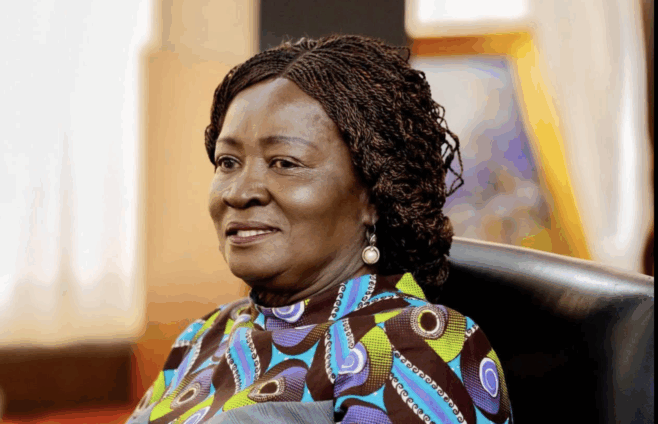
Professor Jane Naana Opoku-Agyemang, the Vice President, has said the government is reshaping Ghana’s tertiary education through the introduction of high-level interventions.
She mentioned the “No Fees Stress” policy, an intervention that removes financial barriers for first-year students in public tertiary institutions, which took effect in the 2025/2026 academic year.
Prof Opoku-Agyemang was speaking at the 59th Congregation of Post-graduate students of the Kwame Nkrumah University of Science and Technology (KNUST) in Kumasi.
The programme, attended by Otumfuo Osei Tutu II, the Asantehene, and the Chancellor of KNUST, conferred Doctor of Philosophy (PhD) certificates on 221 post-graduate students in recognition of their hard work in conducting tangible research.
Prof Opoku-Agyemang also spoke about the introduction of the Free Tertiary Education for Persons with Disability in October this year.
She noted that the intervention widened access to higher education for persons with disabilities who gained admission to accredited public institutions.
This, according to the Vice President, was a clear act of justice by the Government to students with disabilities in the country.
She said both interventions have been designed to ensure efficiency and transparency, giving all persons equal access according to their needs to be admitted to state-accredited tertiary institutions.
“This is an equity-driven intervention, designed to ensure that admissions to our tertiary institutions are determined as much as possible by merit and also by aspiration,” Prof Opoku-Agyemang said.
Additionally, the interventions broadened opportunities and strengthened the long-term development of the country’s human capital.
She emphasised that scholarships must be connected to impacts and not limited to lecture theatres and the laboratories.
Prof Opoku-Agyemang commended the post-graduates for their achievements and charged them to fulfil in their small way the responsibilities that accompanied their certificates.
She stressed that Ghana and the African Continent needed leadership rooted in resourcefulness, data, ethics and public value.
The abilities of the post-graduates to think clearly and act responsibly, she said, would be tested whether they remained in academia, join public service or launch a business.
She, therefore, encouraged them not to forget the contributions made by their families, communities and the nation to see to their success and embrace academic humility in their service delivery.
“Do not forget that your families, communities and nation have not invested in your education for your benefit alone. Remember them and maintain your academic humility,” she advised.
Latest Stories
-
Black Stars face Ivorian test as injuries force major squad changes
25 minutes -
Save Nations Foundation donates learning materials to Nooria Islamic Basic School, calls for more support
32 minutes -
From selling food to solving problems: How Esther Owusu Nkwantabisah rethought entrepreneurship
46 minutes -
High Cost of Domestic Airline Fares: Can government do something about it?
1 hour -
Inflation, cedi depreciation put BoG’s MPC under pressure as policy rate decision looms
1 hour -
Lawyer denies Salomey Baffoe received money from ‘Ghana Jollof’ account operator
1 hour -
Beyond politics: Why Kwame Nkrumah’s ideals still matter for today’s leaders
2 hours -
Top South African policeman charged with sexual offences
2 hours -
More than 170,000 respiratory cases recorded in haze-choked Indonesia
2 hours -
Narrowed space, intolerance – Sammy Crabbe says NPP is driving talented members away
2 hours -
We’re not analytical enough – Sammy Crabbe calls for data-driven decision-making
2 hours -
Tonto Dikeh celebrates Bobrisky as birthday tribute sparks online reactions
3 hours -
Peter Okoye tells court he received over $800,000 in P-Square royalties
3 hours -
I’ve never had problems with artistes – Rema addresses alleged fight with Davido
3 hours -
I was mocked for getting pregnant out of wedlock as pastor’s daughter – Davido’s baby mama
3 hours