

Audio By Carbonatix
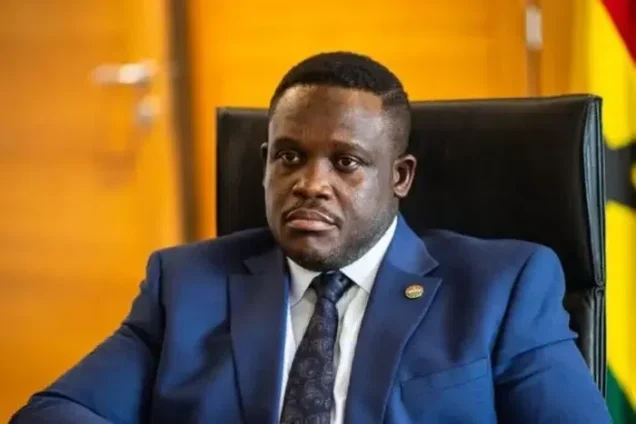
In the wake of a pre-dawn military operation by the United States in Venezuela, Minister of Communication, Digital Technology and Innovations, Samuel Nartey George, has raised questions regarding the future of global stability and the sanctity of territorial sovereignty.
The minister’s reaction follows breaking reports on January 3, 2026, that U.S. forces successfully captured Venezuelan President Nicolás Maduro in a high-stakes raid in the capital, Caracas.
The event has sent shockwaves through the diplomatic world, drawing immediate comparisons to previous Western interventions in the Middle East and North Africa.
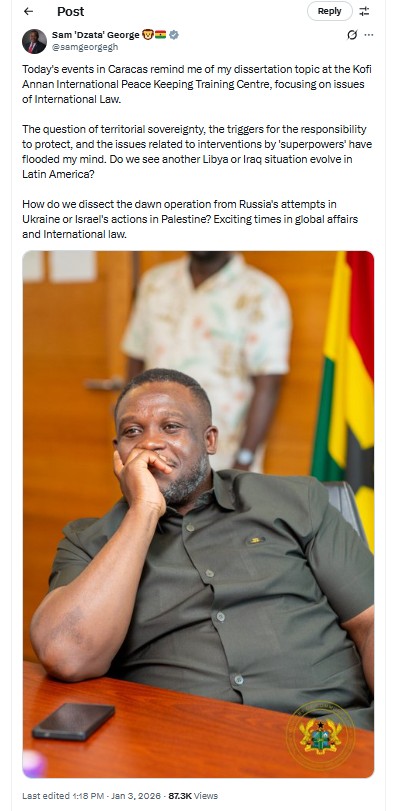
Taking to his X (formerly Twitter) account, the Ningo-Prampram legislator drew upon his academic background in peace and security studies to frame the unfolding crisis.
George, an alumnus of the Kofi Annan International Peacekeeping Training Centre (KAIPTC), noted that the military action serves as a live case study for the theories of international law he once researched.
"Today's events in Caracas remind me of my dissertation topic at the Kofi Annan International Peacekeeping Training Centre, focusing on issues of international law," George posted.
The minister indicated that the operation complicates the established norms of non-interference, stating that the “question of territorial sovereignty, the triggers for the responsibility to protect, and the issues related to interventions by 'superpowers' have flooded my mind.”
Hon. Sam George’s critique centred on whether the world is witnessing a repetitive cycle of "regime change" strategies that have historically led to long-term instability. He questioned the legal consistency of the international community's response to different global conflicts.
“Do we see another Libya or Iraq situation evolve in Latin America? How do we dissect the dawn operation from Russia's attempts in Ukraine or Israel's actions in Palestine?" he asked rhetorically.
His comparison strikes at the heart of the debate over double standard in global affairs—specifically how the world differentiates between an intervention for democratic restoration and aggression against a sovereign state.
While the capture of Maduro has been celebrated by his detractors as a victory for democracy, critics and legal scholars like George view it as a precarious moment for the United Nations Charter.
The minister concluded his thread by characterising the current era as “Exciting times in global affairs and International law”, suggesting that the precedents set in Caracas will redefine the limits of superpower influence for decades to come.
Latest Stories
-
Trump $1 coin makes him first living president on US currency in a century
1 hour -
Sydney police investigate second possible mistaken identity killing in two days
1 hour -
Gauff’s flaw forgotten on winning US Open return
3 hours -
Birds stop play but Medvedev flies into third round
4 hours -
LA Clippers fined $30m by NBA over Leonard scandal
4 hours -
Uber to cut over 3,000 jobs in major global restructuring
4 hours -
Tiger Woods gets five-year driving ban after reckless driving plea
4 hours -
South African airline behind daring stadium stunt cancels next flyby
4 hours -
PURC urges ECG to address outages, metering delays
4 hours -
Police engage traders over alleged harassment, extortion on Aflao-Accra highway
5 hours -
Uber shuts operations in Nigeria and Uganda with immediate effect
5 hours -
Netherlands moves billions in gold to London in ‘crisis preparedness’ move
5 hours -
Legal vacation does not halt urgent court cases – Chief Justice
5 hours -
Keta residents react with mixed feelings to fresh fuel price hike
5 hours -
Managing Director on GH¢150,000 bail over five dud cheques
5 hours