

Audio By Carbonatix
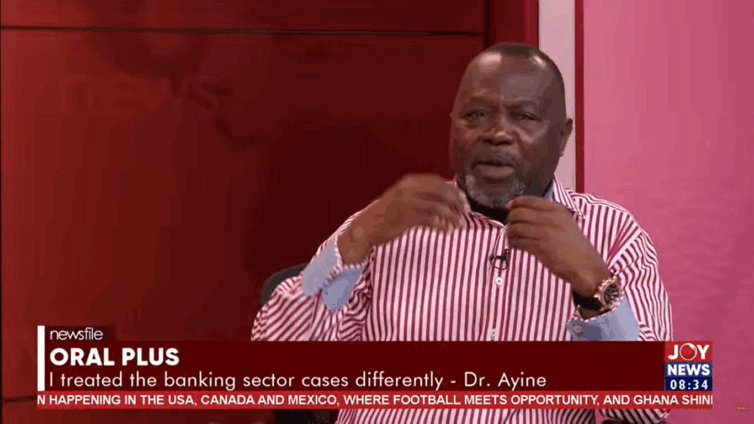
The Attorney-General and Minister of Justice, Dr Dominic Ayine, has explained why he adopted a different approach to the prosecution of banking sector cases, arguing that the charges were largely weak and risked criminalising ordinary banking activity.
Speaking on JoyNews’ Newsfile, Dr Ayine said his assessment of the cases led him to the conclusion that many of the allegations did not meet the threshold for criminal prosecution.
According to him, a central issue in several of the cases was the claim that financial loss had been caused because some banks received liquidity support from the Bank of Ghana and allegedly misapplied those funds.
Dr Ayine questioned the basis of such accusations, stressing that the concept of “misapplication” had not been clearly demonstrated.
“If you take banks generally, banks are in the business of taking risks,” he explained on Saturday, January 10.
“They lend, and sometimes those who take the loans default, probably not due to any fault of theirs, but because the business has gone bust.”
He warned that treating such outcomes as criminal conduct would set a dangerous precedent for the entire financial system. In his view, if banks were to be criminalised simply because liquidity support was granted and loans subsequently failed, then virtually every bank operating in the system could be exposed to prosecution.
“It doesn’t make sense for you to say that because liquidity support was given, they did not apply it in a manner that you thought they ought to apply it,” he stated.
Dr Ayine also addressed specific cases, including that involving former Finance Minister Dr Kwabena Duffuor. He stressed that the allegations were not about theft or personal enrichment.
“In the case of Duffuor, it wasn’t the case that they stole the money. It wasn’t the case that they pocketed the money,” he said.
Rather, the Attorney-General noted that the issues under consideration related to possible negligence and, in some instances, the making of fictitious entries in banks’ books to present a healthier financial position.
He explained that such practices, if proven, may have been aimed at enabling banks to continue operating and to secure further support from the central bank.
“At the end of the day,” Dr Ayine said, “what I then said was that for all the banking cases, I had assessed them, and the evidence was also weak just like the rest of the cases.”
Latest Stories
-
$30m China grant insufficient for Damongo university project – Haruna Iddrisu
7 minutes -
Food vendor recounts how she narrowly escaped New Winneba attack
11 minutes -
Military to secure James Town after massive waste evacuation – Ayariga
12 minutes -
Charlie Kirk murder suspect pleads not guilty as judge clears way for death penalty trial
15 minutes -
Signals Bureau case: ‘We were battle-ready’ – Atta Akyea fires at AG over absence of prosecution team
23 minutes -
NSA sets September 4 deadline for final rectification of biodata mismatches
26 minutes -
Gospel musician Bernice Offei reported missing
30 minutes -
IMF, former gold buyers uncomfortable with Ghana’s gold policy – Asiedu Nketia
33 minutes -
18 years, 66 plays Ebo Whyte has one more story to tell: “Honey trap”
34 minutes -
PHOTOS: McDan and Ayuda claim singles titles in 2026 JoySports Invitational
35 minutes -
IEA describes gov’t proposals on women, marginalised groups in Parliament ‘grossly insufficient’
36 minutes -
Ghana marks 2026 Children’s Day with call to amplify voices against abuse
36 minutes -
TEIN UK–Ireland engages Ghana High Commission on support for students, professionals
37 minutes -
Fire destroys five commercial containers at Kotobabi Down near Antrack Filling Station
40 minutes -
NCD Alliance Ghana urges government to accelerate action on NCDs and mental health
41 minutes