

Audio By Carbonatix
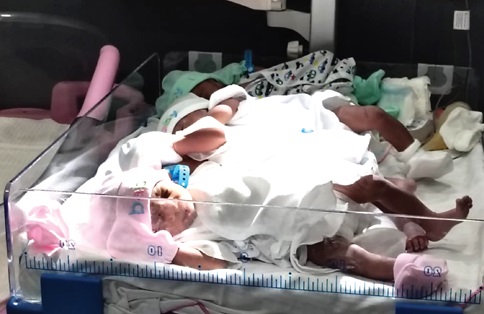
The Walking Egg Medical and Fertility Centre at Pokuase in the Greater Accra Region has delivered a 30-year-old surrogate mother of quadruplets through intrauterine insemination (IUI), a rare occurrence in assisted reproductive technology.
The Chief Executive Officer (CEO) of the centre, Dr Nana Yaw Osei, who performed the delivery, has explained that quadruplet births through IUI are extremely uncommon because, unlike the in vitro fertilisation (IVF) process, doctors cannot control how many embryos implant.
“It is not common to have four babies from IUI.
Usually, we expect one or at most two,” Dr Osei said.
In an interview with the Daily Graphic yesterday, moments following the delivery of the babies, Dr Osei described the pregnancy as smooth.
“The surrogate experienced no major complications.
We delivered at 36 weeks as a precaution, and all four babies were reviewed by paediatricians and found to be very healthy,” he said.
Dr Osei explained that the decision against foetal reduction was guided by ethical and religious considerations.
“For me, as a strong Christian, foetal reduction is equivalent to abortion.
My team and I discussed it thoroughly with the intended parents and the surrogate, and we all agreed to continue with all four foetuses. It was a very special moment,” he said.
Carrying four foetuses is considered high risk, yet the surrogate experienced a smooth pregnancy, and all four babies — two boys and two girls — were delivered healthy, each weighing over two kilogrammes.
“With IUI, you only prepare the sperm and send it into the womb. You cannot control how many embryos will implant.
Unlike IVF, where embryos are fertilised outside the body, and you can choose how many to transfer, IUI relies entirely on nature.
That is what makes this case so rare and remarkable,” Dr Osei said.
Cultural context
The doctor also addressed cultural and societal aspects of assisted reproduction in Ghana.
“Surrogacy is still developing in our society. Most surrogates are independent women, and financial motivation is usually the primary reason they volunteer.
We also ensure that surrogates have at least one child of their own before participating to reduce risks,” he said.
Reflecting on the wider significance of assisted reproduction, Dr Osei recalled a case.
“I remember a 49-year-old woman who lost her womb but remained faithful to her beliefs.
Should we deny such women the opportunity to have a child?
Assisted reproduction can offer hope to families who would otherwise never experience parenthood,” he said.
He added that donors and surrogates remained anonymous, ensuring privacy for all parties.
“Our goal is to combine medical expertise with ethical and culturally sensitive practices.
This successful quadruplet birth demonstrates the potential of assisted reproductive technology in Ghana, and gives hope to couples struggling with infertility,” Dr Osei stressed.
Latest Stories
-
Nigeria set to launch National Digital Address System 9 years after Ghana showed the way
22 minutes -
Policy rate decision takes time to reflect in lower lending rates – BoG
32 minutes -
Western Regional Minister applauds Karpowership’s role in Ghana’s power sector
57 minutes -
Livestream: Road safety crises: Where are we getting it wrong?
59 minutes -
Enterprise Life celebrates 25 years of protecting families and building trust
1 hour -
ICC London rules in favor of Ghana against Tullow over $400m tax charge
1 hour -
We are disappointed in ICC’s ruling over our corporate income tax assessment in Ghana – Tullow Oil
1 hour -
Cost of building inflation for August 2026 increases to 4.6% – GSS
1 hour -
Today’s front pages: Wednesday, September 30, 2026
2 hours -
Bawumia highlights agricultural, compulsory insurance reforms in IBAG engagement
2 hours -
Ghana will secure Tullow tax revenues while protecting Jubilee, TEN investments – Ato Forson
2 hours -
Ghana wins $393m Tullow tax arbitration as tribunal upholds GRA assessment
2 hours -
Gender Minister assures women’s group of action on Affirmative Action, Development Bank
3 hours -
Over 2,000 teachers in Dormaa comply with strike – GNAT Secretary
3 hours -
Food Buffer Stock seeks stronger liquidity buffer despite record profit
3 hours