

Audio By Carbonatix
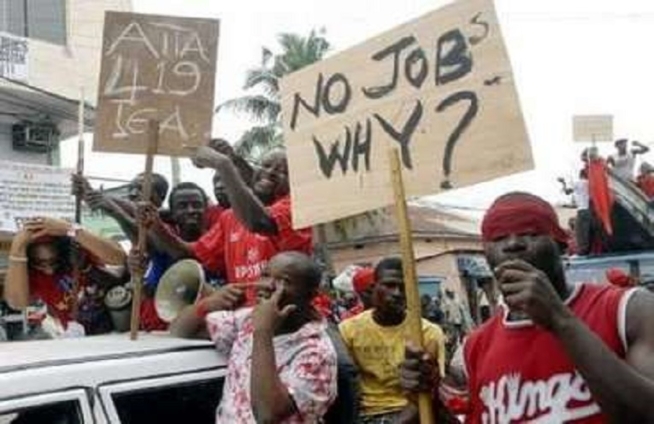
Rising unemployment and limited economic opportunities could pose the greatest threat to Ghana’s stability in 2026, despite signs that inflationary pressures are beginning to ease, according to the World Economic Forum’s Global Risks Report 2026.
The report, based on insights from the Executive Opinion Survey 2025 involving business leaders, indicates growing anxiety that Ghana’s economic recovery has not yet produced sufficient employment, particularly for the country’s expanding youthful population.
This gap between macroeconomic improvement and job creation is viewed as a major vulnerability.
Economists warn that persistent joblessness could weaken household incomes, suppress consumer spending and undermine long-term productivity, increasing the risk of economic and social instability if left unaddressed.
The report identifies technological disruption, especially the unintended consequences of artificial intelligence, as the second most significant risk facing Ghana.
While digital technologies offer efficiency and growth potential, the Forum cautions that rapid adoption without adequate skills development, labour market flexibility and regulatory preparedness could lead to job displacement and deepen inequality.
Inadequate public services and social protection systems also feature prominently among Ghana’s key risks. The assessment highlights mounting strain on healthcare, education, transport infrastructure and pension schemes, at a time when fiscal tightening constrains government spending amid rising population growth and urbanisation.
Concerns about declining health and well-being further emphasise the connection between social outcomes and economic performance, as weak health systems can erode labour productivity and raise household expenses.
Although inflation has slowed from recent highs, the report notes that cost-of-living pressures remain a sensitive issue for households and businesses.
The World Economic Forum concludes that mitigating these risks will require Ghana to move beyond short-term economic stabilisation towards a strategy anchored in job creation, human capital investment and resilient public service delivery.
Latest Stories
-
GSA defends decision to allow importation of vehicles up to 15 years old
54 seconds -
Sammy Gyamfi distracting Ghanaians from ‘BoG-GoldBod’ losses with extortion allegations – Oppong Nkrumah
1 minute -
NACOC boss urges prosecutors to uphold integrity and rule of law
2 minutes -
Africa must take ownership of its development – Vice President
3 minutes -
African CSOs must diversify funding, reduce donor dependence – WACSI
3 minutes -
Partisan politics, selfish interests stalling Ghana’s housing development – Ahmed Ibrahim
3 minutes -
Government must be limited to powers given by citizens — Kofi Bentil
3 minutes -
GIPA CEO urges businesses to tap capital market
8 minutes -
GIMAT calls for stronger parent-school collaboration to support girls’ health and development
9 minutes -
Xpress Gas, Polygon Energy Technology team up to improve cylinder recirculation model
12 minutes -
Why Ghana has banned unrefined gold exports—GoldBod official provides details
22 minutes -
BoG calls for stronger oversight as Ghana launches Virtual Assets Committee
28 minutes -
mNotify selects 14 SMEs for AI-powered digital transformation programme
30 minutes -
Democracy Cup trophy tour reaches Police Headquarters, NCCE ahead of Kotoko-Hearts clash
35 minutes -
Western Rod and Wire calls for recognition of existing local aluminium rod production
36 minutes