

Audio By Carbonatix
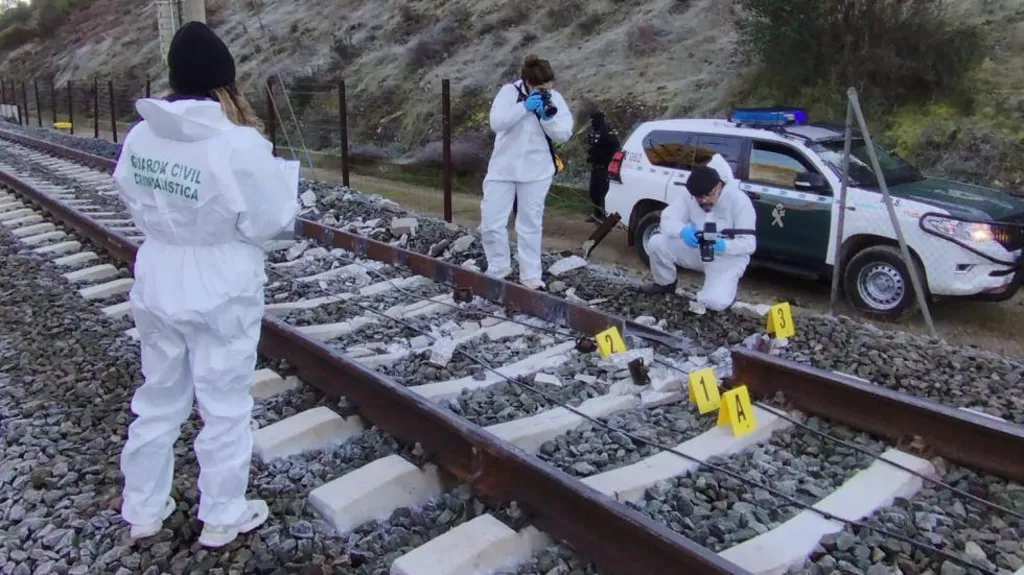
A fracture in a straight section of track "occurred prior to the passage" of a high-speed train that derailed, causing last Sunday's rail disaster in which 45 people died, an initial report has found.
A train run by private company Iryo derailed last Sunday and its rear carriages crossed on to the opposite track into the path of an oncoming train run by state-owned Renfe.
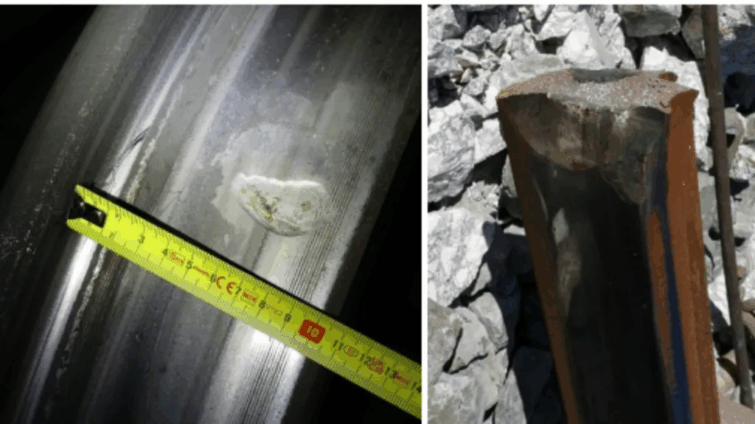
The CIAF rail investigation commission said not only did Iryo train's front carriages which stayed on the track have "notches" in their wheels, but three earlier trains that went over the track earlier did too.
A gap of almost 40cm (15in) in the track has become the focus of the investigation into the crash.
Sunday's deadly collision occurred at around 19:45 local time (18:45 GMT), about an hour after the Iryo train left Málaga for Madrid.
The train's last three carriages - carriages six to eight - derailed and collided with the Huelva-bound Renfe train. "Carriage six derailed due to a complete lack of continuity in the track," the preliminary report finds.
Most of those killed and injured were in the front carriages of the state-operated train.
Earlier this week, Spanish Transport Minister Óscar Puente confirmed reports that grooves were found on the wheels of the Iryo train's carriages, which had passed over the track safely.
"These notches in the wheels and the deformation observed in the track are compatible with the fact that the track was cracked," the CIAF preliminary report said.
It added that three trains that had gone over the tracks at 17:21 on Sunday, 19:01 and then 19:09 had similar notches "with a compatible geometric pattern".
Similar grooves are found on carriages two, three and four of the Iryo train, the report says, but carriage five - the last that did not derail - had a groove on its outer edge, suggesting the rail was already tilting outwards before carriage six derailed.
The CIAF called its report a "working hypothesis", adding that it "must be corroborated by later detailed calculations and analysis".
The transport minister appeared before reporters again on Friday to say that it was too early to have definitive answers, but that if the cause of the crash was the fracture, then it occurred in the minutes and hours before the derailment and could not have been detected.
The Adamuz disaster is is the country's worst rail crash in more than a decade.
In 2013, Spain suffered its worst high-speed train derailment in Galicia, north-west Spain, which left 80 people dead and 140 others injured.
Latest Stories
-
Finance Minister advises African governments to strengthen regional tax cooperation
8 minutes -
NPP accuses NDC of master-minding demolition of Ho regional office fence
9 minutes -
Ghana plans stronger regional power trade with Nigeria
9 minutes -
GRA Commissioner-General calls for stronger tax cooperation to boost regional revenue mobilisation
10 minutes -
NACOC needs more personnel to tackle drug trafficking – Toobu
14 minutes -
Railway workers resist KMA eviction order, demand consultation
16 minutes -
Legacy Leadership Africa Institute to host boardroom women’s leadership programme
28 minutes -
Ghana needs a law to sustain constitutional reforms – CDD-Ghana
4 hours -
COVID fumigation audit: Auditor-General has a lot of questions to answer – Akwatia MP
4 hours -
Stranded Ghanaian medical graduates in Cuba appeal to Mahama for immediate return
4 hours -
GNFS contains fire outbreak at Teshie Lekma Road near Lekma Hospital
10 hours -
Samia Nkrumah rejects the narrative that Ghanaians were happy after Nkrumah’s overthrow
11 hours -
A Mother’s pain: Tribute by Ivan Baidoo’s mother
11 hours -
‘Forgive us for staying away’ — Samia Nkrumah leads family back to Nkroful, pledges to preserve Nkrumah’s legacy
12 hours -
Ernest Nuamah scores twice as Lyon beat Rennes
12 hours