

Audio By Carbonatix
The ongoing evolution of structures to mainstream sustainability principles in businesses has seen nuanced approaches over the years in Ghana. These businesses face climate-related risks that are very tangible, from climate change-induced floods, shifting rainfall patterns, supply chain disruptions, and evolving regulatory expectations.
These challenges, however, present an opportunity to strengthen resilience, unlock new markets, and attract capital by embedding climate action and ESG into everyday decision-making.
In order to understand these challenges and the current terrain of mainstreaming the principles of ESG and sustainability, a thorough scoping assessment was undertaken to identify the existing gaps and measures.
Now, these reviews, which included a thorough scoping and assessment of institutional policy frameworks, knowledge on financial mechanisms, sectoral transitions, and implementation barriers, reveal a clear imperative: Ghanaian businesses must be enabled to move beyond compliance strategies to view ESG and climate resilience as core drivers of long-term profitability and sustainability. This positions the business to tailor context-specific solutions and further take on the role of actors and not only be regarded as being at risk.
In this article, we break down synthesised key findings from the ongoing ICACE[1] project’s initial desk review, focusing on Ghana’s context and outlining how the project is strategising capacity and knowledge enhancement for the private sector towards climate action, in line with Ghana’s green transformation.
Ghana’s Context
Ghana’s financial and regulatory frameworks, including the Bank of Ghana’s Sustainable Banking Principles and the Securities and Exchange Commission’s ESG Disclosure Guidelines, are driving institutional ESG integration.
Despite these advances, 78% of SMEs lack ESG literacy, and stringent financing conditions, such as collateral requirements of 150%, hamper green investment access.
The Ghanaian private sector shows promising momentum, demonstrated by initiatives like the Ghana Climate Innovation Centre and Startup Discovery Africa, supporting cleantech startups and green bonds issued by financial institutions for renewable energy projects.
However, policy enforcement remains inconsistent, especially among informal ventures and small and micro enterprises, with challenges ranging from inadequate knowledge of climate risks, ESG, and climate action, fragmented ESG reporting, limited climate data availability, skills shortages, weak consumer demand for green products, and risks of greenwashing.
Key Knowledge Gaps
Findings from ICACE Desk Reviews
Six key cross-cutting knowledge gaps hindering private sector engagement in climate action and ESG integration for Ghanaian businesses include
- Translating strategies into action: Nationally Determined Contributions (NDCs) and long-term strategies lack detailed, actionable steps tailored specifically for businesses. Also, the engagement of private sector actors in implementation phases remains unclear and more participatory.
- Sectoral transition planning: There is no clear roadmap yet for how agriculture and land use should transition in response to climate change, especially regarding how this could affect internal trade and trade with other countries, or what specific targets should be met.
- Carbon market readiness: Currently, Ghana has an existing Carbon Market Office as a regulator, whilst also supporting capacity building, tracking credits, and playing the role of a liaison institution between buyers and sellers. Challenges, however, still exist, as for some businesses/private ventures, it is unclear whether these projects deliver real emissions reductions; there is the concern of whether emissions are shifted elsewhere rather than reduced overall, and overall, the cost of measuring carbon stored in agriculture and forestry projects remains high.
- Data sufficiency: There is inadequate availability of historical and indicator-specific data needed for accurate progress tracking and prioritisation of climate actions, and in cases where they exist, they are not readily accessible or publicly available
- Behavioural integration: Current climate models don’t seem to fully consider how people make choices or respond to policies (consumer behaviour), which limits the design of policies that aim to change behaviour and reduce emissions. This is important to note as climate change is also influenced by human activities
Additional gaps include inadequate business case studies to learn from, nuanced resilience investment, limited SME access to climate-specific financial products, insufficient technical knowledge on climate-smart business-friendly solutions, and a persistent mindset that views ESG efforts as cost burdens rather than value drivers.
These gaps represent some of the missed opportunities for Ghanaian firms to attract both local investments and Foreign Direct Investments (now 67% ESG-aligned), reduce operational risks, and access emerging markets like carbon credits and sustainability-linked loans.
ICACE’s Strategic Approach to Bridging Gaps and Driving Ghana’s Green Transformation
The ongoing desk review as part of the ICACE project recognises the critical gaps in Ghana’s private sector when it comes to climate action and ESG integration.
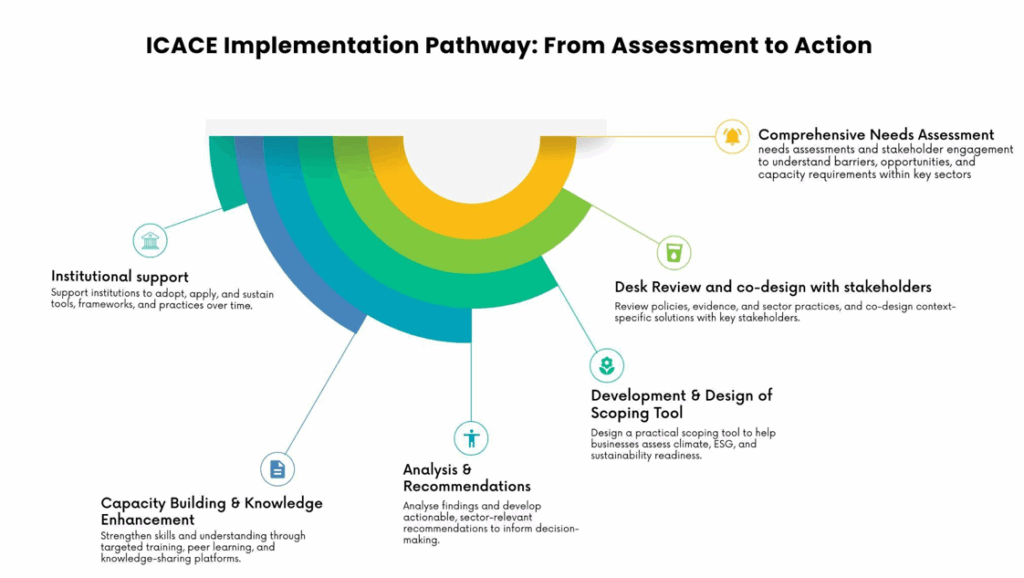
To address these gaps, the project is employing a phased implementation approach that starts with comprehensive needs assessments and stakeholder engagement to understand barriers, opportunities, and capacity requirements within key sectors like cocoa, mining, and renewable energy. Concurrently, efforts are underway to develop policy frameworks and practical tools tailored to Ghanaian businesses, alongside capacity-building initiatives including training and knowledge-sharing platforms. Though still ongoing, the project aims to lay a strong foundation for improving ESG literacy, increasing access to sustainable finance, enhancing compliance and reporting, and ultimately supporting Ghana’s transition toward a resilient and low-carbon economy aligned with national climate targets.
Businesses are becoming more aware of climate risks and ESG opportunities, enabling them to adopt resilient practices that bolster their competitiveness. This provides an enabling environment in which stronger private sector, government, and civil society partnerships can lead to progressively supporting ongoing efforts as well. towards enhanced awareness, when further complemented by improved access to finance, de-risked projects, accessing blended loans, and opened participation in carbon markets.
Collectively, these overarching aims are to contribute to Ghana’s broader ambitions: a transformed economy where sustainability aligns with profitability, enhanced resilience, and access to global funding, supporting targets like 45 percent renewable energy and 65 percent ESG literacy by 2030 (GIPC, 2025).
As echoed by participants during the scoping phase, sustainability has become a new benchmark for trust and success in global markets. The collective efforts of policymakers, investors, and entrepreneurs in harmonising standards, expanding finance, and prioritising capacity building will be essential to turning climate challenges into lasting competitive advantages for the country.
The ICACE project is led by Climate and Development Knowledge Network (CDKN) Ghana, in partnership with the Ghana National Chamber of Commerce and Industry (GNCCI), with funding from International Development Research Centre (IDRC), and seeks to translate global climate and ESG insights into practical tools for Ghanaian businesses.
[1] Integrating Climate Action into Commercial Enterprises (ICACE) project; is led by Climate and Development Knowledge Network, in partnership with the Ghana National Chamber of Commerce and Industry (GNCCI), with funding from International Development Research Centre (IDRC), seeks to translate global climate and ESG insights into practical tools for Ghanaian businesses.
Latest Stories
-
Yusuf Sulemana celebrates Gonja unity at Damba festival
27 seconds -
A Minister under watch: Zanetor’s burden of expectations
14 minutes -
Don’t make funding your starting point for green businesses – Entrepreneurs urged
20 minutes -
Skills gap in electric vehicles presents jobs opportunity for Ghanaian youth
26 minutes -
Mahama heads to Serbia for 65th anniversary of Non-Aligned Movement
32 minutes -
National Children’s Day 2026: Child Online Africa calls for child-led digital protection in Ghana
37 minutes -
Manasseh sets the record straight on Northshore Apparel GH; dispels 1D1F claim
38 minutes -
Supreme Court dismisses injunction bid seeking to halt Skytrain trial
42 minutes -
AU Chairperson reaffirms commitment to global African unity
50 minutes -
Air Pollution in Accra is not random; it is a burden carried by the poor
57 minutes -
GEXIM Bank grows loan portfolio to GH¢1.56bn as equity hits GH¢2.1bn in 2025 – SIGA Report
1 hour -
Ghana Shippers’ Authority grows surplus by 272% as assets reach GH¢979.92m
1 hour -
Government designates 13 blocked-out areas for small-scale mining to curb illegal mining
1 hour -
Number of advertised jobs increased significantly in half-year 2026 – BoG
1 hour -
GAFM demands retraction from GTEC over ‘unrecognised universities’ listing
1 hour