

Audio By Carbonatix
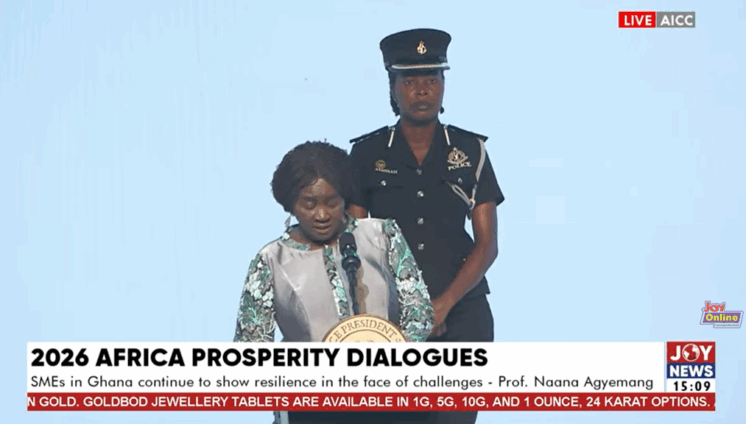
Vice President Professor Jane Naana Opoku-Agyemang has called for stronger efforts to ensure that small businesses, women, and young people benefit fully from Africa’s economic integration agenda under the African Continental Free Trade Area (AfCFTA).
Delivering a speech on behalf of President John Dramani Mahama at the 2026 Africa Prosperity Dialogues held under the theme “Empowering SMEs, Women and Youth in Africa’s Single Market: Innovate, Collaborate, Trade, she said the vision of Africa as a single, integrated economic space remains incomplete, despite decades of Pan-African cooperation.
“The vision of Africa as a single integrated economic space remains unfinished. We must remember what is at stake, and that is prosperity for Africa’s people,” she stated.
Prof Opoku-Agyemang noted that Ghana has consistently played a leading role in promoting unity and economic cooperation across the continent, citing initiatives such as the Pan-African Festival of Arts and Culture, the Year of Return, and the Diaspora Summit.
She said successive governments have pursued these programmes to bridge historical and economic divides, with the understanding that collective progress is stronger than individual efforts.
According to her, this spirit of partnership was reaffirmed at the second African Union–CARICOM Summit held in Addis Ababa last year, where African and Caribbean leaders recommitted themselves to cooperation based on dignity, equity, and mutual benefit.
Against this background, she described AfCFTA as a historic opportunity for Africa’s development.
“It is the world’s largest free trade area by number of participating countries, representing a market of about 1.3 billion people,” she said.
She stressed that small and medium-sized enterprises (SMEs) are central to the success of the free trade area, noting that they generate more than 80 per cent of employment across the continent and contribute significantly to GDP.
In Ghana, she said, SMEs have continued to show resilience and competitiveness despite economic challenges, including high inflation, currency pressures, and rising input costs.
Prof Opoku-Agyemang also highlighted the critical role of women and young people in Africa’s economy.
She noted that women make up nearly half of the continent’s workforce and are major drivers of micro and small businesses, while young people account for more than 60 per cent of the population and are leading innovation in technology and the creative industries.
However, she expressed concern that this potential is not yet reflected in cross-border trade participation.
“Fewer than 20 per cent of SMEs are engaged in export trade. Women continue to face unequal barriers to finance, mobility, and market access,” she said.
She added that many young people still lack the capital, skills, and institutional support needed to scale their businesses across borders.
The Vice President warned that without deliberate policy action, many African economies could remain trapped in low-productivity models, exporting raw materials and importing finished goods, while skilled youth seek opportunities abroad.
“This trajectory is neither inevitable nor acceptable,” she stressed.
The Africa Prosperity Dialogues 2026, held in Accra, brought together political leaders, business executives, development partners, and policymakers to discuss practical ways of accelerating trade, investment, and industrialisation under AfCFTA.
Ghana, which hosts the AfCFTA Secretariat, continues to position itself as a hub for regional trade and economic diplomacy, with government officials reiterating commitments to improving infrastructure, financing, and regulatory frameworks to support exporters and entrepreneurs.
Latest Stories
-
Special agents’ blood and urine test results stolen in FBI hack
5 minutes -
Photos: 3rd Republic Bank-JoyNews Habitat Fair Clinic at Junction Mall, Nungua
14 minutes -
GCIF cautions public as criminals deploy AI in phishing attacks
16 minutes -
Mortuaries and Funeral Facilities Agency gives unlicensed mortuaries 10 days to regularise operations
29 minutes -
Five ‘last mile’ communities in the Upper West Region receive five ambulances after years of struggling to access healthcare
34 minutes -
Stephen Kojo Adjei
41 minutes -
Gov’t building pathways for Ghanaian youth to compete across African markets – Opare Addo
50 minutes -
DCOP Rtr Kwaku Ayesu Opare-Addo
51 minutes -
Epiroc urges businesses to deepen support for education in mining communities
56 minutes -
Jay-Z rape accuser says her allegation was false
56 minutes -
KNUST SHS, OWASS, YAGSS progress to national stage of Public Speaking Competition
59 minutes -
10 rooms destroyed in Bebianiha house fire
1 hour -
Government repatriates 180 Ghanaians from Libya
1 hour -
GNAT demands independent probe into death of teacher at Gindabour
1 hour -
Mark Carney says he has considered possibility of US military action against Canada
1 hour