

Audio By Carbonatix
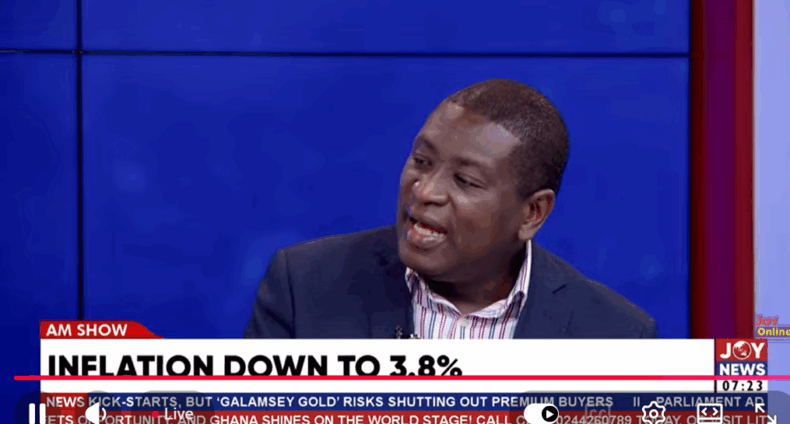
A member of the New Patriotic Party (NPP) and Executive Director of the Institute for Energy Policies and Research, Kwadwo Poku, has questioned claims that Ghana’s falling inflation rate means improved living conditions for ordinary citizens, describing such arguments as misleading and disconnected from everyday realities.
Speaking on the AM show in reaction to the latest inflation figures, Mr Poku said the opposition National Democratic Congress (NDC) was using the data “disingenuously” to suggest that economic hardship has eased, when many Ghanaians continue to struggle with high prices and stagnant incomes.
“But the reality of what Ghanaians are going through today, is it reflective in our lives? That’s the question,” he said. “Inflation is only a statistical number. It guides economic policy, but it does not automatically translate into better living standards.”
His comments come after Ghana’s inflation rate fell sharply to 3.8 per cent in January 2026, according to the Ghana Statistical Service. The figure represents the 13th consecutive monthly decline and the lowest level since the rebasing of the Consumer Price Index in 2021. Inflation stood at 5.4 per cent in December 2025.
The latest data has been cited by the NDC as evidence that economic conditions are improving under current policies, especially after years of high inflation and rising cost of living.
However, Mr Poku argued that focusing only on inflation figures ignores the deeper challenges facing households.
“People keep quoting that inflation is down, so things are better. No,” he said. “If inflation is at three per cent, it means prices are still rising, just at a slower pace. Nothing is being reduced.”
He likened the situation to a moving vehicle, explaining that although the speed has reduced, it has not come to a stop.
“Before, the car was moving faster. Now it is slower, but it is still moving. So prices are still going up,” he added.
The energy policy analyst also noted that inflation plays different roles in different economies and must be interpreted within a broader framework of growth, employment, and social welfare.
“In some jurisdictions, inflation can even be used to fund development,” he said. “But in Ghana, we are beginning to use it as a measure of the standard of living, which is misleading if other factors are not improving.”
He stressed that declining inflation must be supported by rising incomes, job creation, and reduced production costs to have a real impact on citizens.
“They are trying to tell Ghanaians that life is better because inflation is down,” he said. “But when you go to the market, when you pay rent, when you buy fuel, you know that reality is different.”
He called for a more comprehensive approach to economic assessment, one that reflects both statistical performance and lived experiences.
“As a country, we must look beyond the numbers and ask whether policies are truly easing the burden on ordinary people,” he said.
Latest Stories
-
Teacher unions strike: Gov’t presents fresh proposals as talks end inconclusively
41 minutes -
51,000 teachers’ promotion arrears to be validated for October payment – Education Minister
1 hour -
Kwabena Boamah appointed Board Chair for Impact Investing Ghana
1 hour -
Striking teacher unions to meet Fair Wages and Salaries Commission on October 6
2 hours -
EOCO working with AG to arraign Nana Baffour Awuah before weekend court
2 hours -
Duraplast reassures customers after fire, announces October 5 reopening
2 hours -
Call off strike, gov’t will not renege on promotion arrears pledge – Haruna Iddrisu appeals to teacher unions
2 hours -
Committee set up to validate teachers eligible for 20% deprived-area allowance – Education Minister
2 hours -
Five-member committee to search for new Black Stars coach after Sports Ministry-GFA meeting
2 hours -
Pinktober: Breast cancer survival exceeds 90% when detected early – Breast Society of Ghana
3 hours -
TCDA to adopt Upper West’s MATCO mango farm as northern prototype, issues warning against felling shea trees
3 hours -
‘Fear delegates’ tag: Afoko touts genuineness among delegates ahead of NPP delegates conference
3 hours -
John Boadu: The leader our party needs at this time – Amb. Edward Akwasi Boateng
3 hours -
Baffour Awuah: EOCO arrested, detained MP after hours of waiting, questioning – Afenyo-Markin
3 hours -
EOCO court warrant authorised search of Baffour Awuah’s law firm, not residence – Afenyo-Markin
3 hours