

Audio By Carbonatix
Water is life. Yet in Ghana today, access to safe water depends less on need and more on income and location. In a country that has committed itself to international human rights standards, the poorest households often pay the highest price for water while being the most exposed to unsafe and unhealthy sources. This is not an unfortunate coincidence. It is a structural injustice.
International law recognises access to water as a human right. The United Nations affirms that everyone is entitled to water that is sufficient, safe, physically accessible and affordable, without discrimination. Ghana has accepted this obligation by ratifying the International Covenant on Economic, Social and Cultural Rights, which means the right to water is not optional or aspirational. It is a legal duty.
In Ghana’s cities, however, this right is experienced very differently depending on where one lives. Urban water supply is largely managed by Ghana Water Company Limited, and in planned neighbourhoods, households typically enjoy piped connections and regulated tariffs. Water may not always flow consistently, but it is at least priced within an official framework.
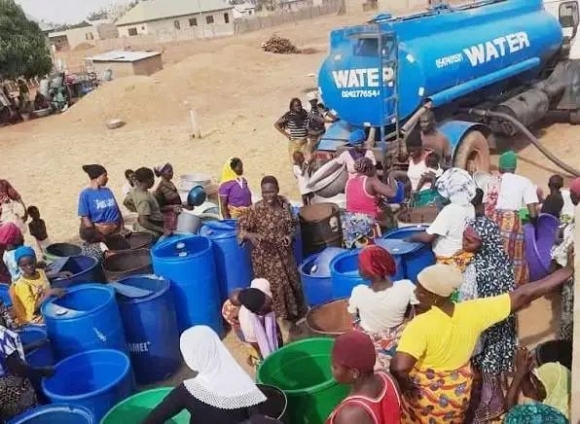
For residents of informal settlements and low-income urban communities, the situation is far more precarious. Many households have no direct connection to the public water system and must rely on private vendors, tankers, or neighbours who resell water. The result is that people with the least money end up paying several times more per litre than wealthier households with direct access. A basic necessity becomes a daily financial struggle, consuming a disproportionate share of household income.
Paying more does not buy safety either. Vendor-supplied water is often stored in containers that expose it to contamination, transported without proper oversight, and sold with little or no quality monitoring. At the same time, pollution of rivers and water sources, driven largely by illegal mining, has degraded the quality of raw water across the country. Treatment costs have increased, supply has become more erratic, and in some areas water is so polluted that it is barely treatable. The communities most affected by these failures are the same communities that already pay the highest prices.
This reality directly contradicts international human rights standards, which are clear that water must not pose a threat to health and that affordability must be ensured in a way that does not undermine other basic needs. When households are forced to choose between buying water and buying food, the right to water has already been violated.
Rural Ghana faces a different, but equally troubling, injustice. Water provision in rural areas falls largely under the responsibility of Community Water and Sanitation Agency and District Assemblies. On paper, rural water may appear cheaper or even free. In reality, the cost is simply shifted from money to labour, time, and health. Women and children often walk long distances to fetch water, boreholes frequently break down and remain unrepaired, and during dry seasons entire communities are forced to rely on unsafe sources. The burden is invisible in financial statistics, but devastating in daily life.
At the heart of this crisis is not scarcity, but governance. International law places a clear duty on governments to protect water sources from pollution, regulate private actors, and prioritise vulnerable communities. When the state allows rivers to be destroyed, tolerates unregulated water markets, and excludes informal settlements from infrastructure planning, it is not merely failing administratively. It is failing legally.
This is why the poor in Ghana pay more for water and remain more exposed to disease. It is the result of policy choices that treat water as a commodity first and a right second. Until that logic is reversed, inequality in access will continue to deepen.
Water should not depend on postal address, income, or political visibility. It is not charity, and it is not a favour. It is a matter of dignity, survival, and justice. When a society allows its poorest citizens to pay the highest price for unsafe water, it is not just water systems that have failed. It is the promise of equal rights itself.
Latest Stories
-
Western Regional Minister applauds Karpowership’s role in Ghana’s power sector
12 minutes -
Livestream: Road safety crises: Where are we getting it wrong?
14 minutes -
Enterprise Life celebrates 25 years of protecting families and building trust
22 minutes -
ICC London rules in favor of Ghana against Tullow over $400m tax charge
32 minutes -
We are disappointed in ICC’s ruling over our corporate income tax assessment in Ghana – Tullow Oil
42 minutes -
Cost of building inflation for August 2026 increases to 4.6% – GSS
43 minutes -
Today’s front pages: Wednesday, September 30, 2026
1 hour -
Bawumia highlights agricultural, compulsory insurance reforms in IBAG engagement
1 hour -
Ghana will secure Tullow tax revenues while protecting Jubilee, TEN investments – Ato Forson
1 hour -
Ghana wins $393m Tullow tax arbitration as tribunal upholds GRA assessment
1 hour -
Gender Minister assures women’s group of action on Affirmative Action, Development Bank
2 hours -
Over 2,000 teachers in Dormaa comply with strike – GNAT Secretary
2 hours -
Food Buffer Stock seeks stronger liquidity buffer despite record profit
2 hours -
LPG investments key to achieving 50% access target by 2030 – Energy Minister
2 hours -
Jinapor: New LPG terminal strengthens Ghana’s energy security
3 hours