

Audio By Carbonatix
President John Mahama has announced a new policy direction aimed at ending the export of Ghana’s mineral ores in their raw form by 2030, as part of his government’s drive to boost industrialisation and job creation.
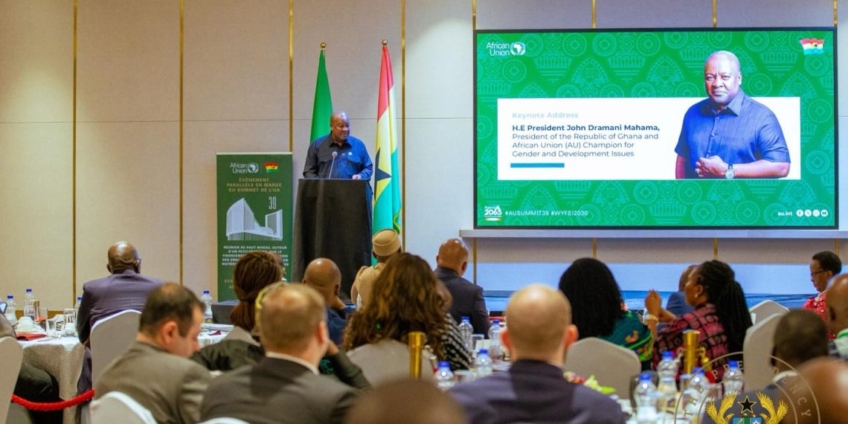
Speaking at the Accra Reset Addis Reckoning event in Addis Ababa on Saturday, February 14, President Mahama said Ghana must move away from exporting unprocessed resources and instead invest in building strong local refining and processing capacity.
“I say in 2030 there will be no mineral ore leaving Ghana. We are not going to ship manganese ore, bauxite, iron ore out of Ghana raw. You must process all that locally. That is the only way we can provide opportunities for our people,” he said.
The President explained that exporting raw materials denies the country significant revenue, jobs, and industrial growth, and has kept Ghana overly dependent on external markets for decades.
According to him, the new policy direction is already being applied to the cocoa sector, which he admitted is facing serious financial and operational challenges.
He disclosed that before leaving for Addis Ababa, his government held an emergency meeting in Ghana to discuss the situation in the sector, particularly issues relating to financing and supply constraints affecting local processors.
As part of ongoing reforms, President Mahama said the government has decided to stop relying on foreign-backed financing arrangements for cocoa purchases and shift to domestic funding through bonds.
He said the new model will allow more cocoa beans to be reserved for local processing and value addition.
“We have the capacity to process 400,000 tonnes of beans, but because those beans are collateralised, we cannot allocate those beans to the local processors, so we have to ship all the beans outside,” he stated.
“Since we produce the beans, we can provide the local processors with 400,000 tonnes of our beans to add value,” he added.
Under the previous system, large volumes of Ghana’s cocoa were used as security for foreign loans, limiting the country’s ability to support domestic industries.
President Mahama said moving to domestic financing will give the government greater control over the sector and ensure that local processors receive enough raw materials to expand production and create jobs.
He noted that adding value to resources such as gold, bauxite, manganese, iron ore, and cocoa would help reduce unemployment, strengthen the cedi, and improve the country’s trade balance.
I
Latest Stories
-
Finance Minister advises African governments to strengthen regional tax cooperation
1 hour -
NPP accuses NDC of master-minding demolition of Ho regional office fence
1 hour -
Ghana plans stronger regional power trade with Nigeria
1 hour -
GRA Commissioner-General calls for stronger tax cooperation to boost regional revenue mobilisation
1 hour -
NACOC needs more personnel to tackle drug trafficking – Toobu
1 hour -
Railway workers resist KMA eviction order, demand consultation
1 hour -
Legacy Leadership Africa Institute to host boardroom women’s leadership programme
1 hour -
Ghana needs a law to sustain constitutional reforms – CDD-Ghana
5 hours -
COVID fumigation audit: Auditor-General has a lot of questions to answer – Akwatia MP
5 hours -
Stranded Ghanaian medical graduates in Cuba appeal to Mahama for immediate return
5 hours -
GNFS contains fire outbreak at Teshie Lekma Road near Lekma Hospital
11 hours -
Samia Nkrumah rejects the narrative that Ghanaians were happy after Nkrumah’s overthrow
12 hours -
A Mother’s pain: Tribute by Ivan Baidoo’s mother
12 hours -
‘Forgive us for staying away’ — Samia Nkrumah leads family back to Nkroful, pledges to preserve Nkrumah’s legacy
12 hours -
Ernest Nuamah scores twice as Lyon beat Rennes
13 hours