

Audio By Carbonatix
The incorporation of context-responsive noise control measures into spatial and physical development plans has become necessary for human settlements.
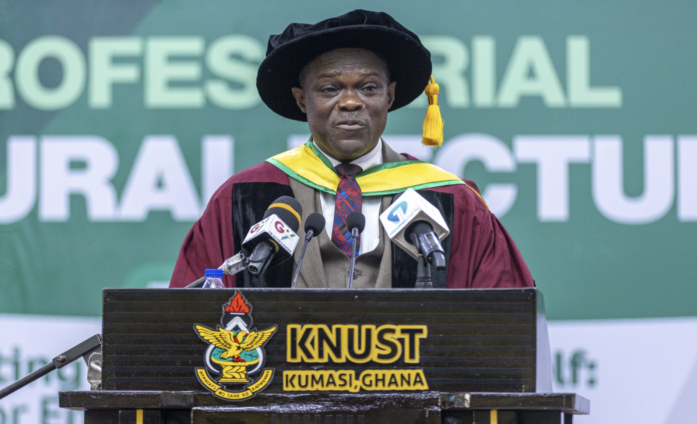
Professor Samuel Amos-Abanyie, from the Department of Architecture at Kwame Nkrumah University of Science and Technology (KNUST), said there was an urgent need to mainstream noise mitigation measures into urban planning and development practice.
According to him, such measures must reflect the unique environmental, cultural, and socio-economic realities of African cities, where mixed land use is prevalent.
He recommended that the Ministry of Works and Housing, in collaboration with higher education institutions such as KNUST, formally incorporate Indoor Environmental Quality (IEQ) monitoring into the defect liability period, as well as requirements for occupancy certification.
He explained that a building might be structurally sound and legally compliant, while occupants could still be exposed to poor indoor environmental conditions, hence the need for such monitoring.
Prof Amos-Abanyie, delivering his Professorial Inaugural Lecture at KNUST, emphasised the need for society to develop technically sound and economically feasible solutions to meet the demands of a rapidly urbanising and climate-stressed future.
The lecture, titled “Protecting Humanity from Itself: Indoor Environmental Quality in Era of Climate Stress,” explored how climate change was intensifying indoor discomfort, noting that rising temperatures and humidity levels in Ghana were increasing dependence on artificial cooling systems.
The Architecture Professor argued that buildings must no longer be seen as passive structures but as active environments that directly influence human health and well-being.
He further recommended that the Energy Commission of Ghana collaborate with universities to develop clear national guidelines for Building Energy Performance Reports to be submitted as part of the permitting process.
“In the Ghanaian context, energy-efficient design strategies are not demonstrably required as part of the building permit acquisition process; thus, they are ignored or weakly applied in property development,” he stated.
Prof Amos-Abanyie also proposed that building design professionals and developers deliberately plan for incremental housing growth at the design stage.
Property development, he suggested, should be centred on a well-designed core unit, supported by a clearly articulated extension blueprint.
He called on the Ministry of Works and Housing and related agencies to jointly drive the establishment of dedicated IEQ Units within metropolitan, municipal, and district assemblies.
These units, he noted, would coordinate the integration of IEQ considerations into planning approvals, development control, and public education at the community level.
Latest Stories
-
NC-PTAs welcomes end of teachers’ strike, urges parents to prepare children for Monday
4 minutes -
Government procures over 2,000 transformers as Ghana’s electricity access hits 89.13% – Energy Minister
30 minutes -
UTAG-UG threatens strike on October 19 over unpaid allowance
39 minutes -
Let The Constitution direct Chieftaincy to deliver “All Development Is Local”
2 hours -
John Jinapor outlines renewable energy, nuclear power priorities for 2027
2 hours -
Ghana explores centre of excellence for hearing, communication and cochlear implant care
3 hours -
Schizophrenia-related disorders lead mental health cases recorded in Ghana
4 hours -
Dutch authorities enlist Ghana in hunt for fugitive drug lord Bolle Jos
4 hours -
Ghana housing finance conference adopts communiqué to improve affordable housing access
8 hours -
Special Initiatives Minister urges Wa Technical Institute to enrol more girls as EU-backed solar training lab opens
9 hours -
In the matter of my first year at the Bar
9 hours -
ActionAid Ghana calls for an end to child marriage, greater investment in girls’ rights
9 hours -
Newsfile to tackle World Cup visa scandal, beach demolitions, education strikes, BRICS bid
10 hours -
UK-Ghana Trade & Investment Summit: Trade Resource Centre to help businesses maximise UK-Ghana trade opportunities
10 hours -
Embassy of Denmark celebrates World Maritime Day
10 hours