

Audio By Carbonatix
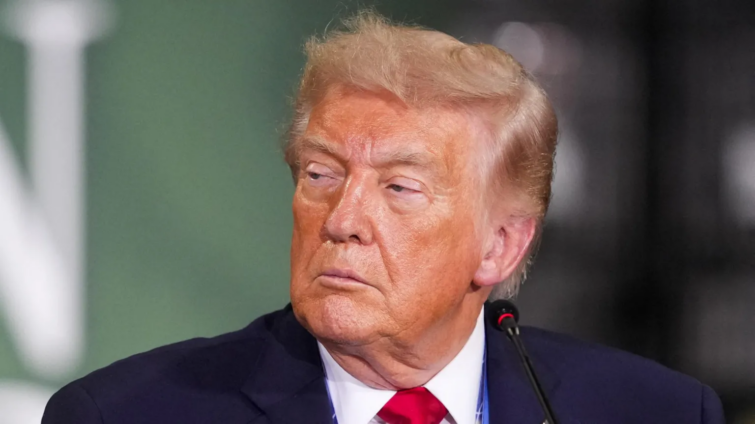
Donald Trump has said the US will hit Iran "hard" on Wednesday, after the two sides exchanged strikes overnight.
"We hit them hard yesterday and we're going to hit them hard again today," he said, speaking to reporters in the Oval Office.
He also reiterated a call for Iran to "sign a deal".
The US launched strikes on Iran on Tuesday after Trump said Iran had shot down of a US army helicopter.
Iran's Islamic Revolutionary Guard Corps (IRGC) said it responded with strikes on US bases in the region.
Earlier on Wednesday Trump wrote on his social media account: "They've taken too long to negotiate a deal that would have been great for them, now they will have to pay the price!!!" He insisted that Iran had been "completely defeated" militarily.
Iran's foreign ministry spokesman Esmaeil Baqai meanwhile accused the US of "damaging this diplomatic process through the contradictory messages it sends, its repeated shifts in positions and demands, and, worst of all, through repeated violations of the ceasefire".
He said Iran needed to re-assess the situation, adding that any diplomatic process required a minimum of stability.
Separately on Wednesday the Indian government said three Indian sailors were missing and 21 crew had been rescued after an attack on a commercial vessel near Oman, the Settebello.
It said the "targeting of commercial shipping and civilian infrastructure in the region must end".
The US military said it had struck an oil tanker in the Gulf of Oman which had "violated the ongoing blockade by attempting to transport oil from Iran".
It said a US aircraft had fired "precision munitions" into the engine room of the Palau-flagged Settebello after its crew "repeatedly failed to comply with directions from American forces".
The US is blockading Iranian ports after the key Strait of Hormuz shipping route was effectively closed by Iran in response to the US and Israeli attack on Tehran in February.
The Settebello is the eighth ship the US has fired on. Earlier this week the Indian crew of a sanctioned oil tanker were rescued by the Omani military earlier this week after the ship was hit by a US missile off Oman.
Tuesday's US strikes on Iran targeted Iranian defence systems, ground control stations and radar sites near the Strait of Hormuz, Centcom said.
Iranian state media said US strikes had hit two reservoirs in the area, leaving thousands of people in the southern port town of Sirik without access to drinking water.
Iran's Islamic Revolutionary Guard Corps (IRGC) said it launched strikes on 21 targets at US bases in the region, one in Bahrain and the other in Jordan, while Kuwait's army said it was also intercepting an attack.
Reuters cited a US official on Wednesday as saying nearly all of the Iranian missiles and drones launched at US bases in the Middle East in response were intercepted, with no reported casualties.
On Tuesday, Centcom described its strikes on Iran as "a proportional response" for the Apache helicopter downing on Monday.
Trump previously said on Truth Social that the helicopter had been "shot down" as it was patrolling the Strait of Hormuz. Fox News quoted Trump on Wednesday as saying that an Iranian drone had hit the helicopter without exploding as it flew "very low" .
The two crew members survived and were rescued by an American sea drone.
Iran's semi-official Iranian Mehr News Agency reported that Iran had not claimed responsibility for downing the aircraft.
The war began on 28 February, after the US and Israel launched wide-ranging strikes on Iran that killed the country's supreme leader.
Iran responded by launching attacks on Israel and US-allied states in the Gulf. The fighting escalated quickly across the region, with Lebanon drawn into the conflict in March.
In April, the US and Iran agreed to a ceasefire that was initially meant to last for a period of two weeks.
Both sides have since exchanged intermittent fire, without returning to full-scale hostilities.
Meanwhile, the countries' representatives have engaged in fraught negotiations, including a meeting in Pakistan, in an attempt to find a lasting solution to the conflict.
Separately on Wednesday, the International Atomic Energy Agency (IAEA) - the UN nuclear watchdog - approved a US-backed resolution telling Iran to provide details on its uranium stockpile and production facilities.
The Iran Mission to the UN in Vienna, where the IAEA is based, criticised the move, saying: "The resolution hypocritically expresses support for a diplomatic solution, while the US simultaneously engages in further acts of aggression including against Iranian civilian infrastructure and promotes confrontation in different fora."
Iran's nuclear programme is central to negotiations between it and the US and Israel, who have both led Western opposition to the programme, claiming Iran is seeking to develop a nuclear bomb.
Iran insists its nuclear programme is entirely peaceful and denies it is seeking to develop nuclear weapons.
Latest Stories
-
ECG announces power outage in parts of Tema, Central Region due to network fault, maintenance
3 minutes -
When the Gospel Becomes a Weapon: The church, blackmail and the abuse of faith
28 minutes -
JoyNews’ Jacqueline Ansomah Yeboah selected for UK Media Excellence for Emerging Technology Fellowship
46 minutes -
Mental Health Alliance urges government to operationalise Mental Health Fund
1 hour -
Ghana–Holy See agreement heads to Parliament after Cabinet approval
1 hour -
Luv FM Corporate Games 2026: Kumasi Central Prisons, Amanfiman Bank win big amid fun
1 hour -
WAFU B U17: Ghana top Group A after win over Togo
2 hours -
Ho Central Mosque reopens amid unresolved leadership dispute that led to closure
3 hours -
Minority caucus questions GH¢16.4m in Ablakwa’s SA evacuation spending, demands independent audit
3 hours -
Gender Ministry meets Nana Akua Addo’s husband over domestic violence after hospital discharge
4 hours -
UG Vice-Chancellor urges swift operationalisation of National Research Fund
4 hours -
Pope Leo to have surgery after lump found in lung
4 hours -
Joseph Cudjoe writes: Ghana must break free from the dangerous mindset that natural resources are the foundation for wealth
5 hours -
Children among 109 dead after boat capsizes off Djibouti, UN says
5 hours -
OmniBSIC Bank’s 11th health walk promotes fitness and business growth
5 hours