

Audio By Carbonatix
India's largest stock exchange and its biggest telecoms operator will both go public by the end of this year in what experts say could be landmark listings for the country's capital markets.
Jio Platforms, the digital arm of billionaire Mukesh Ambani's Reliance Industries, and the National Stock Exchange (NSE) - the world's largest derivatives exchange and among the top three equity exchanges by trading volume - filed draft papers for their initial public offerings just days apart last month.
Jio is expected to mop up around $4bn (£3.02bn) from the market at an estimated valuation of $120-160bn, while NSE's issue will reportedly offer 6% equity for $3.3bn, valuing the bourse at $57bn.
Beyond the unprecedented scale of the offerings - which could take India's overall market capitalisation up by several notches - investors are closely watching the listings because they represent the sweeping changes in the way Indians have come to live, consume, invest and transact in the last decade, Yatin Singh, CEO - Investment Banking at Emkay Global, told the BBC.
"These are unique businesses which don't get built often. NSE is a direct proxy of the 'financialisation' of Indian household savings into mutual funds and stocks, while Jio is the story of a company that single handedly ushered in a digital revolution, becoming a driving factor for several new-age Indian businesses," said Singh.
"Their listings could be seminal for the Indian markets in the way the marquee offerings of software companies became many decades ago," he adds.
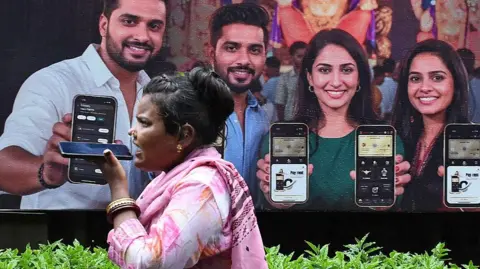
Jio's belated entry into India's crowded telecom market in 2016 consolidated a highly fragmented industry of 17 operators and turned it into a virtual duopoly, as the Ambanis sparked a fierce pricing war by offering virtually free data to hundreds of millions of new users.
Barely 200 million Indians used the internet a decade ago. That number is now inching closer to the billion mark, with Jio alone amassing 525 million of those subscribers. They use its data to make payments, watch web shows and shop online.
In fact, Indians are now the largest consumers of mobile data globally, surpassing even developed markets like the US and China. And this has largely been driven by Jio's low-cost tariffs, which democratised smartphone use.
The way the country spends its time and money has also changed dramatically as a result of this digitisation.
India's United Payments Interface (UPI), launched in the same year as Jio, went from processing nearly zero digital payments to 228 billion transactions in 2025, according to Zerodha, a brokerage firm. And paid subscribers to OTT platforms jumped 40% between 2019 and 2026.
"The monthly data bill of Indians quietly tripled, growing at 3x the rate of rural wages", according to a report from Kotak Bank, with people spending more and more time watching video and using social media apps.
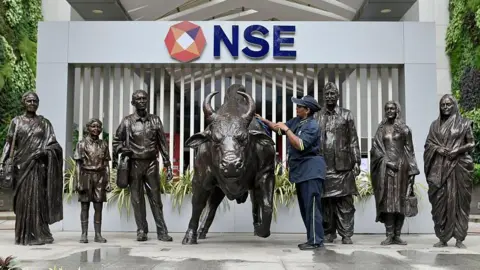
The rise of the NSE, meanwhile, mirrors the explosion of retail investing in India, as millions of mom-and-pop investors entered the stock market during the pandemic. Fuelled by cheap mobile data and rising smartphone use, the number of online trading accounts surged from about 30 million to more than 200 million.
Its listing, long delayed by a host of governance issues, signals the "maturing" of India's market infrastructure and the broad-basing of its investor base, Feroze Azeez, of Anand Rathi Wealth Limited, a wealth management firm, told the BBC.
The exchange is the backbone of India's $4.85tn stock market, now the world's fourth largest by market capitalisation. Every trade executed on its platform generates revenue for the NSE, and trading volumes have grown rapidly.
It also earns exceptionally high profits, even though its revenues are directly affected by trading volumes, which can swing quite sharply.
As it readies for a listing, Jio is now positioning itself as more than just a telecom company.
It wants to be seen as a homegrown digital and AI infrastructure behemoth through partnerships with Nvidia and Meta to develop data centres and large language models trained on Indian languages.
It is also moving from a phase of "market share acquisition to monetisation" driven by tariff increases, higher data use, and upgrades to postpaid plans, according to Elara Securities - a signal that the country's consumer market is becoming more sophisticated.
"Together, Jio and NSE represent the twin pillars of India's new economy," Azeez said.
Their simultaneous offerings could help attract global capital, as these companies "broaden the investable universe" and provide foreign investors with opportunities to invest in sectors central to India's growth story going forward.
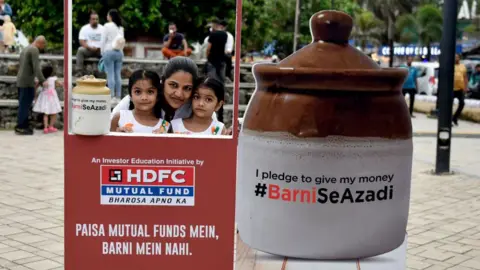
But whether the issues alone will be enough to "turn the tide for foreign investors to come back in droves to the Indian markets, remains uncertain", says Singh.
The Indian markets have been among the worst performing globally over the last year, as foreign investors pulled billions of dollars from the country in search of higher returns in the US and AI-driven opportunities elsewhere in Asia.
A crashing currency has only worsened the country's appeal.
Many small investors have also burnt money in recent years, investing in flashy share sales of companies like PayTM and LIC - the country's biggest financial behemoths. And dozens of high-profile IPOs are now trading at below their listing prices.
All of this has shaken investor confidence.
The pricing of these issues will ultimately determine whether their business success translates into shareholder returns.
"Even high-quality businesses can deliver disappointing returns if they are issued at overly aggressive valuations," said Azeez.
Latest Stories
-
Africa not seeking Western cash in reparations campaign – Ablakwa
10 minutes -
Production decline, reserve depletion threaten Ghana’s upstream sector – Jinapor
14 minutes -
Surveyors caution against treating compensation disputes as professional misconduct
17 minutes -
Mahama calls for AU dialogue on migration after South Africa xenophobic tensions
22 minutes -
I haven’t experienced any envy in the gospel music industry — Ohemaa Mercy
2 hours -
Prayer does not solve everything — Ohemaa Mercy
2 hours -
New PURC office symbolises stronger consumer protection – Dr Jinapor
2 hours -
Rev. Wengam re-elected Assemblies of God, Ghana General Superintendent
3 hours -
Less than 20km of clearing left to connect Accra-Kumasi Expressway to Kumasi – Agbodza
3 hours -
US judge strikes down policy suspending immigrant visa processing for 75 nations
3 hours -
MCEs collecting fees from galamseyers are facilitating illegality – Ken Ashigbey
3 hours -
Developer LMI Holdings commits to completing first 700 Saglemi housing units
3 hours -
Africa’s next chapter will be built by institution-builders, not idea-havers
3 hours -
Wenchi Traditional Council suspends Twafohene indefinitely
4 hours -
Kpassa-Merimeri road undergoes filling and levelling works to improve accessibility
4 hours