

Audio By Carbonatix
Ghanaian factories, manufacturers, shopping centers, and other commercial and industrial energy users can adopt solar power without committing capital of their own upfront, according to CIPA Holdings Group, which used this year's Energy Sustainability Leadership Conference (ESLC) in Accra to set out how its solar financing model works, and its plans to fund and scale it further.
The 3rd Edition ESLC, held on August 27, 2026 at the Labadi Beach Hotel in Accra, was organized by Safety Communication Consult (SCC) in partnership with the Ministry of Energy and Green Transition, under the theme “Public-Private Synergy: The Role of Corporate Ghana in National Energy Transformation.”
Dr Yussif Sulemana, Technical Advisor at the Ministry, delivered the keynote on behalf of Hon. John Jinapor, Minister for Energy and Green Transition, calling on corporate Ghana to move beyond being consumers of electricity or government contractors to become “investors, innovators and strategic partners” in the country's energy transformation.
Dr Kojo Ackaah-Kwarteng, Board Chairman of SCC, echoed that call, pointing to innovative financing models as an area where private capital needed to move faster.
It was against this backdrop that, in a presentation titled “Unlocking Local Capital for C&I Solar,” the CFO of CIPA Holdings Group explained that the company is already financing solar and battery energy storage system (BESS) projects for C&I clients in Ghana using local currency, structured through Solar as a Service arrangements.
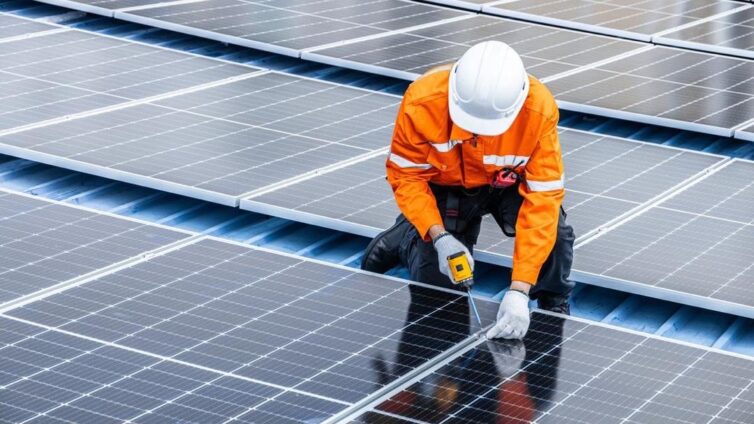
Under this model, CIPA and its financing and technical partners fund, install, and often operate the solar system, while the client simply pays for the power it consumes, typically at a lower and more predictable rate than grid tariffs.
The CFO said the businesses best placed to benefit are those with sizeable and consistent power consumption, usable rooftop or land space, and a sound payment history – factors that apply as much to a factory or processing plant as to a shopping center, hotel, or office complex.
The presentation also addressed why this kind of financing has historically been hard to access at scale in Ghana, citing four recurring obstacles: a mismatch between the three-to-seven-year terms local banks typically lend on and the ten-to-fifteen-year repayment periods solar assets need; limited lender experience underwriting this asset class; the absence of a standardized, aggregated project pipeline; and deal sizes too small to meet typical project finance thresholds.
“The problem is not that Ghana lacks capital. The problem is that the capital is not yet packaged in a form that institutional investors can efficiently deploy into distributed energy assets,” the CFO said.
CIPA's response, the CFO said, has been to pool multiple C&I solar assets into a single investable portfolio, backed by independent governance and catalytic first-loss capital, so that local banks, private credit funds, and pension funds can lend against a governed platform rather than a single project.
Building on that model, the CFO disclosed CIPA is sponsoring a cedi-denominated green bond programme, delivered through its GreenStar platform, with an ambition to scale up to GHS1 billion over five years, intended to bring more local institutional capital into the sector.
The platform is also meant to operate as a financing gateway for other qualified C&I solar and BESS developers, bringing additional bankable projects into a common capital-raising framework rather than one-off transactions.
The programmer’s first phase is anchored by a pipeline of at least 20 megawatts of aggregated assets, the CFO said, with an ambition to scale well beyond that as CIPA brings in other developers and service providers collaboratively.
CIPA said it was in early engagement with capital markets advisors and would proceed through the applicable Securities and Exchange Commission approval process ahead of any issuance.
“Our goal is that any creditworthy commercial or industrial energy user in Ghana – a factory, a manufacturing plant, a shopping center, or an industrial enclave – should be able to power a meaningful share of its operations with solar without having to raise that capital itself,” the CFO said.
“This green bond programmed, which we intend to scale up to GHS1 billion over the next five years, is what allows us to extend that offer to more clients, faster, by partnering with other C&I solar and BESS developers and service providers to do this at scale across the market.”
The presentation cited a 2023 BloombergNEF study ranking Ghana among the top three C&I solar markets in Sub-Saharan Africa, projecting the segment to grow at roughly 39 per cent a year through 2031 – growth the CFO said has likely accelerated further since, as rising energy costs push more businesses toward on-site solar.
The broader financing context was picked up later in the day by Mr Kwaku Osei-Sarpong, Founder and Chief Executive Officer of CIPA Holdings Group, who featured on two plenary panels: Corporate Governance in Energy Projects, and Climate Finance and Green Bonds.
On climate finance, he said Ghanaian banks have gradually extended lending tenors to around seven years, still short of what solar assets typically require, and made the case for local currency financing to reduce foreign exchange exposure for issuers, investors, and businesses alike.
He also pointed to Ghana's pension funds as a large, largely untapped pool of long-term capital suited to energy assets – the “missing middle” of the country's climate finance landscape – aligning with government's own target of raising renewables to 10 per cent of the national mix by 2030, and 50 per cent by 2060.
On governance, he argued that lenders increasingly treat oversight and transparency as a condition for financing. “Capital does not just ask whether an asset is good anymore,” he said.
“It asks who is watching the money, and whether that answer can be trusted.” He pointed to the Energy Commission's Integrated Power Sector Master Plan as evidence the sector's real risks were flagged well in advance, with the test now being whether such plans translate into procurement discipline.
“The next phase of this sector belongs to institutions that can be trusted with real capital, not just good ideas,” Mr Osei-Sarpong said, tying the day's discussions back to the conference's theme of public-private synergy.
CIPA Holdings Group is a Pan-African climate-resilient infrastructure holding company headquartered in Accra, with interests spanning clean energy, public infrastructure, digital infrastructure, electromobility, climate-smart agriculture, and real estate.
Latest Stories
-
Mustapha Hamid leads NPP First Vice Chairman race in latest poll
7 minutes -
Standard Chartered Bank pays GH¢97.8m dividend to SSNIT
12 minutes -
Frimpong Kodua leads NPP General Secretary race with 44.6% – Global Info Analytics
15 minutes -
LGA commends State-Owned Enterprises for recording strong 2025 performance
19 minutes -
The million-dollar problem sitting offshore: Why Ghana’s cement makers are adding GH¢12 to every bag
24 minutes -
Ghana Water serves about 18.5 million people nationwide – MD
30 minutes -
Daily Insight for CEOs: Closing the gap between strategy and execution
46 minutes -
Mahama’s Feed the Industries policy to rejuvenate industry, drive real-sector growth and 24-hour economy
47 minutes -
Ghana Water MD admits ‘smart’ meters installed since 2017 still not fully activated
56 minutes -
Bongofari, others salute Ebo Taylor at tribute concert
57 minutes -
Africa Food Systems Forum: John Dumelo urges Ghanaian youth to embrace agriculture
57 minutes -
Africa World Airlines resumes Accra – Abidjan direct flights
59 minutes -
Ageing GWCL pipelines dating back to 1960s driving water losses – MD laments
60 minutes -
Africa Food Systems Forum: Dumelo calls for borderless Africa to boost agricultural trade
1 hour -
First National Bank’s Investment Gift Cards out now to give Ghanaians a new way to gift a brighter future
1 hour