


Audio By Carbonatix
Facebook is asking British users to send naked photos of themselves to the social network, to try to stop revenge porn.
If you're worried an intimate photo of you could be shared by someone else, the idea is to get it blocked before it appears online.
Similar technology is used to try to stop the spread of child abuse images.
Facebook's been testing the system in Australia and is extending the trial to the UK, the USA and Canada.
A spokesman told Newsbeat the idea is open to people in the UK now.
Facebook hasn't revealed any details about how the trial in Australia went - but obviously, the idea requires a huge leap of faith.
Would you send sexually explicit photos of yourself to Facebook?
Could you be certain the image would be handled sensitively - and crucially, not shared?
How it works
If there's an image you're worried about, Facebook says you should contact its partner for the trial. In the UK, it's the Revenge Porn Helpline.
Staff there will then get in touch with Facebook and you'll get sent a link to upload the photo.
Who will see my naked photo?
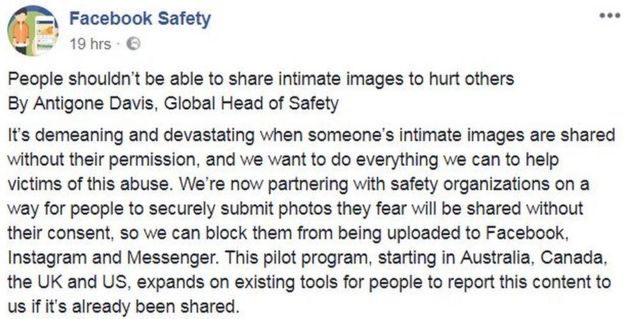
Facebook's Global Head of Safety Antigone Davis told Newsbeat that photos will only be seen by "a very small group of about five specially trained reviewers".
They'll give the photo a unique digital fingerprint - something called hashing.
That code will then be stored on a database. If anyone else tries to upload the same photo, the code will be recognised and it'll be blocked before it appears on Facebook, Instagram and Messenger.
The original photos will not be stored.
Will the idea definitely work?
Antigone Davis admits there's "no 100% guarantee when it comes to photo-matching technologies".
That's because it's possible to manipulate images so they're different to the original. But she says they are getting better at it.
This whole system only works if you actually have the image you're worried about.
If, for example, your ex took a load of photos on their phone and you don't have them, this idea doesn't help.
The UK's Revenge Porn Helpline has seen huge year-on-year increases in reported incidents since it was launched in 2015.
The hotline received just over 500 reports in 2015 and more than 1,000 in 2017.
Latest Stories
-
Ato Forson thanks constituents for 18 years of support
7 minutes -
T-bills auction: Government exceeds target by 51%, interest rates fall again
9 minutes -
Avoid comparing governments, Catholic Bishops tell Chief Justice
48 minutes -
140 migrants in single dinghy rescued in English Channel
1 hour -
FIFA president Infantino will stand for re-election
1 hour -
Catholic Bishops reject calls for Chief Justice’s resignation over political remarks
1 hour -
Germany’s far-right AfD set for big win in eastern state, just short of majority
2 hours -
Catholic Bishops urge Chief Justice to avoid remarks that could raise doubts about impartiality
2 hours -
Mrs Doris Emma Doryumu (Nee Dove)
2 hours -
Illegal mining concessions easier to obtain than lawful ones in Ghana – Prof Frimpong-Boateng
2 hours -
At least 5 dead after Amazon cargo plane barreled off runway at Miami airport
2 hours -
Frimpong-Boateng proposes Environmental Restoration Fund funded by mineral royalties
3 hours -
Corrupt individuals are worse than pathogens; their actions cause premature deaths – Prof Frimpong-Boateng
3 hours -
No illegal mining operation will find refuge on Akyem Essase lands — Chief declares
3 hours -
Flight price rises due to ‘foolish leaders’ starting wars, Virgin’s Branson says
3 hours