

Audio By Carbonatix
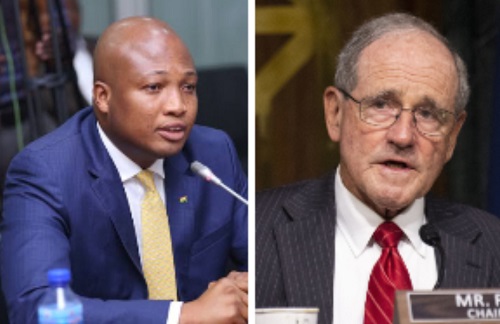
Minister for Foreign Affairs, Samuel Okudzeto Ablakwa, has rejected comments by a senior US lawmaker Jim Risch who criticised Ghana’s government over debts owed to American companies and taxpayers, using the opportunity to reignite calls for reparations from the United States over its role in the transatlantic slave trade.
The diplomatic spat began when the US Senate Foreign Relations Committee, via a post on social media, suggested that Ghana’s Foreign Minister should stay home and prioritise paying outstanding debts rather than travelling to Washington for diplomatic engagements.
The tweet, which has drawn sharp responses online, accused Ghana of continuing to pay larger debts to China while allegedly defaulting on its financial obligations to American entities.
“Instead of a trip to D.C., Ghana’s foreign minister should focus on honoring his government’s commitments to repay U.S. companies and the American taxpayers. We cannot keep subsidizing Ghana while it continues paying far larger debts to China,” the post read.
In a swift and strongly worded reply posted on Twitter (formerly X), Mr Ablakwa described the remarks as “very rich” coming from a country that has consistently failed to confront and atone for its involvement in the slave trade.
“This is very rich coming from someone who refuses to engage in the same advocacy for the payment of reparations by the US for its despicable and condemnable role in slavery,” the Minister wrote.
Reaffirming Ghana’s sovereignty and the legacy of its independence struggle, Mr Ablakwa referenced the country’s founding father, Dr Kwame Nkrumah, to assert Ghana’s independence in foreign affairs.
“You will not be allowed to dictate to a sovereign country on how we conduct our foreign policy — if you need to be reminded — this is Kwame Nkrumah’s Ghana — the first African nation to defeat colonialism and imperialism,” he declared.
While acknowledging that Ghana owes debts to some American companies, the Foreign Minister downplayed their scale and placed them in historical context.
“Those measly debts, compared to what you owe us in reparations, would be paid when we deem appropriate based on our prudent economic recovery program — even though the debt was not created by the new Mahama administration,” he stated.
The Minister’s remarks mark a rare and open challenge to Washington’s tone in bilateral discourse, and revive a growing continental call for reparatory justice in the wake of centuries of colonialism and slavery.
His comments also come at a time when the Mahama administration is navigating a complex economic recovery programme, including debt restructuring and reforms aimed at restoring macroeconomic stability.
Mr Ablakwa concluded by stressing Ghana’s commitment to fulfilling its obligations, despite not being responsible for the origins of the debt in question. “Unlike you, we take responsibility and honour our national obligations,” he stated.
Latest Stories
-
Prudential Life settles GH¢100,000 medical bills under its PRUCares Valentine Experience Initiative
5 hours -
Wa West Picnic: Peter Lanchene Toobu champions peace, health and unity in landmark celebration
5 hours -
Dr Mensah Market flooded after downpour in Kumasi
5 hours -
Armed men reportedly storm Adjen Kotoku Onion Market amid tensions
6 hours -
Tecco Mensah writes: Why football fans must look beyond statistics
7 hours -
Police recover stolen Honda CR-V in Kumasi within 48 hours
8 hours -
Apetorku Gbodzi 2026 Festival opens in Dagbamete with development focus
8 hours -
President Mahama arrives in Lyon to co-chair One Health Summit
8 hours -
Beverly View Plus Hotel draws crowds amid coastal Easter rush in Volta
8 hours -
Maiden Zongo Festival held in Wa amid calls to tackle drug abuse among the youth
8 hours -
FDA warns of fake HIV test kits on Ghanaian market
9 hours -
Africa urged to build resilient health systems as donor support tightens
9 hours -
Easter gesture: Ablakwa settles medical bills for 85 North Tongu constituents
11 hours -
Africa must harness its population strength—Titus-Glover
11 hours -
Visa-free access doesn’t mean unlimited stay – Lom Ahlijah
11 hours