

Audio By Carbonatix
A week after flash floods hit eastern Spain, recriminations are flying over who was to blame for the country’s worst natural disaster in living memory amid angry scenes on the part of those affected.
An initial image of cross-party unity has been replaced by disputes over which institutions had jurisdiction in the disaster areas where at least 218 people lost their lives.
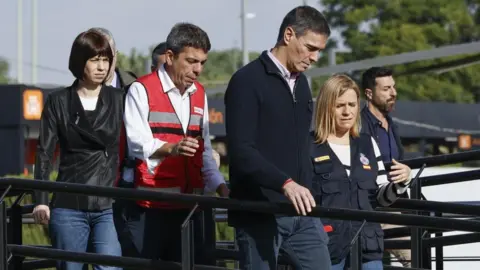
In the immediate aftermath of the floods, Valencia regional leader Carlos Mazón of the conservative People’s Party (PP) welcomed Socialist Prime Minister Pedro Sánchez and thanked him for his government’s support.
It was an unusual sight in the context of Spain’s deeply polarised politics, with Mazón even calling Sánchez "dear prime minister".
Valencia's regional leader has faced criticism for taking around 12 hours to respond to a red weather warning by Spain's National Meteorological Office (Aemet) on 29 October and issue an alert directly to people’s phones, by which time the flood was already causing enormous damage.
However, the national leader of the PP, Alberto Núñez Feijóo, questioned the information provided by the Aemet, which is supervised by the central government. He also complained that the prime minister's administration had not coordinated with the regional government.
In the days since, pressure has mounted on Mazón, with many commentators and political adversaries calling on him to resign for his actions on that day, as well as for eliminating the Valencia Emergency Unit (UVE) upon taking office last year.
In response, he has taken a more confrontational approach, in line with that of his party boss.
That has included blaming the CHJ hydrographic agency, which is controlled by Madrid, for allegedly activating and then de-activating an alert on the day in question.
“If the CHJ had re-activated the hydrological alert, the alarm message would have been sent immediately” by the regional government, Mazón said.
The CHJ has responded by explaining that it provides data on rainfall and related matters but that it does not issue alerts of this kind.
Fifteen thousands troops, civil guards and police have now arrived in the Valencia region, double the number from last weekend.
Mazón has countered claims that his government did not request enough support from the military in the wake of the weather event, insisting that the armed forces themselves were responsible for such decisions.
The head of the military emergency unit (UME), Javier Marcos, responded by saying that protocol dictated that the regional government had to request any such support.
“I can have 1,000 men at the door of the emergency but I can’t go in, legally, without authorisation from the head of the emergency,” he said, referring to the Valencia leader.
Mazón’s comments about the military reportedly enraged the defence minister, Margarita Robles, who expressed her anger during a crisis meeting of ministers with King Felipe on Monday.
Meanwhile, the political situation has been further complicated after calls by Núñez Feijóo for the prime minister to declare a national state of emergency, which would centralise management of the crisis in Madrid, wresting powers from Valencia’s regional government.
The leader of the far-right Vox party, Santiago Abascal, has also backed such a measure, which has been ruled out by the government.
“Sánchez is the one responsible for not activating all the state resources when lives could have been saved,” he said, denouncing the “evil and incompetence” of the administration.
The king, Sánchez and Mazón were all hit by the blowback of public anger over the handling of the tragedy on Sunday, when people in the Valencian town of Paiporta, the worst hit by the floods, threw mud and jeered at them, calling them “murderers”.
As the scenes became increasingly violent, the prime minister’s security detail led him away to his car. Mazón stayed near the king and Queen Letizia, who both engaged with some of the local people to reassure them that everything possible was being done to help.
While the wisdom of that visit has been widely questioned, Mazón has since presented a €31.4bn proposal for the reconstruction of the flood-devastated areas, to be financed by the central government.
Sánchez, meanwhile, has announced a separate initial aid package worth €10.6bn.
“What Spaniards want is to see their institutions, not fighting with each other, but working shoulder to shoulder,” he said as he announced it.
Latest Stories
-
Trade Minister applauds GUTA as a pillar of economic growth; Prez Mahama honoured
51 minutes -
President’s brother’s takeover of Damang Mines is ‘untidy’ – Alhassan Tampuli
57 minutes -
It’s not true that gov’t decided not to renew the lease for Gold Fields – Bobby Banson
1 hour -
Ghana to boost tomato production with 60-hectare irrigated farms and processing initiatives
1 hour -
E&P’s takeover process of Damang Mines was very clean – Inusah Fuseini
1 hour -
Damang takeover: There is not going to be any job loss; it is a lease change – Bobby Banson
2 hours -
Gold Fields didn’t stop mining at Damang mines; such claims are untrue – Bobby Banson
2 hours -
Engineers and Planners currently operate only in Ghana – Bright Simons
2 hours -
Lands Minister has no legal basis to restrict lease to Ghanaian firms – Bright Simons
2 hours -
Gov’t’s refusal to renew Gold Fields’ lease was simply untenable – Bright Simons
2 hours -
SOS Children’s Villages Ghana deepens partnership with Gender Ministry
3 hours -
Gender Ministry celebrates Christina Koch, reaffirms commitment to empowering girls
3 hours -
Live stream: Newsfile digs into E&P’s takeover of Damang Mines, OSP powers and Anti-LGBTQ Bill
3 hours -
Moody’s maintains Ghana’s rating at Caa1, revises outlook to positive
4 hours -
Zambia elevates tourism education to national priority as President Hichilema backs continental summit
4 hours