

Audio By Carbonatix
The Spanish government has said that the national grid operator and private power generation companies were to blame for an energy blackout that caused widespread chaos in Spain and Portugal earlier this year.
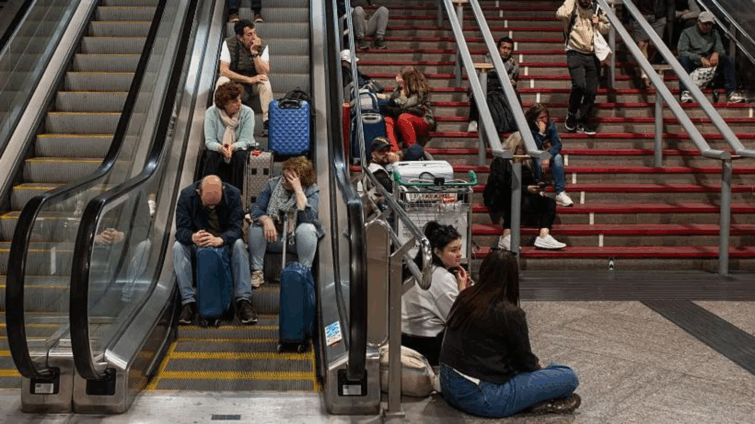
Shortly after midday on 28 April, both countries were disconnected from the European electricity grid for several hours. Businesses, schools, universities, government buildings and transport hubs were all left without power, and traffic light outages caused gridlocks.
While schoolchildren, students and workers were sent home for the day, many other people were stuck in lifts or stranded on trains in isolated rural areas.
In the immediate aftermath, the left-wing coalition government did not provide an explanation, instead calling for patience as it investigated.
Nearly two months after the unprecedented outage, the minister for ecological transition, Sara Aagesen, has presented a report on its causes.
She said the partly state-owned grid operator, Red Eléctrica, had miscalculated the power capacity needs for that day, explaining that the "system did not have enough dynamic voltage capacity".
The regulator should have switched on another thermal plant, she said, but "they made their calculations and decided that it was not necessary".
Aagesen also blamed private generators for failing to regulate the grid's voltage shortly before the blackout happened.
"Generation firms which were supposed to control voltage and which, in addition, were paid to do just that did not absorb all the voltage they were supposed to when tension was high," she said, without naming any of the companies responsible.
The day after the outage, Prime Minister Pedro Sánchez suggested that private electricity companies might have played a role, saying that his government would demand "all the relevant accountability" from them.
However, the new report on the blackout also raises questions about the role of Beatriz Corredor, president of Red Eléctrica and a former Socialist minister, who had previously insisted that the grid regulator had not been at fault.
Aagesen said that there was no evidence that a cyber-attack had caused the blackout.
The government's delay in presenting an explanation for the blackout had drawn widespread criticism and led to intense scrutiny of the country's energy model, with the opposition suggesting that an increasing reliance on renewables and rejection of nuclear energy may have played a part.
Alberto Núñez Feijóo, leader of the main opposition People's Party (PP), said that the prime minister was "so intent on being the greenest in the world that you have led Spaniards into the dark".
However, the government has repeatedly insisted that Spain's renewable energy output was not the cause of the outage.
Latest Stories
-
Consumer Protection Agency commends FDA for destroying illegal bales of diapers
2 minutes -
GNFS rescues stranded persons after flooding in Hohoe
23 minutes -
Baffour Awuah deliberately refused to honour EOCO invitation – Deputy AG, Srem-Sai
39 minutes -
‘Believe in these players’ – Carlos Queiroz tells Ghanaians after leaving Black Stars job
39 minutes -
ECG announces planned maintenance outage in parts of Accra on Friday
51 minutes -
Carlos Queiroz sacked as Black Stars head coach
58 minutes -
Parliamentary Sports Committee to ‘interrogate’ Black Stars struggles with Ministry, GFA invitations
1 hour -
Asutifi North Police arrest 7 in crackdown on suspected drug activities
1 hour -
Attijariwafa Bank: What to know about the Moroccan Group taking over SG Ghana
1 hour -
University Librarians Ghana honours past leaders for distinguished service
1 hour -
Seychelles President leads high-level dialogue on Africa’s digital future at FALS Global Conversations in New York
1 hour -
24-hour economy requires faster justice for commercial cases – Chief of Staff
2 hours -
Five Agric Colleges receive digital tools to drive climate-smart farming
2 hours -
GPL 2026/27: Kotoko face Karela test as Hamza Obeng takes temporary charge
2 hours -
QNET condemns misuse of its name in fraudulent recruitment schemes
2 hours