

Audio By Carbonatix
President John Dramani Mahama has called on African nations to assert greater control over their affairs, stressing the need for self-reliance, unity and responsible management of the continent’s vast resources.
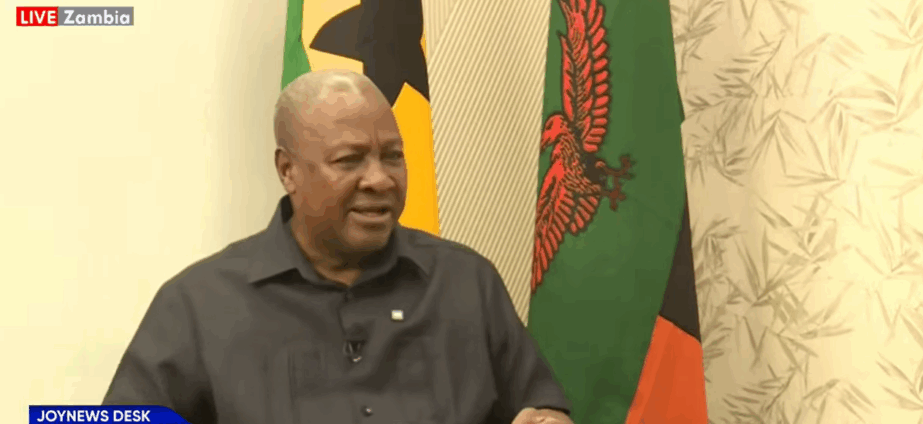
Speaking during an exclusive end-of-visit interview with JoyNews’ Maxwell Agbagba and a Zambian journalist, President Mahama outlined the thinking behind the Accra Reset, a policy framework aimed at positioning Africa strategically within a rapidly shifting global geopolitical order.
“Accra Reset is about what chart Africa should pursue in the changing geopolitical world because the rules-based system, the multilateral system, has become shaky. Countries are acting unilaterally,” he said.
President Mahama expressed concern about declining international support for Africa, warning that the continent can no longer depend on external assistance.
“They are cutting down the overseas development assistance. Humanitarian assistance has gone down. Africa cannot continue going cup in hand, you know, begging for that kind of assistance. We need to pull ourselves up by our bootstraps,” he stated.
He explained that the Accra Reset is intended to drive internal reforms and collective decision-making among African states.
“I chose to give a speech that rallies Africa together based on the objectives of the Accra Reset so that we can come together, collective decision-making, and then, apart from that, carry out internal reforms in terms of our governance and everything, respect for human rights, you know, and all the fight against corruption, accountability, selfless leadership, service, consider leadership as service to the people. All those things are necessary for us to be able to face the rest of the world.”
Clarifying the intent of the initiative, President Mahama stressed that it does not seek to undermine international cooperation.
“Accra Reset is not about disrupting global partnerships. It's about forging new ones based on mutual respect and shared prosperity,” he said.
Linking the initiative to the ideals of pan-Africanism, he reflected on the vision of Ghana’s first President, Dr Kwame Nkrumah.
“I think that it's a carryover from the early days of pan-Africanism. And, you know, when President Nkrumah said, ‘We need to show to the world that, after all, the Black man is capable of managing his own affairs.’ And so we must learn to manage our own affairs.”
A central pillar of President Mahama’s message was Africa’s need to assert sovereignty over its natural resources and break away from extractive economic models inherited from the colonial era.
“The colonial period, where our resources were pillaged and just sent away, without any real value coming back to us, must change. We must take more control of our resources. We must make more out of our resources. We must add value to our resources before we export. We cannot continue to be exporters of raw material without, and then they will add value to it.”
He cited Zambia and Ghana as examples of the imbalance in global trade relations.
“They take copper out of Zambia. They go use the copper, produce finished products, and bring the finished products back to Zambia at 1,000 times the cost of the copper ore that they took. Same with Ghana. Manganese, bauxite, and all that are taken in their raw form. And they are used to produce items that are brought back to us at 1,000 times the price.”
President Mahama said Ghana has begun reversing this trend through policy reforms.
“In Ghana, we are changing the narrative. We are asking to ban the export of raw bauxite and raw manganese. And we've asked the mining companies to set up the refining plants to refine the ore into at least primary processed products before they are exported. With bauxite, we want the full value chain, you know, from the ore to the alumina production and then to the VALCO aluminium smelting so that we bring it out in its purer form for use as engine blocks for aeroplane manufacturing and all that kind of thing.”
He also pointed to progress in the gold sector.
“We started with gold. You saw the signing ceremony with Gold Coast Refinery to refine one ton of gold a week, which amounts to about 52 tons of gold a year. Our total production from the small-scale mining sector is 104 tons. So if we are refining 52 tons, it means half our production from the artisanal and small-scale mining is going to be processed and refined before we export the refined gold, which has a higher value than when you export the raw bullion. They call it dory gold. And then when you refine, you're able to get silver, nickel, and other metals that are associated with gold.”
On the broader continental outlook, President Mahama called for cooperation among African countries to pursue value addition and economic self-determination.
“I think that we can share the same examples with Zambia to push for value addition and then for more sovereignty over their resources to earn more money. People can't come and take these things cheaply, and then our people sit in poverty just watching them cut away all the wealth without anything coming back.”
Latest Stories
-
Nearly 400 sentenced in Nigeria for links to militant Islamists
21 minutes -
Ghana’s recovery supported by gold strength despite global oil price pressures – Standard Bank Research
28 minutes -
Kwaku Azar writes: A-G vs OSP
1 hour -
Mfantsipim–Adisadel rivalry built excellence, not division – Sam Jonah
1 hour -
Vice President launches Mfantsipim’s 150 years of shaping Ghana’s greatest mind
2 hours -
I assure Otumfuo, Mahama will join him to commission KNUST Teaching Hospital by end of this year – Haruna Iddrisu
2 hours -
Barcelona dominate derby to extend La Liga lead
3 hours -
Gov’t to roll out free special education for persons with disabilities from July 1 – Education Minister
3 hours -
Importers and Exporters Association declares full support for Publican AI port system
3 hours -
“We used it to test our officiating officials’ readiness” – Bawah Fuseini after CAA Athletics event
3 hours -
Volleyball emerges as Ghana’s fastest rising sport
3 hours -
National Sports Fund needs strong leadership from the top – Administrator David Wuaku
4 hours -
JoySports Exclusive: Steve McLaren in talks with GFA after expressing interest in Black Stars job
4 hours -
Fire guts auto parts warehouse at Bubuashie, one fire officer injured
4 hours -
I owe my victory to coach Ofori Asare – Allotey after winning WBA Africa Gold Super Flyweight belt
4 hours