

Audio By Carbonatix
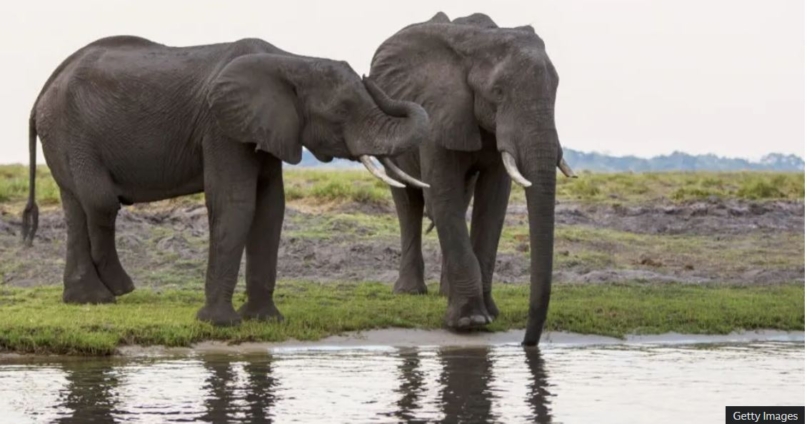
African elephants call each other and respond to individual names — something that few wild animals do, according to new research published Monday.
The names are one part of elephants’ low rumbles that they can hear over long distances across the savanna. Scientists believe that animals with complex social structures and family groups that separate and then reunite often may be more likely to use individual names.
“If you’re looking after a large family, you’ve got to be able to say, ‘Hey, Virginia, get over here!’” said Duke University ecologist Stuart Pimm, who was not involved in the study.
It’s extremely rare for wild animals to call each other by unique names. Humans have names, of course, and our dogs come when their names are called. Baby dolphins invent their own names, called signature whistles, and parrots may also use names.
Each of these naming species also possesses the ability to learn to pronounce unique new sounds throughout their lives — a rare talent that elephants also possess.
For the study in Nature Ecology & Evolution, biologists used machine learning to detect the use of names in a sound library of savanna elephant vocalizations recorded at Kenya’s Samburu National Reserve and Amboseli National Park.
The researchers followed the elephants in jeeps to observe who called out and who appeared to respond — for example, if a mother called to a calf or a matriarch called to a straggler who later rejoined the family group.
Analyzing only the audio data, the computer model predicted which elephant was being addressed 28% of the time, likely due to the inclusion of its name. When fed meaningless data, the model only accurately labelled 8% of calls.
“Just like humans, elephants use names but probably don’t use names in the majority of utterances, so we wouldn’t expect 100%,” said study author and Cornell University biologist Mickey Pardo.
Elephant rumbles include sounds that are below the range of human hearing. The scientists still don’t know which part of the vocalization is the name.
Researchers tested their results by playing recordings to individual elephants, who responded more energetically, ears flapping and trunk lifted, to recordings that contained their names. Sometimes elephants entirely ignored vocalizations addressed to others.
“Elephants are incredibly social, always talking and touching each other — this naming is probably one of the things that underpins their ability to communicate to individuals,” said co-author and Colorado State University ecologist George Wittemyer, who is also a scientific adviser for the nonprofit Save the Elephants.
“We just cracked open the door a bit to the elephant mind.”
Latest Stories
-
NPP deploys regional heavyweights to oversee polling station and electoral area polls
58 minutes -
Akufo-Addo to lead ECOWAS election observers for Benin’s high-stakes presidential transition
1 hour -
Callistus Mahama writes on slavery reparation: ‘We cannot confuse participation with responsibility’
2 hours -
‘The gravest crime against humanity’: What does the UN vote on slavery mean?
3 hours -
Catholic Bishops back Mahama after US university rescinds honorary degree over LGBTQ stance
3 hours -
Ablakwa expresses disappointment over US ‘no’ vote on the UN Slavery Resolution
4 hours -
Luxury watches and cash theft: Joy Sports Editor Fentuo details what happened at the Black Stars camp before the Austria game
4 hours -
India grants ‘penalty-free’ exit window for overstayed Ghanaian nationals
4 hours -
Panic selling sweeps GSE: Market cap sheds GH¢44billion in two days
4 hours -
This Saturday on Prime Insight: Experts to probe slavery and next NDC flagbearer
5 hours -
This Saturday on Newsfile: ‘No-bed syndrome’ and sole-sourcing under the lens
5 hours -
Amid steep sell-off, GSE posts fourth consecutive decline
5 hours -
ZEN Petroleum to list on GSE after securing fully subscribed IPO
5 hours -
Only 14% of the world’s cities breathed safe air in 2025, new global report finds
6 hours -
Ghana’s air quality improves for the first time since 2021; country places 11th in Africa – IQAir 2025 report
6 hours