

Audio By Carbonatix
Africa’s debt sustainability has become a pressing concern, advisory firm, Bridgewater Advisors has stated in its Africa Economic Outlook.
According to the firm, the continent’s public debt between 2010 and 2024, surged by a staggering 170%, partly due to the global financial crises, Covid-19, and geopolitical tensions.
In comparison, global public debt rose by just 54% over the same period. These debt burdens have been further exacerbated by recent exchange rate depreciations, which have significantly increased debt repayment burdens.
Compounding this, it said, is an international financial architecture ill-equipped to offer affordable liquidity at scale to close Africa’s developmental gap.
In a bid to turn the tide, African leaders have approved the establishment of the African Financial Stability Mechanism (AFSM), a $20 billion fund hosted by the African Development Bank. This facility aims to avert future debt crises by offering concessional financing to member states that commit to prudent macroeconomic and fiscal reforms.
The AFSM is anticipated to save African countries approximately $20 billion in debt servicing costs by 2035. While the AFSM offers a safety net, it is not a definite solution.
“Achieving lasting debt sustainability will require coordinated action across the continent, anchored in robust macroeconomic management, strengthened fiscal discipline, and improved domestic revenue mobilization, Prosper Melomey, Partner, Corporate Transactions & Investment Bank, Africa stated.
Ghana recorded $6bn debt increase in 2024
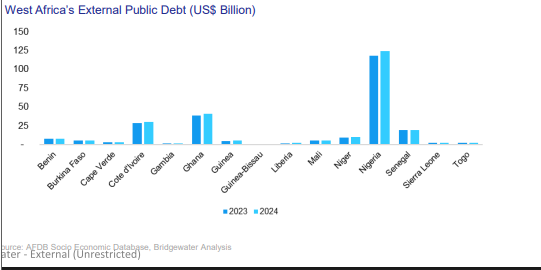
West Africa maintained a stable fiscal position with external debt-to-GDP ratio of 31%, despite a 5% rise in external funding.
However, Ghana and Nigeria recorded the highest nominal debt increases of $6 billion and $2.5 billion, respectively in 2024.
Nigeria accounted for about 48% of the region’s total external debt.
Bridgewater Advisors continued that Africa's external debt outlook for 2025–2026 remains high, with Southern Africa seeing the highest debt levels, rising from 30% to 31% driven by South Africa’s fiscal pressures and Zambia’s restructuring challenges.
East, North, and West Africa maintain stable debt at 22%, while Central Africa has the lowest at 3%. Debt sustainability remains a concern, especially in high borrowing regions like Southern Africa.
Latest Stories
-
Anti-LGBTQ Bill: Forget the rumour mongers, I’m a man of action, and will pass the bill – Speaker
40 minutes -
Women and children among those killed in Sudanese army shelling of wedding celebration
44 minutes -
President Mahama is not sincere with Ghanaians on LGBTQ bill matter – Hassan Tampuli
1 hour -
Gov’t to establish Prison Industrial Hub to equip inmates with income-generating skills – Prison Service boss
1 hour -
Alhassan Tampuli donates cement, roofing sheets to support storm victims in Gushegu
1 hour -
Alhassan Tampuli appeals for urgent support for storm victims in Gushegu
1 hour -
The hypocrisy must stop; pass Anti-LGBTQ+ Bill now – Alhassan Tampuli to Mahama
1 hour -
Imprisonment should be rehabilitative, not punitive – Ghana Prisons boss at UNGA
2 hours -
Ga Adangbe traditional priests petition Mahama over McDan aviation licence revocation
2 hours -
Anti-LGBTQ Bill: NDC’s arrogance is worrying – Hassan Tampuli
2 hours -
Let’s give OSP time to mature, not to scrap it – Hassan Tampuli
2 hours -
Nigeria convicts 386 Islamist militants in mass trials
2 hours -
Djibouti president wins election with 97.8% of vote, state media says
2 hours -
We don’t have mandate to deduct tax from rent allowance of security services personnel – Interior Ministry clarifies
3 hours -
Ablakwa receives Presidential Special Envoy on Reparations to advance global agenda
3 hours